
After a hard rain, the problem usually shows up in the same places. Water sits across the driveway apron. A patio stays slick long after the storm passes. The strip in front of the garage turns into a shallow pond, and every time a car rolls through it, that water splashes toward the slab, the walls, or the plant beds.
In West Tennessee, that kind of runoff doesn't stay cosmetic for long. Repeated pooling can stain concrete, feed mildew, soften soil along the edges, and start washing out the area around your hardscape. If you've been searching for Channel drain installation near me, you're probably not looking for theory. You're looking for a fix that intercepts water and gets it away from the problem spot.
Is Standing Water Damaging Your Driveway or Patio
A lot of homeowners wait too long because the first sign seems minor. It starts as a puddle near the garage after a storm. Then the patio gets slippery. Then you notice dark staining on the concrete and soil washing away beside the slab. By that point, the water has already shown you where the drainage plan is failing.
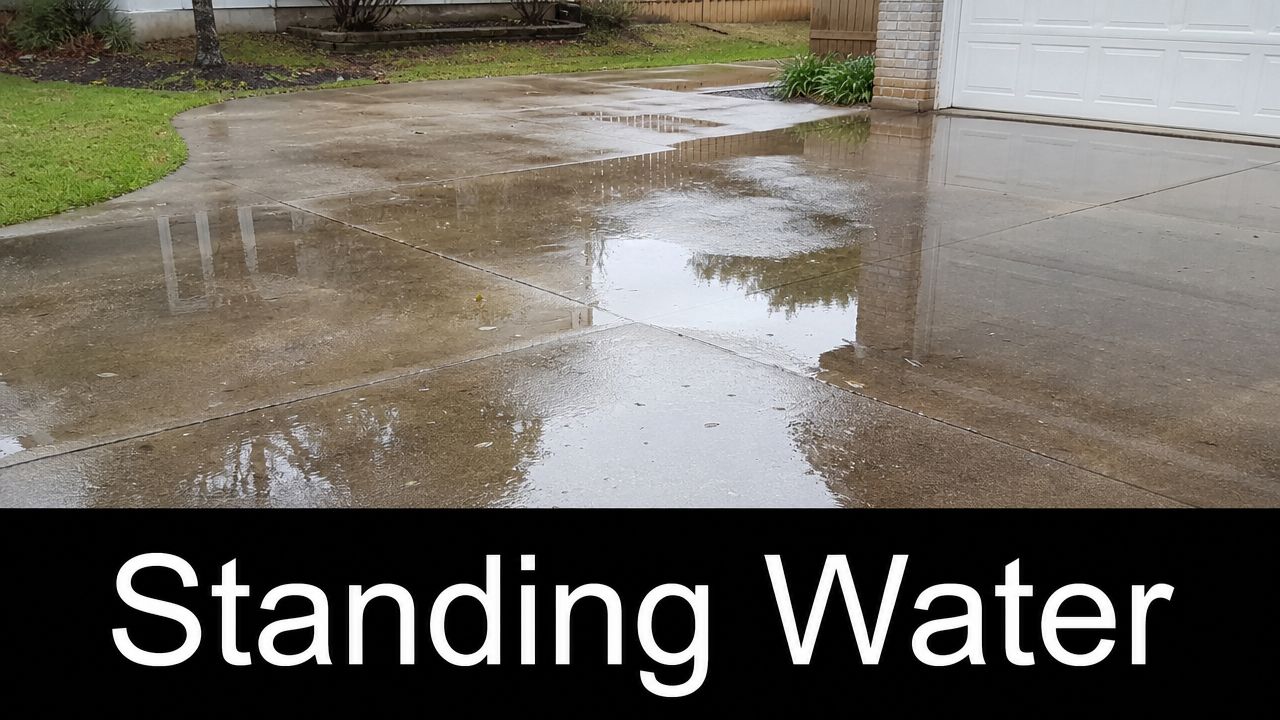
West Tennessee properties often have a mix of hard surfaces, compacted soil, and low spots that trap runoff instead of shedding it. A driveway that pitches toward the garage, a pool deck with nowhere for sheet flow to go, or a patio that sits lower than the surrounding grade can all push water exactly where you don't want it. If the water issue is broader than the concrete itself, this guide on standing water in yard solutions helps explain the surrounding site conditions that often contribute to the problem.
What homeowners usually notice first
- Garage-edge puddling: Water collects right where the driveway meets the garage apron.
- Patio slickness: The surface stays wet long enough to become a safety issue.
- Concrete discoloration: Repeated runoff leaves staining and encourages mildew.
- Washed-out edges: Soil starts disappearing along the slab or paver border.
- Water moving toward the house: The most serious warning sign.
Practical rule: If water repeatedly crosses a hard surface and settles in one narrow zone, a point solution usually won't solve it. You need a linear drain that captures runoff across the full path of travel.
A channel drain is often the right answer when the problem is surface water moving across concrete, pavers, or another finished hardscape. It's built to catch that sheet flow before it reaches the garage, doorway, pool edge, or patio threshold. Homeowners comparing regional drainage approaches may also find value in this resource on foundation drainage design in the Mid-Atlantic, especially for understanding how site layout and water movement affect long-term structural protection.
Understanding Channel Drains and Their Benefits
A channel drain is the simplest way to think about a hardscape water problem. It's a rain gutter for your ground. Instead of collecting water off a roof, it collects water moving across the surface of a driveway, pool deck, patio, walkway, or garage apron.
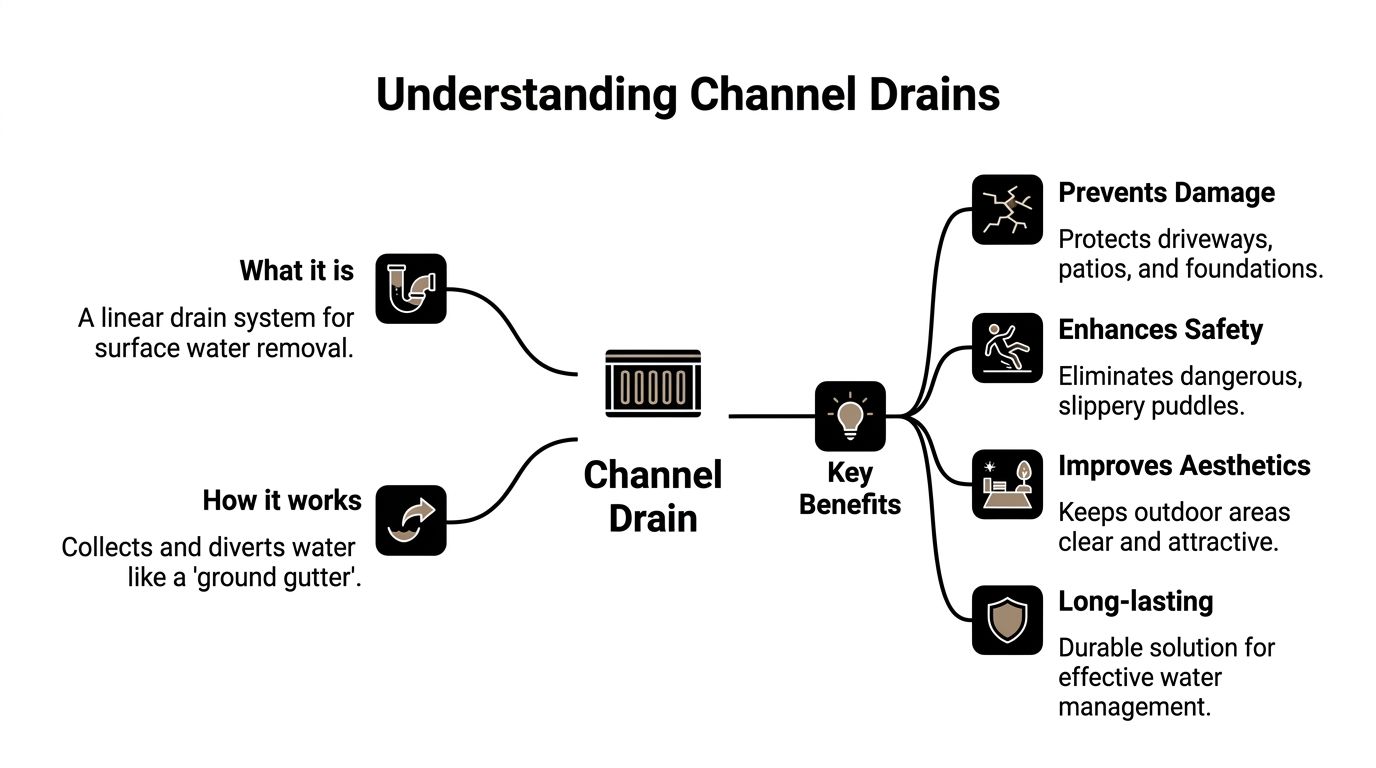
What a channel drain actually does
Channel drains, also called trench or strip drains, are engineered to manage surface water runoff in places where pooling, erosion, and flooding can damage hardscapes like driveways, patios, pool decks, and garage aprons. Proper sizing isn't guesswork. Installation guidance requires the contractor to calculate stormwater runoff volume, compare it to the manufacturer's Flow Discharge tables, and confirm the selected channel can carry the expected load. The total system capacity is figured by multiplying the channel's Flow Rate per linear foot by the full length of the run. If that total is too low, the drain size or outlet plan has to change, and the grate must also be rated for the expected physical load on the drain (installation guidance on channel sizing and load capacity).
That matters because the drain itself is only part of the system. A good installation has to match the amount of water arriving at the drain, the slope feeding it, and the outlet that carries water away.
Signs your property needs one
- Water stops at a threshold: Garage doors, shop doors, and patio entries are common trouble spots.
- Runoff crosses a finished surface: Water moves over concrete or pavers instead of soaking in.
- Low edge against a slab: One side of the hardscape acts like a dam and traps water.
- Pool deck runoff: Water has nowhere to go except across the deck or toward the house.
- Recurring cleanup: You keep pushing water off the same surface after storms.
A channel drain works best when the water issue is visible on top of the surface. If the problem is below grade, the fix is usually something else.
For homeowners looking at broader drainage planning around the house and yard, this overview of drainage solutions for yards is useful because channel drains are often only one piece of a complete system.
What works and what doesn't
A correctly sized channel drain intercepts water where it naturally concentrates. That usually means running it across the full width of a driveway apron, at the edge of a patio, or along the low side of a pool deck.
What doesn't work is dropping in a short drain section because it "looks about right." If the runoff volume, drain capacity, grate load, and outlet path don't line up, the system can still back up or fail under use.
Channel Drains vs French Drains Which Solution is Right for You
Homeowners mix these up all the time, and that mistake leads to wasted money. A channel drain handles water you can see moving across the surface. A French drain handles water moving through the soil.
That distinction matters more than the product name. If water is traveling over concrete toward the garage, you need interception at the surface. If your lawn stays soft, soggy, or swampy after rain, you may be dealing with subsurface water instead.
A key reason this gets confused is that many DIY articles blur the line between the two. One industry discussion notes that homeowners often misunderstand surface water versus groundwater problems, and that channel drains need a precise slope of 1/8 inch per foot minimum so water doesn't pool inside the drain itself. The same source says this point is missing in 90% of "near me" content focused more on product choice than drainage physics (discussion of channel drains versus French drains).
Channel Drain vs. French Drain At a Glance
| Feature | Channel Drain | French Drain |
|---|---|---|
| Primary job | Captures surface runoff | Relieves subsurface water |
| Typical location | Driveways, patios, pool decks, garage aprons | Lawns, beds, retaining areas, soggy yard zones |
| Visible at surface | Yes, with a grate | Usually no, often buried below stone or soil |
| Best for | Water sheet-flowing over hardscape | Persistent wet ground and saturation |
| Wrong use case | Soggy yard with groundwater pressure | Water racing across concrete |
Quick self-check
- You need a channel drain if water runs across a slab and pools in a narrow low point.
- You need a French drain if the yard stays wet even when no obvious surface stream is crossing it.
- You may need both if hardscape runoff and saturated soil are feeding the same problem area.
If you want a separate breakdown of buried drainage for soggy yard conditions, this guide on how to install a French drain system gives the right framework. For another regional take on surface runoff and yard drainage, this article on fixing Austin yard water problems is also a useful comparison.
Our Professional Channel Drain Installation Process
A proper channel drain install is not just cutting a trench and dropping in plastic. The drain has to sit at the correct elevation, follow the right fall, tie into a working discharge path, and leave the surrounding area stable when the job is finished.
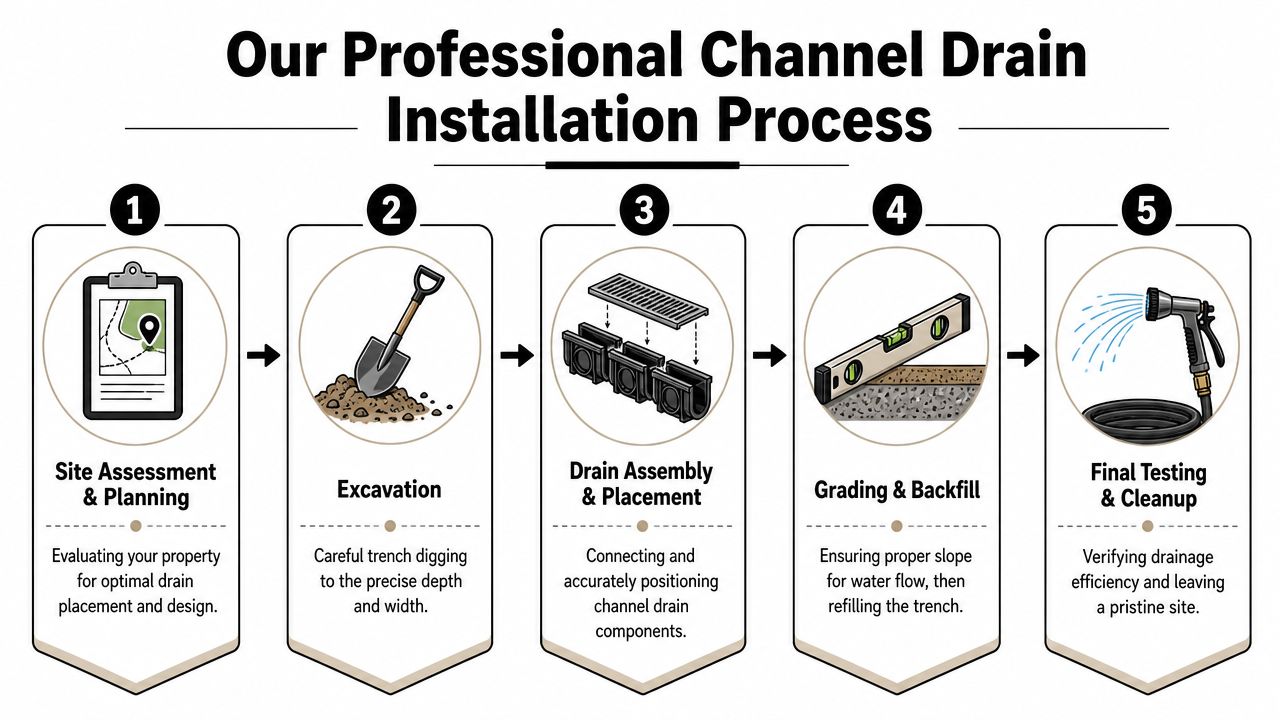
Site assessment and layout
First, the low point has to be confirmed. Not guessed. Measured. On many West Tennessee properties, the visible puddle isn't the whole story because surrounding grade, downspouts, and adjacent beds all influence where runoff ends up.
This is also where the discharge route gets planned. A channel drain that captures water but has nowhere suitable to send it is only half a system. Homeowners comparing service options can review drainage installations to see the kinds of systems commonly tied together on residential properties.
Trenching, grade, and setting the drain
The trench has to be cut or excavated to the correct depth and width for the selected channel and surrounding finish. Then the drain run is set to a continuous fall. One installation guide states that channel drains must have a minimum longitudinal fall of 5mm per metre, which equals a 1:200 gradient or 3/16 inch per 39.4 inches, to maintain water flow and prevent pooling. The same guidance warns that insufficient slope can reduce efficiency by up to 40% under light rainfall conditions and increase sediment buildup and clogging risk (channel drain gradient guidance).
Field reality: If the drain body is level when the surface isn't, or the surface is level when the drain needs fall, water will tell on the installation fast.
Anchoring and connection details
A channel drain has to stay put after concrete is poured or the surrounding hardscape is reset. With systems such as the Spee-D® Channel Drain, standard installation practice includes driving 1/2-inch or 5/8-inch rebar into the trench, drilling small holes in the bottom flange, feeding tie wire through those holes, and twisting the wire to the rebar so the channel remains fixed during placement. The top of the channel is set 1/8 inch below the finished concrete edge to improve water capture and keep the transition smooth. That product is a lightweight alternative to traditional concrete systems, measures 4-3/4 inches wide, 3-3/4 inches high, and 4 feet long, and can be cut to length as needed. It also uses a patented flying buttress design for support in linear and contour applications (Spee-D® Channel Drain specifications and installation details).
Restoration is part of the job
Many installations falter at this stage. The trench gets closed, the drain works for a while, but the surrounding soil settles, edges erode, and the yard looks half-finished.
A complete project includes cleanup, backfill stabilization, surface repair, and restoring the disturbed area so runoff doesn't start damaging the drain perimeter. The drain is only successful when the site around it is stable too.
Channel Drain Installation Costs in West Tennessee
There isn't one flat price that fits every channel drain project. The total cost depends on what has to be cut, excavated, installed, connected, and restored.
A short run across a simple patio edge is very different from a full-width driveway install tied into underground piping. The material choice matters too. So does grate type, site access, the depth of the discharge line, and whether the crew has to cut existing concrete or work around pavers, retaining edges, or landscaping.
What drives the price
- Drain length: Longer runs require more channel sections, more excavation, and more finish work.
- Surface type: Cutting existing concrete is a different job than setting a drain during new construction.
- Outlet complexity: The captured water still has to go somewhere appropriate.
- Grate and channel selection: The assembly must fit both water volume and traffic load.
- Restoration scope: Regrading, replacing topsoil, sod, mulch, or hardscape edging adds labor and materials.
The cost most homeowners don't factor in
A lot of local content talks about trenching and piping as if the drain is the whole project. It isn't. One industry source notes that 40% of drainage failures stem from improper soil compaction and lack of topsoil or sod replacement after installation, which leads to erosion around the new drain and leaves the property looking unfinished (property restoration and drainage failure discussion).
Cost insight: The cheapest quote can become the expensive one if it leaves the surrounding grade unstable and you end up paying for erosion repair later.
If you're comparing drainage budgets more broadly, this page on the cost of French drain installation helps frame how scope, access, and restoration affect underground water management projects too.
Your Local Drainage Experts in Jackson and West TN
When homeowners search for channel drain installation near me, they're usually trying to answer two questions. Can this company solve the water problem correctly, and will the property look right when they're done?
Those are the right questions. A drain contractor shouldn't just install hardware. The contractor should identify why water is concentrating there, choose a system that fits the surface and expected load, and leave the surrounding area stable enough that the fix lasts.

Lawn & Leaf Solutions serves Jackson and West Tennessee with more than 18 years of hands-on experience and Tennessee license TNPL23317. The company handles outdoor area and drainage work that includes channel drains, French drains, sump pumps, erosion control, and property restoration after installation. That combination matters because drainage problems often cross over from hardscape into soil, turf, and grade repair.
What local homeowners should expect
- A diagnosis first: The visible puddle is only part of the story.
- A drain matched to the site: The system has to fit runoff conditions and surface use.
- A clean finish: Disturbed areas need to be compacted, graded, and restored.
- Clear communication: Homeowners should know where water is being captured and where it will discharge.
Good drainage work protects the slab, the yard, and the appearance of the property at the same time.
For homeowners in Jackson and across West Tennessee, local experience matters because clay-heavy soil behavior, runoff patterns, and existing grading problems all affect the final design. The right install keeps water off the hardscape, out of problem thresholds, and away from the edges that tend to wash out first.
Frequently Asked Questions About Channel Drains
How long does a channel drain installation usually take
It depends on the length of the run, the surface being cut, the discharge path, and how much restoration is needed afterward. A simple installation moves faster than a project that involves saw cutting concrete, tying into underground pipe, and rebuilding disturbed lawn or bed areas.
Can I install a channel drain myself
Some homeowners can physically place a drain. The hard part is getting the diagnosis, slope, capacity, outlet, and finish details right. Most DIY failures come from choosing the wrong drain location, giving the system poor fall, or not planning where the collected water will go.
Do channel drains need maintenance
Yes. Grates should be kept clear of leaves, sediment, and debris. If the surrounding area sheds mulch, pine straw, or silt into the opening, regular cleaning protects flow and reduces clogging.
Will a channel drain fix all the drainage problems on my property
Not always. A channel drain is built for surface water on hardscape. If the yard also has soggy soil, buried water pressure, or poor overall grading, the property may need additional drainage work to solve the full problem.
What happens to the area around the drain after installation
That area should be compacted, graded, and restored so runoff doesn't start eroding the edges of the new system. This part gets overlooked far too often. If you're also reviewing roof water management before getting drainage work done, it's worth comparing Expert gutter repair and installation quotes so roof runoff isn't adding unnecessary volume to the same trouble spots.
If water keeps pooling on your driveway, patio, pool deck, or garage apron, get a plan that addresses the whole problem from capture to discharge to final cleanup. Lawn & Leaf Solutions provides drainage evaluations and channel drain installation for homeowners in Jackson and across West Tennessee, with fast, free estimates and a focus on protecting both your hardscape and the surrounding property.