
You walk outside the morning after a hard rain, and the yard still squishes under your boots. The dog tracks mud back into the house. Water sits by the downspout. One corner of the lawn looks like a shallow pond, and the side yard near the foundation never really dries out.
That’s common in Jackson and across West Tennessee, but it’s not something you should just accept. Standing water usually means the yard isn’t moving water where it needs to go. Left alone, it turns into more than an eyesore. It keeps turf thin, softens soil around foundations, stains hardscapes, and makes parts of the property useless for days at a time.
In this region, the fix usually isn’t one generic national tip. It’s matching the right solution to heavy clay soil, tight grades, and hard runoff events. Good drainage work is part observation, part grading, and part system design. Done right, it solves the problem. Done wrong, it just moves the puddle somewhere else.
Why Your West Tennessee Yard Turns into a Swamp
A lot of homeowners think their yard stays wet because they got “too much rain.” Rain is part of it, but a primary problem is usually what happens after the rain hits the ground. In West Tennessee, many yards don’t absorb water quickly, and many lots don’t have a clean path to move it away.
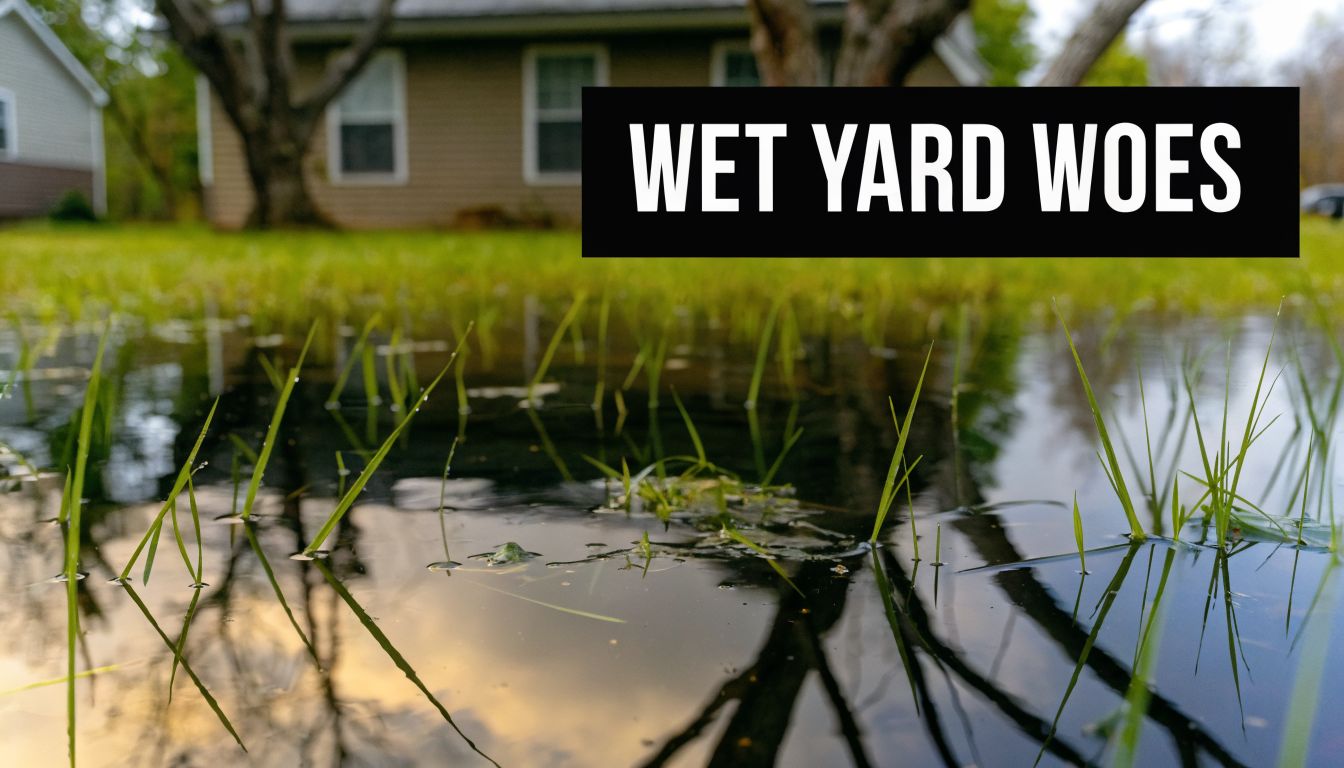
Clay soil is the first reason. When that soil gets packed by foot traffic, mowing, construction, or years of settling, water tends to sit on top instead of soaking in. A yard can look mostly level and still hold water because one shallow dip or one bad slope line traps runoff. Add roof water dumping near the house, and the problem gets bigger fast.
Development changed how water moves, too. Urban development significantly impacts water infiltration, and the U.S. Geological Survey notes that properly designed residential infiltration basins can capture 0.90 to 1.87 acre-feet of stormwater runoff annually in typical settings, which shows how much difference engineered drainage can make when a yard is built to handle runoff correctly (USGS infiltration research).
What usually makes it worse here
Some drainage failures are built into the property from day one. Others show up over time.
- Settling around the house often creates a trough that holds roof runoff close to the foundation.
- Short downspouts dump a surprising amount of water into one concentrated spot.
- Flat side yards trap water between homes where there’s no easy outlet.
- Driveways and patios shed water fast and push it into lawn areas that can’t take the volume.
Practical rule: If water stands for days after a storm, you don’t have a “normal wet yard.” You have a drainage path problem, a soil problem, or both.
A lot of landscaping work fails because it focuses only on appearance. Good drainage has to come first. If you’re planning broader yard improvements, it helps to think about drainage and grading as part of the same project, not as an afterthought to landscaping in Tennessee.
Diagnosing the Source of Your Standing Water
Before you buy pipe, gravel, or catch basins, figure out where the water is coming from. Most homeowners waste time because they treat every puddle the same. A low spot, a roof discharge problem, and groundwater seepage do not get solved the same way.
The best time to diagnose the yard is during rain and again the day after. Don’t guess from memory. Watch where water starts, where it flows, and where it stops.
Start with a storm walkthrough
Walk the property in the rain if it’s safe. If not, go out as soon as the storm passes.
Look for these signs:
- Water falling from the roof edge means gutters may be clogged or undersized for the runoff they’re handling.
- Downspouts dumping beside the foundation usually create localized saturation, not a yard-wide problem.
- Sheet flow across the lawn points to grading or runoff entering from uphill areas.
- One area bubbling or staying wet in dry weather can signal something other than rainwater, such as irrigation or plumbing trouble.
If you’re also seeing moisture inside the house, the outside drainage pattern may be tied to basement or crawlspace issues. For homeowners trying to connect yard runoff with interior water problems, this guide on finding solutions for wet basements gives useful context on how exterior drainage failures show up indoors.
Separate surface water from subsurface water
This matters more than commonly understood. Surface water is easy to see. It runs across the yard, off hard surfaces, and into low spots. Subsurface water is slower. It saturates soil below the surface and keeps areas soft long after the storm is over.
Here’s a quick way to tell the difference:
| Sign in the yard | Likely issue | Typical fix direction |
|---|---|---|
| Water ponds quickly during rain | Surface runoff concentration | Regrading, swales, catch basin, downspout routing |
| Area stays soft for days with little visible flow | Saturated subsurface soil | French drain, soil work, outlet correction |
| Wet spot appears only near one downspout | Roof water discharge | Solid drain extension, splash control |
| Wet area shows up even in dry periods | Possible leak or groundwater issue | Plumber or drainage inspection |
Check the four most common causes
A simple checklist usually narrows the problem down.
Low spots in the yard
Even a shallow depression can collect enough runoff to keep grass weak and muddy.Compacted soil
Clay that’s been compressed acts more like a lid than a sponge.Roof water dumping too close
A lot of “yard drainage” calls start with a gutter problem.Runoff entering from somewhere else
Neighboring lots, driveways, and street flow can all push water onto your property.
If the yard only floods after big storms, that doesn’t mean the issue is minor. It usually means your drainage system has no backup capacity.
If you want a more structured way to inspect the property, this yard-specific drainage diagnosis guide walks through the same kind of problem-mapping a drainage contractor uses before recommending a fix.
First-Line Defenses Simple and Low-Cost Fixes
Not every wet yard needs trenching. Some of the best standing water in yard solutions are basic corrections that remove the obvious failure points first. If you skip these and jump straight to a bigger system, you can spend money without solving the root cause.
Start with the easiest water to control
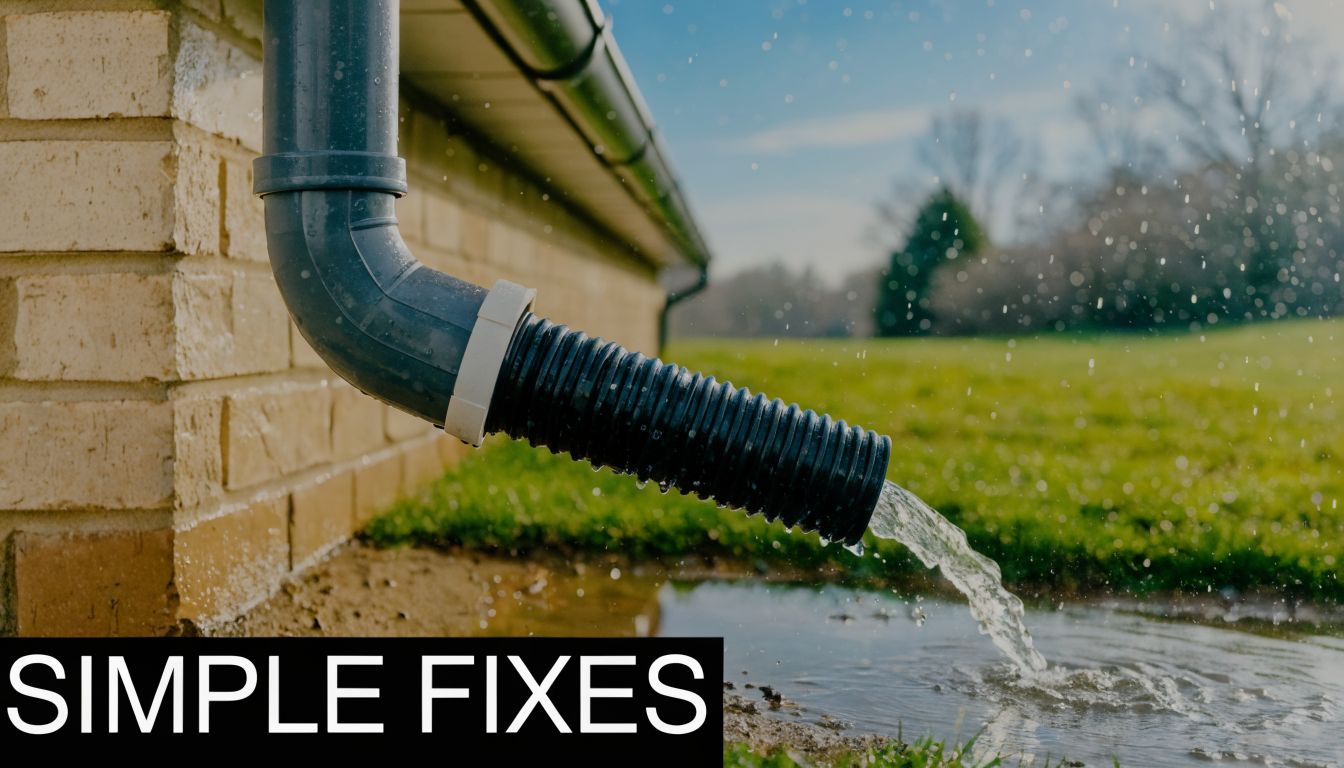
Roof runoff is the low-hanging fruit. If a downspout empties beside the house, that area will stay wet no matter how much seed, mulch, or topdressing you throw at it. Extend the discharge away from the foundation and make sure it releases somewhere that can drain.
Aeration also helps when the problem is shallow saturation in compacted lawn areas. It won’t solve a grading failure, but it can improve how the top layer handles moderate rainfall. On clay-heavy properties, I look at aeration as support work, not as a standalone cure for chronic ponding.
Fix small depressions the right way
Many DIY jobs go wrong when homeowners dump loose topsoil into a soggy spot, rake it smooth, and assume it’s fixed. After the next few rains, the soil settles, the dip comes back, and water ponds again.
For small depressions, a precise regrading method has an 85 to 95 percent success rate when done correctly. The method uses 4 to 6 inch lifts of compacted topsoil and finishes with a 1 to 2 percent slope away from structures to a drainage point at least 10 feet from the foundation, consistent with the cited guidance and code reference (Fairfax County drainage guidance).
Here’s the practical version:
- Strip the weak surface so you’re not burying grass, thatch, and soft mud under fill.
- Build in layers instead of one deep dump of soil.
- Compact each lift so the repaired area doesn’t settle back into a bowl.
- Finish with positive grade. If the area has no place to drain, filling it won’t last.
Use plants where plants actually help
Water-tolerant plantings can help in places that are seasonally damp, especially near the edge of a drainage swale or in a designed rain garden. They’re useful for softening the look of a drainage area and helping the surface handle moisture better.
They are not a substitute for correcting a bad outlet, a reverse grade, or roof runoff concentrated at one point.
A rain garden works when you choose the spot on purpose. It fails when it becomes the place you dump every water problem you didn’t solve upstream.
Don’t ignore nearby hardscape runoff
Sometimes the lawn isn’t the main source. The driveway, walkway, or patio is. Water sheds off those surfaces quickly and often lands right where the yard is weakest. If that sounds familiar, it helps to review practical gravel driveway drainage solutions because the same runoff principles apply to transitions between stone, pavement, and turf.
Low-cost fixes worth trying first
These are the first corrections I’d look at before recommending excavation:
- Extend downspouts properly so roof water leaves the wet zone.
- Regrade isolated dips with compacted fill, not loose topsoil.
- Core aerate compacted lawn areas where surface sealing is part of the problem.
- Add a shallow swale when the yard has room to move water naturally.
- Use moisture-tolerant plants in persistently damp areas that don’t need to stay dry like a play lawn.
For more hands-on examples of these lower-cost corrections, this overview of how to fix yard drainage problems is a useful next step.
Heavy-Duty Solutions Engineered Drainage Systems
When the yard stays wet no matter what you do above ground, you’re usually past the point of simple fixes. That’s when engineered systems matter. In West Tennessee, the right system depends on whether you’re dealing with widespread saturation, concentrated pooling, runoff from hardscape, or water collecting near the foundation.
French drains for widespread sogginess
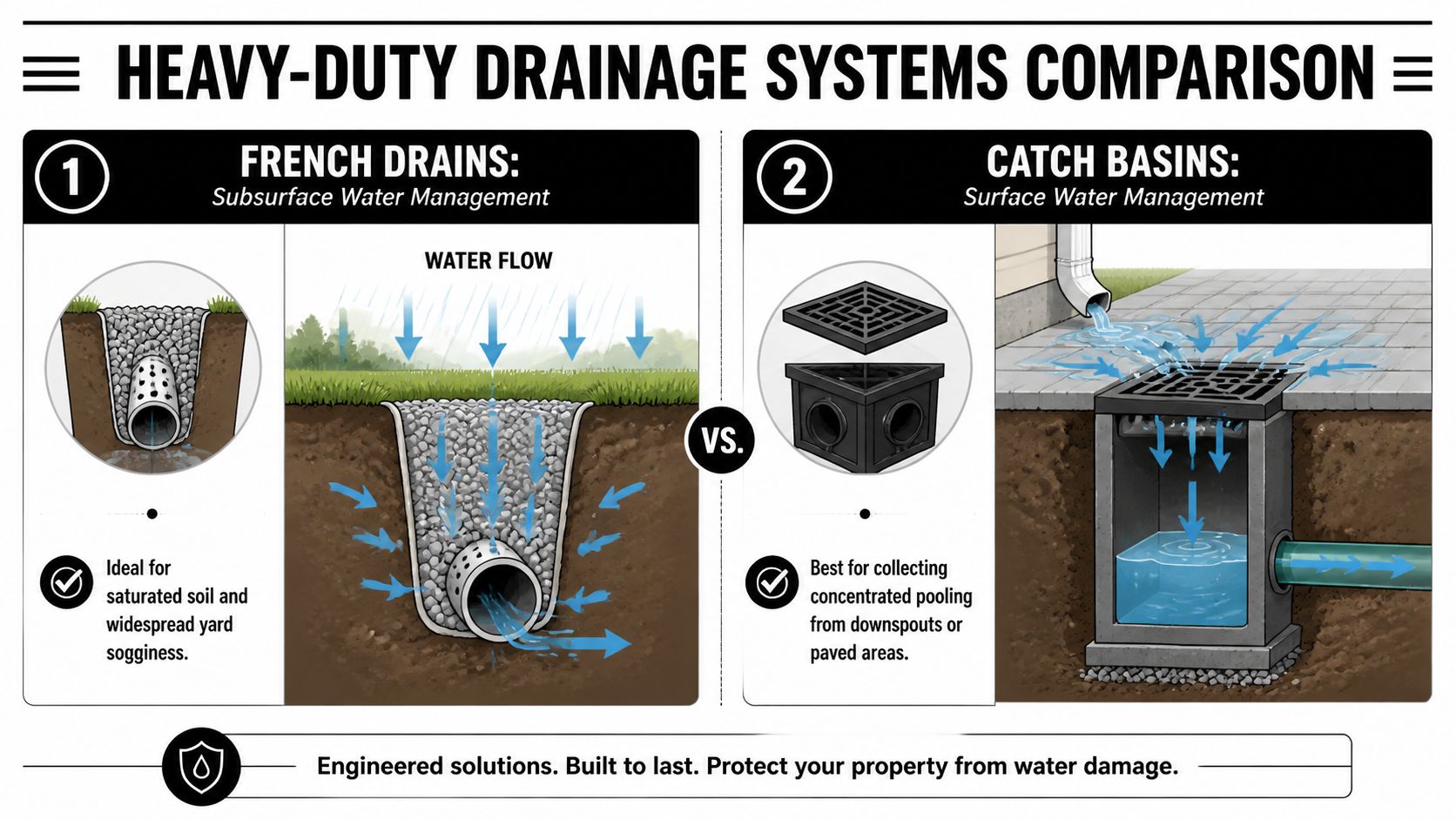
A French drain is the workhorse for subsurface water. It intercepts water in the soil and moves it through a gravel-filled trench with perforated pipe toward daylight or another discharge point. This is often the right answer when the lawn feels soft for days, the side yard never dries, or water migrates toward the foundation through the soil instead of just across the surface.
The details matter. Proper French drain installation can be 80 to 92 percent effective, but the trench needs a minimum 1 percent slope, geotextile lining, washed stone, and a clear outlet. Failures are common, with 35 percent tied to incorrect slope, which is exactly why so many DIY trench jobs underperform or clog early (Oklahoma State Extension French drain guidance).
In West Tennessee clay, French drains work best when:
- the trench has fall from start to finish
- the outlet stays open in wet seasons
- roof water isn’t overloaded into a system sized only for subsurface seepage
- fabric and stone are installed cleanly so sediment doesn’t choke the trench
A French drain is not magic. If the yard has nowhere to send water, the drain can only collect it, not solve it.
Catch basins and channel drains for surface water
When water runs across pavement, pools at the bottom of a driveway, or pours off a patio edge, a catch basin or channel drain is usually a better tool than a French drain.
A catch basin collects concentrated surface water at a low point and sends it into solid pipe. A channel drain is a linear grate system that intercepts sheet flow before it spreads across the property. These systems shine around driveways, garage aprons, pool decks, and patios where water is visible and fast-moving.
They are less useful in broad soggy lawn areas where the problem is soaked soil below the surface. That’s where homeowners choose the wrong system all the time. They install a grate because they can see water on top, but the issue is water trapped in clay below.
Dry wells and infiltration areas
A dry well or infiltration area stores runoff and lets it soak into the surrounding soil over time. In theory, this is elegant. In practice, clay-heavy yards can limit how well this performs unless the design fits the actual soil conditions and available space.
That doesn’t mean infiltration is useless here. It means you have to respect site limits. Earlier research on residential infiltration shows that even relatively small, properly designed systems can handle meaningful runoff volumes. But in heavy clay, you can’t assume the ground will accept water quickly enough just because there’s a hole filled with stone.
The best drainage system is the one that matches how water behaves on that lot. Not the one that looked good in a video from another state.
Sump pumps for trapped water and low outlets
Some yards have a tough geometry problem. The wet area sits lower than any place you can gravity-drain to. In those cases, a sump basin and pump may be the only practical way to move water out.
This is common in flat backyards, enclosed courtyards, low side yards, and foundations where gravity fall isn’t available. A sump setup can collect water from drains and discharge it to an approved outlet point. It introduces a mechanical component, so maintenance matters more, but it solves a problem grading alone can’t fix.
Professionals also use sump systems in hybrid drainage layouts. A French drain may collect the water, and the sump pump may provide the lift needed to get rid of it.
A side-by-side look at the main systems
| System | Best use | Where it struggles | Maintenance reality |
|---|---|---|---|
| French drain | Saturated soil, side yards, broad lawn sogginess | No outlet, bad slope, heavy sediment | Needs periodic inspection and flushing |
| Catch basin | Low-point pooling, downspout collection, driveway runoff | Wide subsurface wetness | Grates and boxes need cleaning |
| Channel drain | Surface flow across pavement or hardscape | Deep lawn saturation | Debris removal is routine |
| Dry well | Controlled runoff where soil can accept water | Tight clay, undersized designs | Performance depends on soil and sediment control |
| Sump pump | Low areas with no gravity outlet | Power loss, neglected systems | Pump testing is not optional |
What works best in West Tennessee
If I’m looking at a typical Jackson property, I don’t start with brand names or favorite products. I start with the water path.
A few common patterns:
- Wet strip along the house often needs downspout correction, grade repair, and sometimes a foundation drain approach.
- Side yard staying soft for days often points toward a French drain if a proper outlet exists.
- Driveway or patio collecting water usually needs surface interception with a basin or channel system.
- Flat backyard with no natural discharge often needs a hybrid system with collection and pumping.
This is also where people underestimate how important containment and controlled routing really are. In industrial settings, engineers think carefully about directing liquids into the right collection method, and the same planning mindset helps in drainage work. The principles behind selecting spill containment systems are a good reminder that collection design only works when the path, volume, and outlet are all considered together.
Foundation areas need their own strategy
Water around the foundation is different from water in the back corner of the lawn. Near the house, there’s less room for error. Fill, slope, discharge location, and pipe routing all matter more because a mistake can keep water where you least want it.
If the problem is close to the home, a dedicated look at foundation drainage solutions is worth it before choosing a system. Foundation-adjacent drainage often combines surface correction with subsurface collection, and it needs to be laid out carefully.
What doesn’t work
Some fixes sound good and fail fast.
- A trench with pipe but no slope is just buried frustration.
- Loose gravel in a wet spot does not create drainage. It creates a muddy stone pit.
- One catch basin in the wrong place won’t solve broad saturation.
- Dumping all roof water into one undersized drain line can overload the system during hard rain.
- Cheap fabric or no fabric leads to silt infiltration and declining performance.
The best heavy-duty systems look boring when they’re finished. That’s usually a good sign. The grade feels natural, the collection points sit where water goes, and the yard dries in a way that makes sense after a storm.
DIY Project or Time to Call a Professional
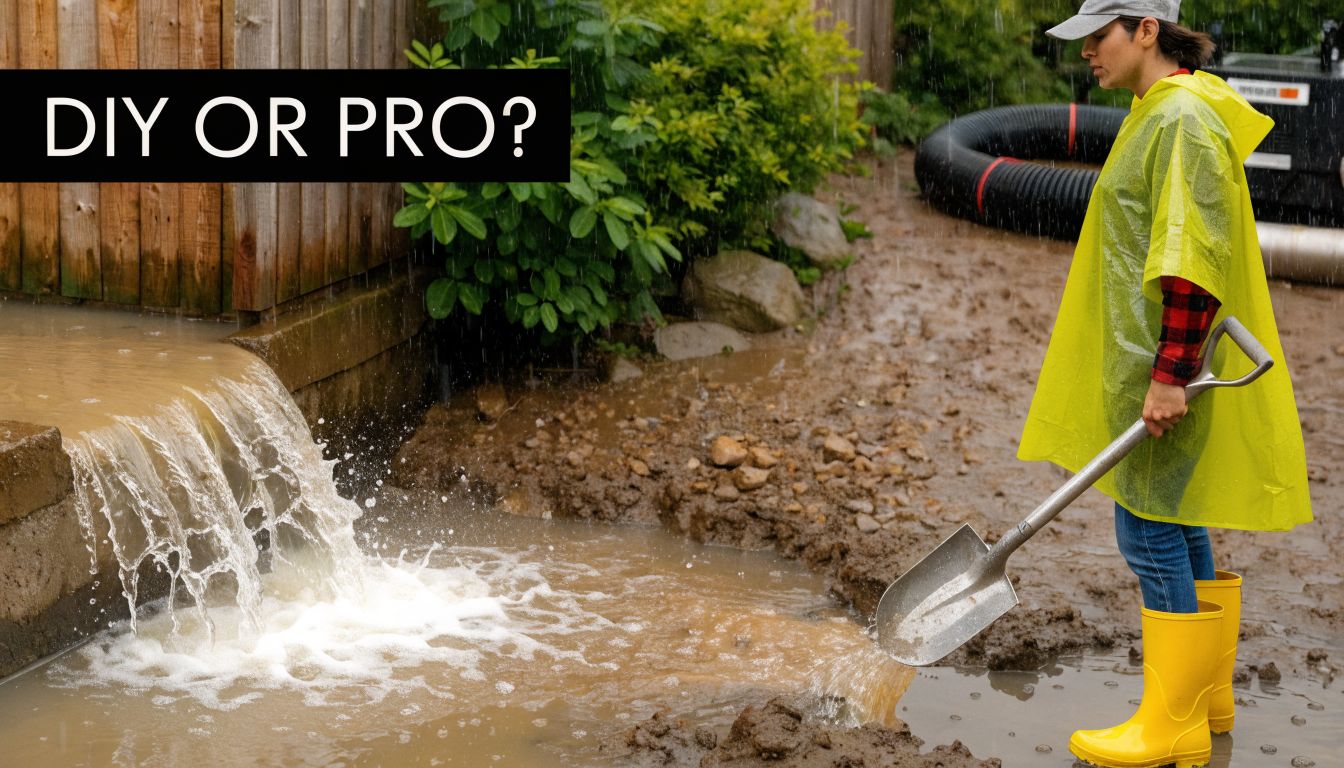
Some drainage work is very reasonable for a homeowner. Some of it is not. The hard part is knowing the difference before you spend a weekend digging, rent equipment, and still end up with a wet yard.
Good DIY jobs
DIY makes sense when the scope is limited and the consequences of getting it slightly wrong are low.
Examples include:
- Extending a downspout
- Touching up a minor low spot
- Building a simple rain garden in the right location
- Aerating compacted lawn
- Cleaning existing grates and outlets
Those jobs are visible, accessible, and easy to check after the next storm.
When DIY gets expensive
French drains are where a lot of homeowners underestimate the risk. The trench looks simple until you have to maintain consistent fall, choose the right outlet, prevent sediment issues, and avoid creating a trench that fills with water and stays full.
The cost gap tempts people to try it themselves. DIY French drains typically run about $500 to $1,500, while professional installation runs about $1,500 to $4,000. Professional work reduces failure rates by 40 percent, and poor DIY jobs often fail within 2 years. Foundation damage from drainage mistakes can exceed $5,000 (drainage cost comparison and failure discussion).
That math is why I tell people to think beyond install price. Drainage isn’t just about digging a trench. It’s about whether the system still works after the second winter, the first clog, and the next big storm.
If the repair is near your foundation, requires exact slope, or depends on an outlet you’re not fully sure about, that’s when you stop treating it like a weekend project.
Call a professional when these show up
You don’t need a contractor for every puddle. You probably do need one if any of these are true:
- Water is standing near the foundation
- The yard has no obvious gravity outlet
- The problem covers a large area
- Runoff crosses from hardscape into the lawn
- You’ve already tried regrading and the problem came back
- You suspect multiple causes at once
This is also where local soil knowledge matters. Clay in West Tennessee behaves differently than sandy soil in national how-to videos. One option homeowners consider is working with a local drainage contractor such as Lawn & Leaf Solutions, which installs French drains, channel drains, sump pumps, and erosion-control systems in Jackson and surrounding West Tennessee areas.
If you’re weighing whether the risk is worth it, this comparison of French drain install vs DIY and which is right for your property is a practical place to start.
Newer systems are making sense on flat properties
Some sites need more than a static pipe layout. Smart drainage systems that combine sump pumps, channel drains, and sensors can be the better fit on flat yards with recurring water problems. The maintenance is different, and the design is more involved, but that’s often the right answer when grade alone won’t save you.
Maintaining Your Dry Yard for Years to Come
A drainage system can be installed correctly and still underperform later if nobody maintains it. Most failures I see after installation come from neglect, not from the original concept.
Seasonal checks that actually matter
Keep the maintenance simple and consistent.
- Clean grates and basin tops so leaves, mulch, and sediment don’t block intake.
- Check downspout discharge points to make sure water still exits where it should.
- Watch for settling over buried lines and repaired low spots.
- Flush French drain lines when needed if you notice slower drainage or recurring wetness.
- Test sump pumps before wet seasons so you’re not finding out they failed during a storm.
If the lawn is part of the drainage plan, support it like it matters. Avoid repeated traffic on saturated ground. Don’t keep compacting the same route with mowers or equipment. Aeration can help maintain the top layer where surface sealing comes back over time.
Smart systems still need oversight
Technology can help, but it doesn’t replace inspection. Smart drainage systems that pair sump pumps and channel drains with IoT sensors reduced standing water by 70 percent in flat yards in the cited 2025 study, which shows the value of automatic activation in difficult sites (smart drainage discussion and cited study reference).
That kind of setup still needs someone to confirm sensors are working, pump discharge is clear, and debris isn’t choking the collection points.
A practical maintenance rhythm
A simple routine works well:
| Time | What to do |
|---|---|
| After major rain | Walk the property and confirm water followed the intended path |
| Spring | Clear grates, inspect outlets, test pumps |
| Mid-season | Look for settling, clogged discharge points, turf thinning |
| Fall | Remove leaves from drains, basins, and swales |
A dry yard stays dry because somebody keeps the system open, graded, and functional. Drainage isn’t a one-time event. It’s part of property maintenance.
Frequently Asked Questions About Yard Drainage
Will a drainage system hurt my mature trees
It can if the trenching route cuts major roots or changes moisture too aggressively in the root zone. That’s why layout matters. A good plan routes pipe and collection points where they solve the water issue with the least disruption. Around mature trees, hand-digging portions of the route may be the smarter approach.
Do I need a permit for a French drain in Jackson
Maybe. It depends on where the water is going, how the discharge is handled, and whether the work ties into anything regulated locally. Simple yard drainage corrections may be straightforward, but once a system gets more complex, don’t assume. Check local requirements before digging.
What if my neighbor’s runoff is causing the problem
Start by documenting what happens during rain. Take photos, note flow direction, and confirm whether the water is naturally crossing grades or being concentrated by a gutter, driveway, or other change. Don’t start a property-line dispute before you know the facts. Sometimes the best solution is intercepting and redirecting the water on your side. Sometimes a conversation with the neighbor is necessary.
How do I know if it’s a plumbing leak instead of a drainage problem
If the wet spot shows up in dry weather, smells off, or causes odd patches of unusually lush growth, don’t treat it like a normal rainwater issue. Call a licensed plumber. Drainage contractors solve runoff and grading problems. Pipe leaks, sewer issues, and irrigation failures need different diagnosis.
How long does professional drainage installation take
That depends on access, weather, soil conditions, and system type. A simple correction can move quickly. A property-wide drainage plan with trenching, collection points, discharge routing, and restoration takes longer. The right timeline is the one that allows proper grading, clean installation, and testing before the crew leaves.
Will adding topsoil alone fix a wet yard
Only if the problem is a very minor depression and the fill is compacted and graded correctly. In most recurring wet-yard situations, topsoil alone is a cosmetic patch. If the water source, grade, or outlet problem remains, the soggy spot usually comes back.
Are French drains always the best answer
No. They’re excellent for the right problem, especially subsurface saturation. They’re the wrong choice for some hardscape runoff problems, and they don’t replace a needed grading correction. The best system depends on whether the water is moving across the surface, through the soil, or collecting in a low area with no outlet.
If your yard in Jackson or West Tennessee stays wet after every storm, the fix starts with the right diagnosis. Lawn & Leaf Solutions handles drainage evaluations and installs practical systems that address standing water, runoff, and foundation-risk areas with grading, drains, and water-management planning matched to local soil conditions.