
You may be comparing program brochures at midnight, trying to figure out whether a landscape design degree is the right move, or whether a shorter certificate would get you into the field faster. That's a smart question, because the degree alone doesn't automatically make someone a licensed architect, and that difference shapes the jobs you can pursue, the projects you can sign, and the money and time you'll invest.
The cleanest way to think about it is this, a landscape design degree sits between creative training and regulated professional practice. It can prepare you for residential design, site planning support, and technical drafting, but if your goal is full landscape architecture licensure, the education path becomes more specific and more demanding, because states generally require licensure for landscape architects and that process usually includes an accredited bachelor's degree, internship experience, and a qualifying exam. The rest of this guide breaks the choice down by program type, format, coursework, and career outcome so you can match the credential to the work you want.
What a Landscape Design Degree Covers
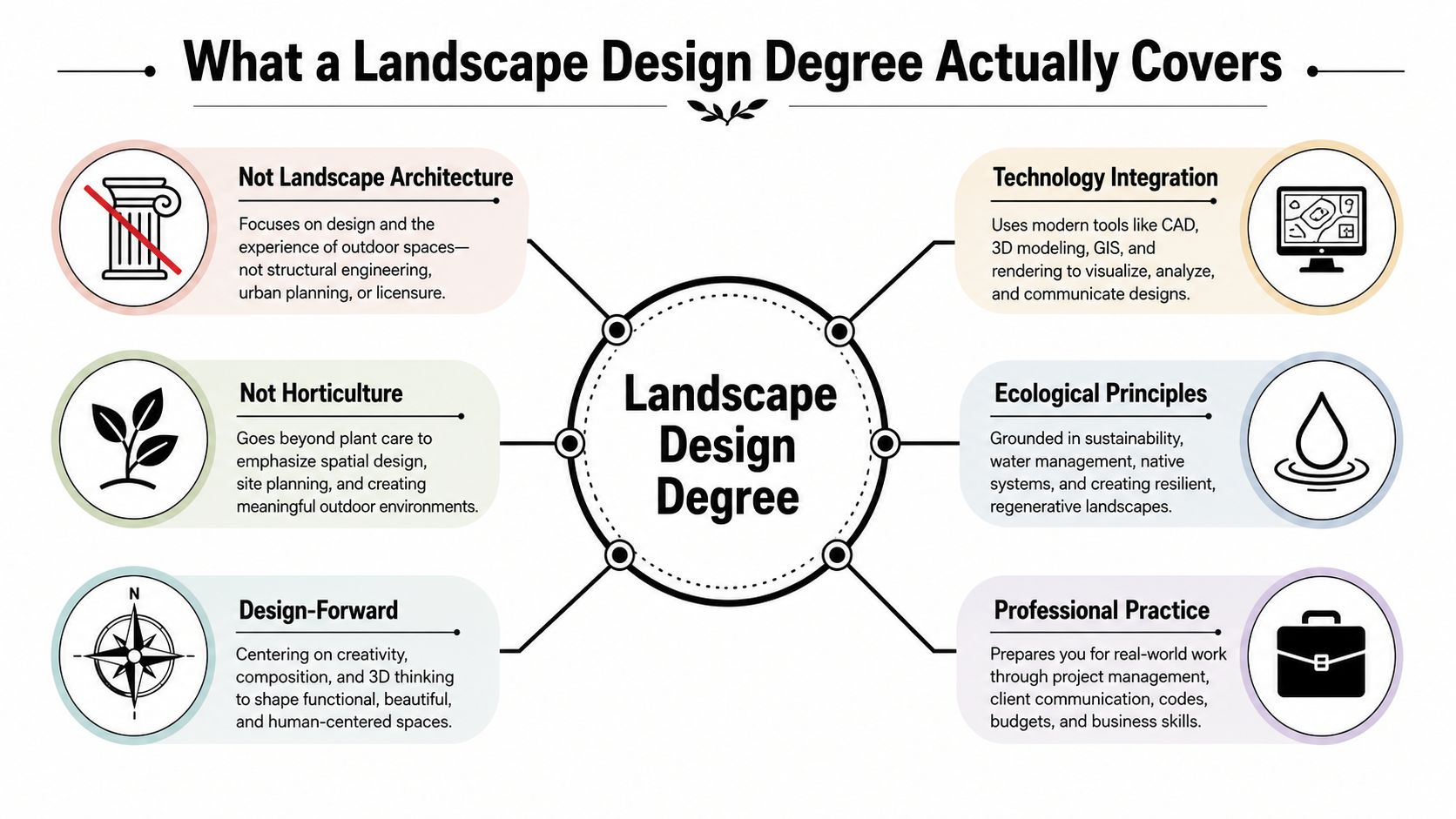
A student who wants to design a courtyard, refine a front yard plan, or support a residential install crew needs a degree that teaches drawing, plant choices, and site thinking. A student who wants to sign professional plans under state rules needs to follow the licensure path, which is a separate credential. That split shapes what a program teaches, what jobs it supports, and how you should read a brochure before you apply.
An outdoor space design degree builds a mix of visual design, site problem-solving, and professional practice. Students usually work through drawing, digital tools, planting design, ecological thinking, and the technical side of turning an idea into a buildable plan. The training sits close to architecture and engineering in how it handles plans and site systems, while still staying more design-centered than a pure plant-science program.
Why the credential is specialized
The field is more structured than many students expect, and that structure affects program choice. In the United States, there are 64 accredited institutions offering architecture degrees, and graduates reached 1,050 in 2023–24, down from 1,673 in 2010, a decline of about 37% (source). That limited supply helps explain why employers value applicants who can already work in plans, sections, materials, and site systems.
For students, the practical lesson is straightforward. If you want to do residential design, help with installations, or move into a technical assistant role, a degree in this field can be a sensible fit. If your goal is the credential tied to state-licensed professional work, you need to look closely at accredited architecture pathways, because that route is shaped by licensure requirements, not just creative coursework.
Practical rule: choose the credential based on the work you want to do first, then work backward to the degree that supports it.
If you are still sorting out the basics of the field, a plain-language overview like landscape design basics can help you separate style, site function, and the practical job of turning a concept into a usable outdoor space.
Program Types You Can Choose From
Not every student needs the same level of training. The right program depends on whether you want to design smaller residential projects, move into a licensed profession, or add a focused credential to an existing background. The degree title matters less than the kind of work it prepares you to do.
The main routes in plain language
An associate degree is usually the fastest option for someone who wants hands-on design support work, entry-level drafting, or a bridge into a longer program later. A bachelor's degree is the main route for people aiming at professional practice, stronger technical depth, and licensure-oriented work. A certificate is often best for career changers or homeowners who want design skills without committing to a full degree, while a master's degree can suit people who already hold a related degree and want advanced specialization or a stronger professional profile.
| Program Type | Typical Length | Best Suited For |
|---|---|---|
| Associate degree | Usually shorter than a bachelor's path | Entry-level design support, residential work, transfer into a four-year program |
| Bachelor's degree | Standard professional route | Students aiming for deeper technical training and licensure-oriented careers |
| Graduate certificate | Focused, shorter study | Career changers, skill-building, and professionals who already hold a degree |
| Master's degree | Advanced study after a prior degree | Specialization, research, teaching, or a stronger professional niche |
The reason the bachelor's route dominates is simple, licensure and larger-scale professional work depend on formal preparation. The Bureau of Labor Statistics notes that all states require architects in this field to be licensed, and licensing usually requires at least a bachelor's degree, internship experience, and a qualifying exam (BLS). That makes the longer pathway worth the effort if public-sector or commercial work is your target.
A certificate can still be the right move if you're testing the field. It gives you a lower-risk way to build a portfolio, learn the language of the profession, and decide whether you want to invest in a full degree later. For someone returning to school, that's often a much safer first step than committing to a four-year program before they've seen the work up close.
Online vs In-Person Learning Options
Format changes the experience as much as the curriculum does. Two students can study the same subject and leave with very different strengths, depending on whether they spent their time in a studio, in a hybrid program, or in an online classroom.
What online can do well
Online learning works best when the program is structured around clear assignments, critique cycles, and portfolio output. It's a strong fit for working adults, parents, and students who don't live near a school with a design program. It also forces you to build discipline around software, drafting, and presentation, which are all valuable habits in real practice.
Where in-person still has the edge
In-person study usually gives you more direct access to studio culture, physical material samples, pin-ups, faculty feedback, and field observation. Those things matter because the work is spatial and tactile. You need to understand how a slope feels, how a material reads in daylight, and how a planting plan changes when it meets an actual site.
A strong online student usually builds the missing pieces on purpose, through local internships, volunteer install work, and regular site visits.
Accreditation still matters in any format, especially if your long-term goal is licensure. The same program that looks convenient on paper can be a poor fit if it doesn't line up with professional expectations in your state or country. So when you compare schools, look past the marketing and ask who critiques the portfolio, what software is taught, whether fieldwork is included, and where graduates land.
If you're leaning online, don't assume the format will carry you. You'll usually need to create your own network through internships, garden centers, design-build firms, or community projects, because employers still want evidence that you can work with both drawings and real sites. A solid online program can absolutely work, but it asks more of you outside class.
Core Coursework and Technical Skills You Will Build
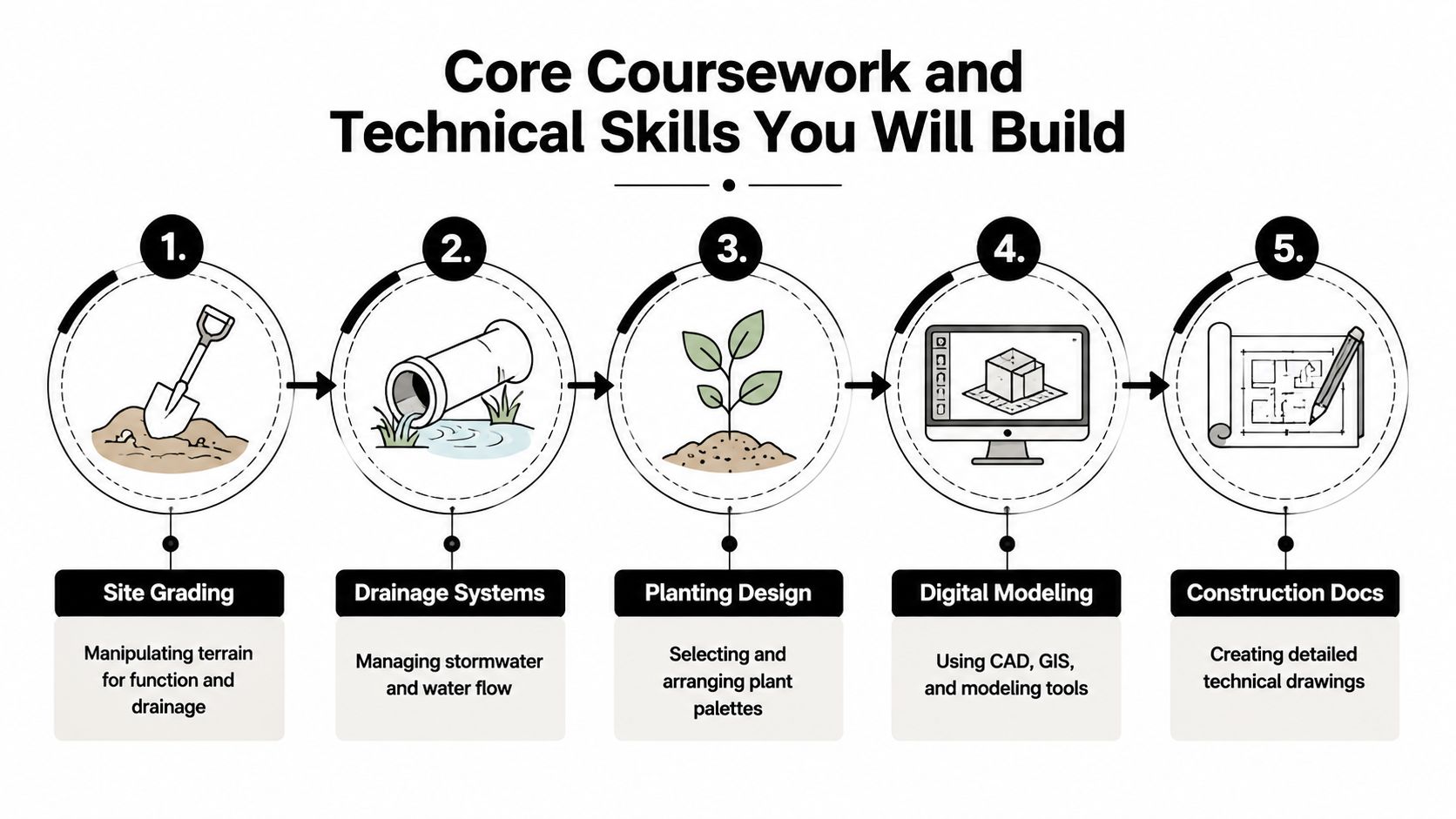
A landscape design degree gets serious fast because the work is technical. The appealing part of the job still depends on whether the plan solves grading, drainage, access, and construction problems before anyone plants a single shrub.
The skills that matter on site
Accredited programs commonly require substantial work in site engineering, grading, materials, construction documents, planting design, and water-sensitive site design. Cal Poly's BLA program, for example, explicitly trains students in site engineering, material explorations and detailing, construction documents, plant materials, and planting design, while Virginia Tech requires passing work in landform function, watershed-sensitive site design and construction, and detailed design with materials, methods, and assembly (Cal Poly program details).
That technical depth is there because a drawing only works if the site can support it. When the ground does not move the way the plan assumes, the design fails in practice. A yard that slopes the wrong way sends water where it should not go, and attractive planting cannot solve a drainage problem after the fact.
Why the engineering side matters
Grading works like a roof pitch. A roof that does not shed water becomes a maintenance problem, and a site that does not shed water becomes a design problem. Good work starts with the surface moving water safely, then layers in planting, circulation, and materials that can survive the conditions.
For everyday practice, that means you are not just choosing pretty plants. You are specifying pavers, understanding wall sections, drawing details that contractors can build from, and deciding how a rain garden or swale should function over time. If you want a clear example of how software and layout planning show up in the trade, this overview of landscape design software for homeowners shows the same digital logic in a simpler setting.
A strong program should leave you able to speak in plans and sections, not just in mood boards. That is the dividing line between decorative inspiration and professional work.
Landscape Design vs Landscape Architecture vs Horticulture
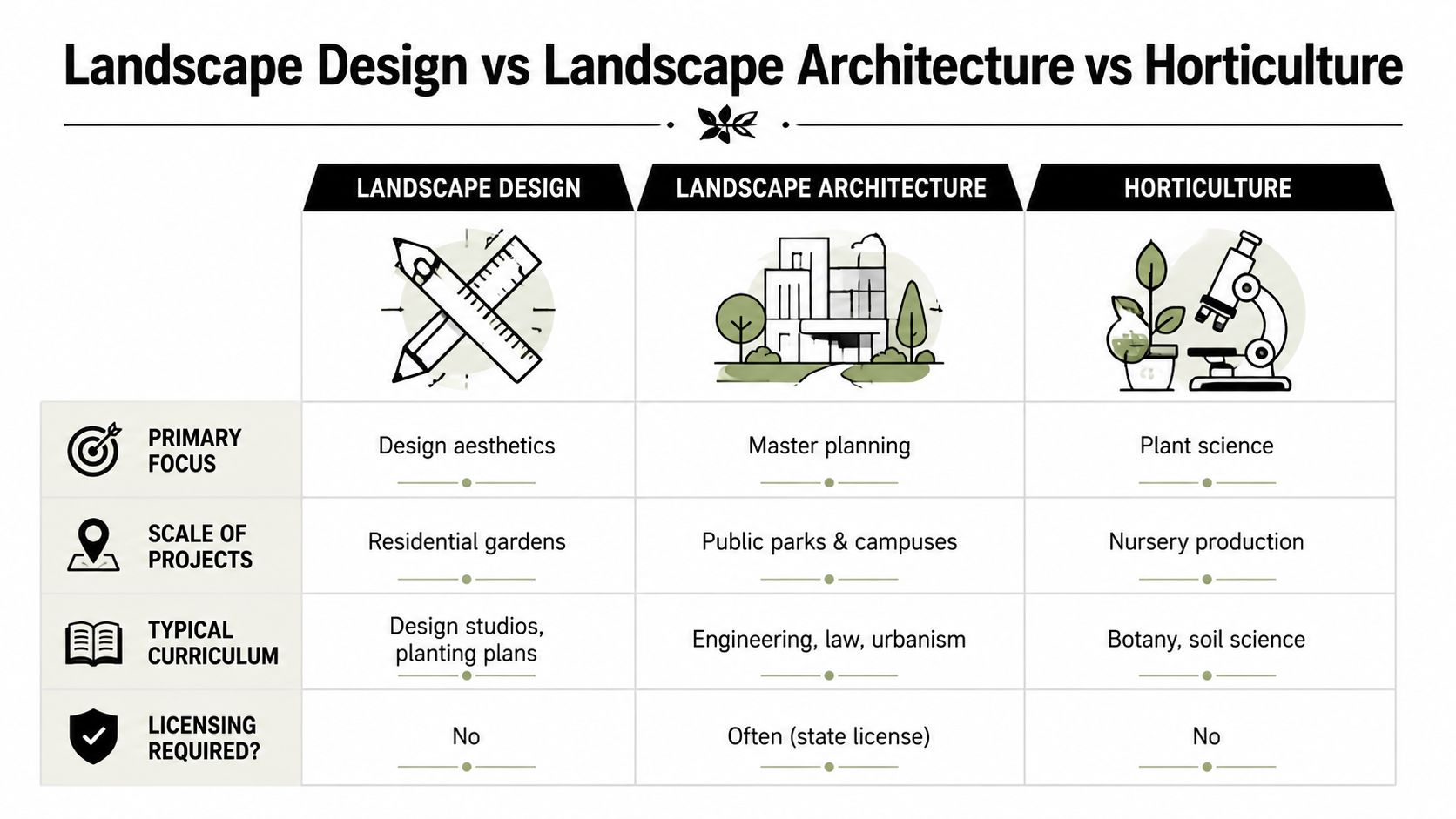
Students often use these terms as if they describe the same path, but employers usually read them very differently. The title on your degree shapes the kind of work you can pursue, the amount of responsibility you can take on, and whether licensure enters the picture.
Choosing Between Design, Architecture, and Horticulture Paths
Design centers on layout, planting composition, outdoor rooms, and the way a site feels and functions for the people who use it. Many designers work in residential settings, small commercial spaces, or design-build firms, and the credential can be more flexible because local rules and project scope often shape what is allowed.
Outdoor design is the regulated professional path. The BLS explains that outdoor designers must be licensed in every state, and that licensing generally involves a bachelor's degree, supervised experience, and a qualifying exam (BLS). That route fits larger public projects, commercial developments, campuses, and work that requires formal sign-off.
Horticulture focuses on plant science, growing systems, soils, and the conditions plants need to thrive. Horticulture professionals often work alongside designers, since healthy planting depends on careful species selection and good site care, but their training centers on plant performance, production, and maintenance rather than overall spatial composition. If you want a practical example of how ecological care shows up in site planning, creating a sustainable landscape with eco-friendly practices for your lawn connects those ideas to everyday outdoor space decisions.
The easiest way to choose is to start with the kind of problem you want to solve. If you enjoy arranging space, shaping circulation, and creating an outdoor setting that feels intentional, design points you in that direction. If you want to prepare for public work, code coordination, and the responsibilities that come with licensed practice, landscape architecture is the clearer track. If plant health, soil behavior, and growing systems interest you most, horticulture may be the better fit.
A useful way to separate the paths is to ask where your attention naturally goes on a project. A designer studies how the site reads as a whole. A designer with advanced credentials adds regulated professional practice and technical accountability. A horticulturist studies how plants live, respond, and develop over time.
Those roles can overlap in real jobs, which is why titles sometimes blur. Someone may design residential spaces, manage installation details, and understand drainage without being a licensed architect. That does not mean the credential failed. It usually means the person trained for one lane of work and then built experience in adjacent tasks.
For prospective students, the key is to match the program to the outcome you want. A certificate may support entry-level design work. An associate degree may help with drafting, installation, or design support roles. A bachelor's degree can open more doors, especially if you are weighing future licensure or broader project responsibility. The right choice depends on whether you want to design spaces, support plant systems, or prepare for regulated practice from the start.
Career Paths and Salary Expectations
A degree in this field can lead to a clear set of jobs, but the diploma title does not tell the whole story. Employers also look for portfolio quality, technical fluency, and evidence that you can handle the scale and pace of the projects they manage.
Common Entry-Level Roles
New graduates often step into roles such as designer, site design assistant, design-build estimator, and junior architect. In practice, those titles can sit in different kinds of offices, from residential firms and commercial design practices to municipalities and multidisciplinary teams that mix planning, engineering, and site development. The work usually grows more demanding as the sites get larger, the consultant list gets longer, and the approval process adds more moving parts.
A hiring manager's checklist often makes the portfolio point clear. Job postings in this field frequently ask for a portfolio, CAD or drafting samples, and familiarity with site analysis or planting plans, which shows how strongly employers weigh proof of work. One recruiter-focused way to say it is that the sample work helps them see how you solve design problems before they ever meet you.
The long-term outlook is steady rather than flashy. The Bureau of Labor Statistics projects 3% employment growth from 2024 to 2034, which it describes as about as fast as average for all occupations (BLS outlook). That points to ongoing demand, especially for people who can combine design judgment, technical competence, and sustainability thinking.
Career reality: pay and responsibility rise when you can handle drawings, client communication, code awareness, and site-based problem solving without close supervision.
Salary can vary widely by region, project type, and whether you are working in a regulated role. A school or employer that sells the field as a quick route to high pay is leaving out the hard part, which is the mix of design judgment, technical accuracy, and client demands. The better question is whether you want a role centered on residential creativity, technical support, or licensure-backed professional practice.
For people who are also weighing the homeowner side of the field, this look at whether landscaping increases home value is a useful reminder that outdoor design is often judged by function and curb appeal together, not by appearance alone.
For applicants, the strongest prep package usually includes a portfolio, evidence of drawing or CAD skill, site observation experience, and some proof that you can work with plant material and hardscape details. Those pieces tell employers more than a transcript by itself, and they can help them see whether you are ready for the kind of tasks they assign on day one.
Students who are comparing this path with related fields can also benefit from reading about environmental science career outcomes, since that comparison makes it easier to separate design work from environmental analysis and other adjacent jobs.
Admissions, Cost, and Financial Planning
Getting into the right program takes more than filling out an application. Schools want evidence that you can think visually, work consistently, and handle the technical load that comes with a design degree.
What admissions usually ask for
Undergraduate applicants often need transcripts, a statement of purpose, and sometimes a portfolio that shows drawing, photography, hand composition, or related creative work. Graduate programs may also ask for recommendation letters and, in some cases, standardized test scores depending on the school. The exact package varies, but the portfolio is usually the part that reveals the most about fit.
The credit load can also be heavier than students expect. Purdue's BSLA requires 120 credits, while Penn State's B.L.A. requires a minimum of 139 credits and includes graded major courses that must be completed at C or better (Purdue program). That's another sign that this is not a casual art elective path, it's a serious professional curriculum.
How to plan financially
One of the smarter moves is to separate tuition planning from life planning. Tuition, supplies, software, travel for studios, and living costs all compete for the same budget, so students who underestimate the full price often feel the strain later. If you're comparing funding routes, look at FAFSA, departmental scholarships, assistantships for graduate students, and employer tuition help for working adults.
A useful outside resource is this overview of environmental science career outcomes, because it shows how adjacent fields frame return on education and career flexibility. That comparison can help you think more clearly about whether you want a broad environmental credential or a more design-specific one.
Start with the outcome you want, then pick the credential that makes that outcome realistic.
If you're choosing among programs, ask three questions before you apply. Does the curriculum lead toward the job type I want? Can I realistically finish the credit load? And will the school help me build a portfolio that employers respect?
Practical Next Steps for Prospective Students
A student who wants a design degree should start with a clear distinction. A program can prepare you for design work, portfolio development, and entry into related jobs, while licensure follows a different path and depends on meeting professional requirements that not every program covers. That difference matters before you apply, because the right choice affects what you can do after graduation.
Start by matching the credential to the role you want. An associate degree can suit students who want a faster route into support roles or early field experience. A bachelor's degree usually gives you broader studio training and a stronger base for design-focused jobs. A certificate can help with specific skills or career changes, and an online program can work well if you need flexibility, provided it still gives you enough critique, feedback, and portfolio development.
Build a portfolio with real range
Your portfolio should show more than one kind of ability. High school students can include hand sketches, photography of outdoor spaces, and any creative or technical classwork that shows observation and composition. Transfer students should add drafting samples, site analysis exercises, and work that shows they can revise ideas without losing clarity. Graduate applicants need a tighter portfolio, one that shows maturity, process, and an understanding of how design decisions are built.
A strong portfolio works like a sample set for a future employer. It should show what you can notice, what you can draw, and how you explain choices.
Get experience where the job happens
Classroom work is one part of preparation, but employers also want to see that you understand how outdoor projects function in real settings. Internships matter because they show how design feels once a project leaves the classroom. Design-build volunteering, nursery work, seasonal landscaping, and community garden projects all give you material for a resume and a conversation with future employers. They also help you learn the language of crews, clients, and site conditions before you are responsible for them.
If you are still exploring the field, read a few practical landscape design books and compare what they teach with the kind of work you see in local offices and crews. That makes it easier to tell whether you prefer drawing plans, working on site, or building toward licensure later.
Keep your professional lane clear
If you want licensure, track the requirements carefully and do not assume every design program qualifies. If you are interested in practice standards and documentation, keep an eye on records and professional organizations such as CLARB and ASLA. If you are comparing school options in West Tennessee, ask how each program lines up with local employers, the kinds of residential projects in the area, and the field work students can realistically find nearby.
For students in West Tennessee, the question is not only what you study, but where that study leads in the local market. A program that supports residential site work, drainage awareness, and portfolio pieces tied to real properties can be more useful than a program that looks impressive on paper but does not fit the jobs available near you.
If you are choosing among programs, ask three questions before you apply. Does the curriculum lead toward the job type I want? Can I realistically finish the credit load? Will the school help me build a portfolio that employers respect?