
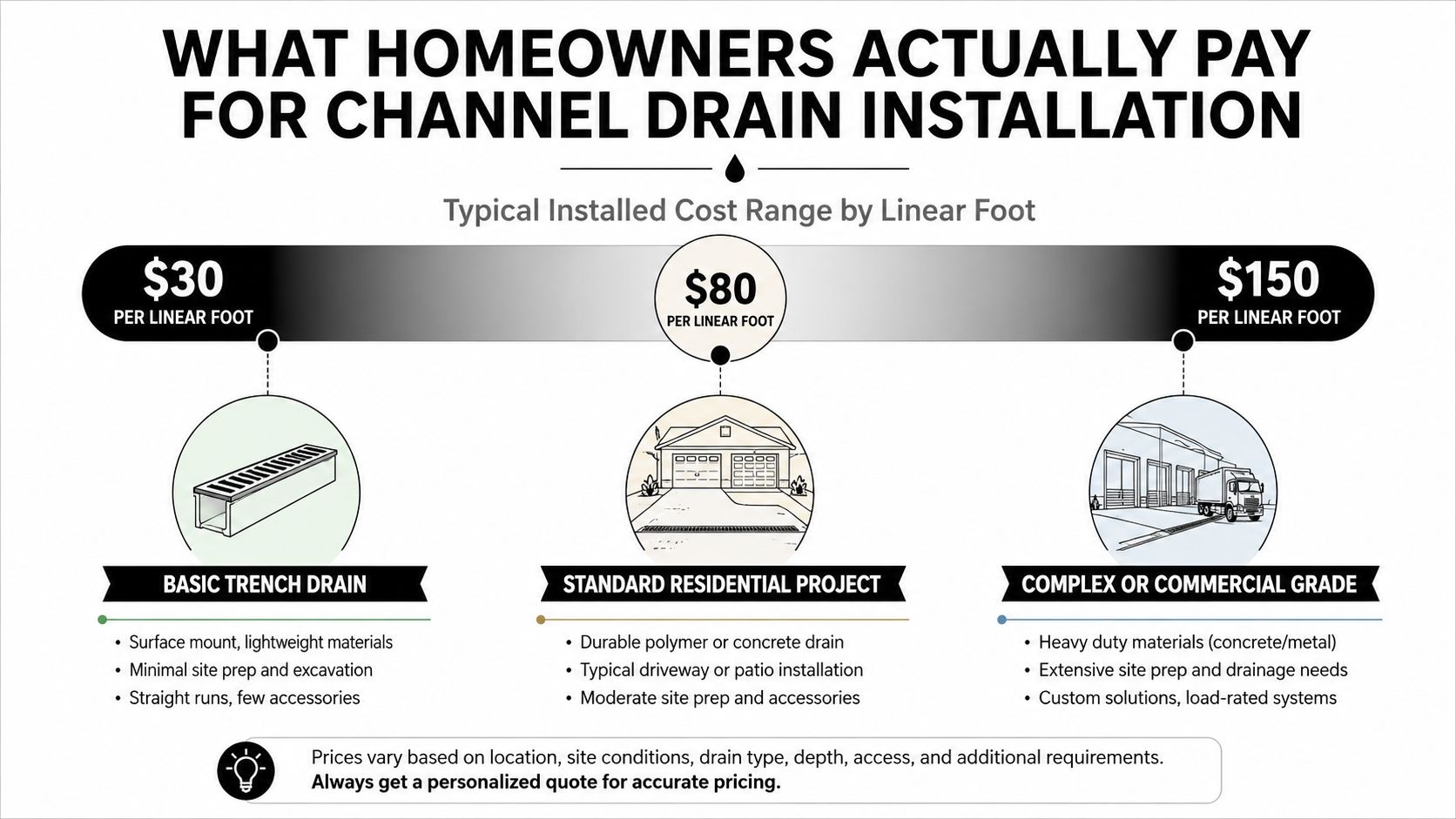
Most homeowners pay $30 to $150 per linear foot installed, and total projects usually land between $2,100 and $6,700. Two neighbors can still get wildly different quotes because the drain is only part of the job, the rest is excavation, concrete cutting, disposal, outlet work, and cleanup.
I see that mismatch all the time in West Tennessee. One driveway looks simple from the street, then the crew hits clay, rebar, deep trenching, or a buried obstruction, and the invoice climbs fast. The number on the brochure is never the whole story.
What Homeowners Actually Pay for Channel Drain Installation
The first mistake homeowners make is treating channel drain installation cost like a single product price. It isn't. It's a site work price, and the site controls almost everything, from labor to restoration.
A simple run across an open driveway can stay near the low end, while a cut through concrete, with a real outlet and a proper finish, moves up fast. Neutral industry guides put typical installed rates around $30 to $150 per linear foot, with all-in totals often between $2,147 and $7,169. Broader 2026 estimates also stretch from $10 to $85 per linear foot and $1,500 to $8,500 total, which tells you how much site conditions swing the bill. (HomeGuide cost guide)
The three pricing models contractors use
You'll usually see one of three setups. Per-foot pricing is the easiest to compare, flat-rate pricing is common on straightforward jobs, and time-and-materials appears when the site is messy or the scope isn't fully known.
Practical rule: If a contractor won't tell you what's included in the quote, you're not comparing prices, you're comparing assumptions.
Ask direct questions. Is concrete cutting included. Is haul-off included. Is the drain tied into an existing outlet, or is that extra. A low quote that leaves out those pieces is bait, not savings. That's why a homeowner comparing drainage work should also look at related project scope, like this French drain installation cost guide from Lawn & Leaf Solutions, because surface drainage and subsurface drainage are often priced very differently.
A useful outside comparison is Bear Valley Plumbing & Heating's plumbing budget guide, because the same budgeting problem shows up there too, headline numbers look neat until labor and site conditions hit the invoice.
What a suspiciously low quote usually means
If one bid is way below the others, it usually means something got excluded. Maybe there's no concrete restoration. Maybe they plan to dump spoil on site instead of hauling it. Maybe they're not reconnecting to a proper outfall. I'd rather see a quote that's honest about the work than one that looks cheap on paper and grows teeth later.
Material Choices and How They Change the Price
Material choice is where homeowners still have some control, and it matters more than people think. The wrong material can turn a decent-looking drain into a cracked, rusted, or overloaded problem that you end up replacing early.
The price tiers are really load tiers
HDPE or plastic channels are the lowest-cost option, usually about $45 to $95 per linear foot before labor. Polymer concrete sits higher, around $70 to $140 per linear foot, and stainless steel climbs to $150 to $320 per linear foot. Heavy-duty commercial systems can run $400 to $800+ per foot in demanding applications. (EngineerFix material cost guide)
That spread isn't random. Higher load classes need stronger channel walls, thicker grates, better corrosion resistance, and more careful installation. A driveway that only sees passenger vehicles doesn't need airport-grade hardware. A loading dock or traffic-bearing apron does.
| Channel Drain Material Cost Comparison | ||
|---|---|---|
| Material | Cost Per Linear Foot | Best Use Case |
| HDPE or plastic | $45 to $95 | Light residential runs, low-load areas |
| Polymer concrete | $70 to $140 | Driveways, patios, pool decks |
| Stainless steel | $150 to $320 | Heavy-duty, corrosion-prone, high-end applications |
Match the material to the surface, not the sales pitch
A concrete driveway wants a different conversation than a paver patio. A pool deck brings water chemistry into play. A garage threshold needs a clean, flush finish more than a flashy grate. The drain has to fit the load, the exposure, and the look of the surface it's sitting in.
Contractor's rule: Don't buy the cheapest channel. Buy the cheapest channel that still matches the load, the water exposure, and the finish you want.
That's why one-size-fits-all advice is bad advice. The lowest-priced option can be fine for a modest residential run, but it's the wrong move when the system needs to survive vehicles, standing water, or regular chemical exposure. For a practical install example, see Lawn & Leaf Solutions' how to install channel drain resource, then compare it against the quote you're holding.
If you want the cleanest decision rule, use this one. Pick the lightest material that still safely handles the load and environment, then spend the savings on correct installation and proper outlet work.
The Hidden Line Items That Drive the Final Invoice
The per-foot price on a quote is only the opening move. The bill shows up in the stuff that doesn't fit on a glossy estimate sheet, and that's where homeowners in West Tennessee get surprised.
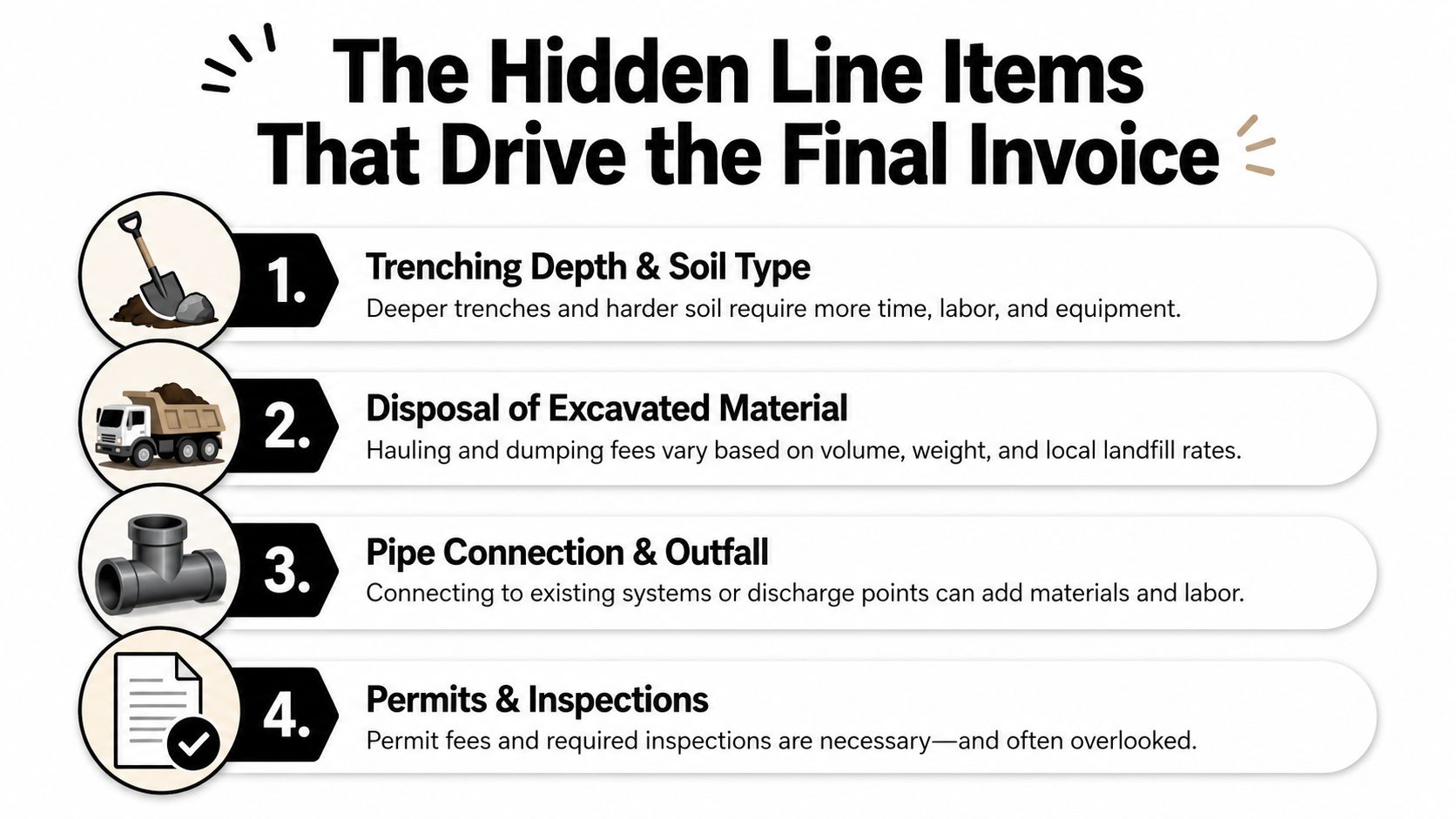
The charges that usually get buried
Trenching depth and clay soil are the first money traps. Clay takes more effort to cut and shape, so labor climbs when the trench has to stay clean and level. Concrete cutting and disposal are another common add-on, because saw work, slab removal, and hauling debris are separate jobs on the crew's day.
Pipe connection and outfall work can swing a quote hard when the drain needs to tie into an existing discharge point. Permits and inspections can also show up, especially when the work touches a municipal storm connection. If the drain area needs restoration, that's another line item, because soil, sod, pavers, or concrete all have to be put back cleanly.
If you're comparing bids, ask one question before anything else, “What is included, and what is excluded?”
That question exposes the price. A quote can look like $40 per foot until you add cutting, haul-off, pipe runs, reconnects, and restoration, then the installed number feels much closer to a premium bid. If the job also involves water damage cleanup from the same drainage failure, this find water damage restoration cost resource is useful context because drainage repairs and water remediation often sit in the same budget conversation.
The quote that looks cheap usually isn't
The cheapest headline price often belongs to the contractor who's excluding the most. That's not a deal, that's deferred billing. I'd rather pay for every necessary step once than get nickeled-and-dimed after the crew is already on site.
For homeowners comparing scope, Lawn & Leaf Solutions' drainage installations page is a better model than a bare per-foot ad, because real drainage work lives in the cuts, the tie-ins, and the finish, not just the trench.
DIY Installation Versus Hiring a Professional
A DIY channel drain can make sense on a simple, short run if you're handy, patient, and honest about the mess you're about to make. It stops making sense fast once concrete, slope correction, or outlet work enters the picture.
What DIY really demands
You'll need a concrete saw, a trenching tool or jackhammer, a level, a PVC saw, and some way to haul away spoil. You also need the time to keep checking slope, because a drain that sits flat or back-pitches is a mistake you'll pay for every time it rains.
A first-timer can lose a full weekend on a short run. A professional crew can often handle the same basic install in a few hours because they already own the tools, know the cut sequence, and don't waste time relearning the job in your driveway.
Why West Tennessee makes DIY riskier
Clay soil doesn't forgive sloppy excavation. It walls in, shifts, and holds water, so a shallow or uneven trench can fail before you're done cleaning up. Depth matters too, because the outlet elevation and the local freeze exposure both affect how the system drains and survives.
An improper connection to a storm system is the biggest mistake I see from ambitious DIY work. Once water has nowhere valid to go, the drain is just a fancy gutter in the wrong place.
| DIY vs Professional | DIY | Professional |
|---|---|---|
| Tools | Rented or borrowed | Owned and ready |
| Time | Full weekend for a novice | Short crew window |
| Risk | Higher slope, cutoff, and connection errors | Lower if the site is evaluated correctly |
| Best fit | Small, simple, open-access job | Concrete cuts, clay soil, code-sensitive tie-ins |
The rule is simple. DIY only if the run is short, the outlet is obvious, and you're not cutting into finished concrete. Otherwise, pay a pro and protect the rest of the work you've already done on the property.
Lawn & Leaf Solutions also handles drainage work through its landscape design company services, which matters when the drain has to fit into a larger yard fix instead of standing alone.
Realistic Pricing Scenarios for Jackson and West Tennessee Homes
Local numbers make more sense than abstract ranges, because the driveway, patio, and discharge path determine the actual bill. Here's how these jobs usually pencil out when the scope is honest and the installation is done right.
Short driveway run at a garage threshold
A short channel drain across a garage approach usually lands around $1,400 to $2,600 when the run is simple and the outlet is close. In that kind of job, material might be a modest share of the total, while labor, saw cutting, and restoration do most of the damage to the budget.
A homeowner with a low front apron, a clean concrete cut, and an easy tie-in will land near the lower end. Add harder access, thicker slab, or a longer discharge path, and the number climbs.
Patio and pool deck tie-in
A longer run around a patio or pool deck commonly lands around $3,200 to $5,500. That's because the crew is protecting finished surfaces, working around transitions, and usually connecting to an existing yard drain or outfall line.
For pool-adjacent work, the finish matters as much as the function. A rough patch job around a clean deck is how homeowners end up paying twice, once for the drainage and again for the cosmetic fix.
Long, heavy-duty approach or apron
A commercial-style driveway apron or a long run with a heavy-duty grate can reach $6,000 to $9,500. The jump comes from the stronger channel, more labor, more restoration, and a more serious discharge setup.
A good way to think about it is this. The drain itself is only part of the invoice. The rest of the price comes from everything around it, especially the connection and the surface you're cutting into.
For homeowners comparing yard drainage to a surface drain, Voyager Plumbing's French drain tips are useful because they reinforce the same point, different drainage problems call for different fixes.
Bottom line: In West Tennessee, the property, not the brochure, decides the final price.
If you want a local starting point, search Lawn & Leaf Solutions' channel drain installation near me option and compare an on-site estimate against these scenario ranges.
When a Channel Drain Is the Wrong Solution
A channel drain is great at one job. It catches surface water on hardscape and moves it away. It does not fix a yard that's graded wrong, a soil profile that stays saturated, or a lot that holds water like a bowl.
If the water is coming from the lawn instead of crossing the driveway, the drain is probably treating the symptom, not the cause. In those cases, a French drain, sump system, or regrading may be the better move, and broad drainage systems commonly land around $1,000 to $4,000 or $2,147 to $7,169 total. (Ware Landscaping drainage cost guide)
Signs you're buying the wrong fix
Standing water in the yard after rain is a grading or subsurface issue more often than a channel-drain issue. Water that seeps back toward the foundation points to a bigger drainage problem. If the same puddles return after hard rain even though the surface runoff looks better, the root issue is still there.
Channel drains also make less sense when the hard surface is secondary to the problem. A driveway drain won't cure a saturated side yard. It just keeps the garage apron drier while the rest of the property still struggles.
Don't pay for a surface fix when the real failure is under the soil.
That's the honest split. Use a channel drain when water crosses a slab, driveway, or patio and needs to be captured cleanly. Use grading or subsurface drainage when the ground itself is the problem.
Practical Ways to Reduce Your Channel Drain Cost
The cheapest way to save money is to reduce scope before the crew shows up. Haggling after the quote is weak. Better decisions made early save more and protect performance.
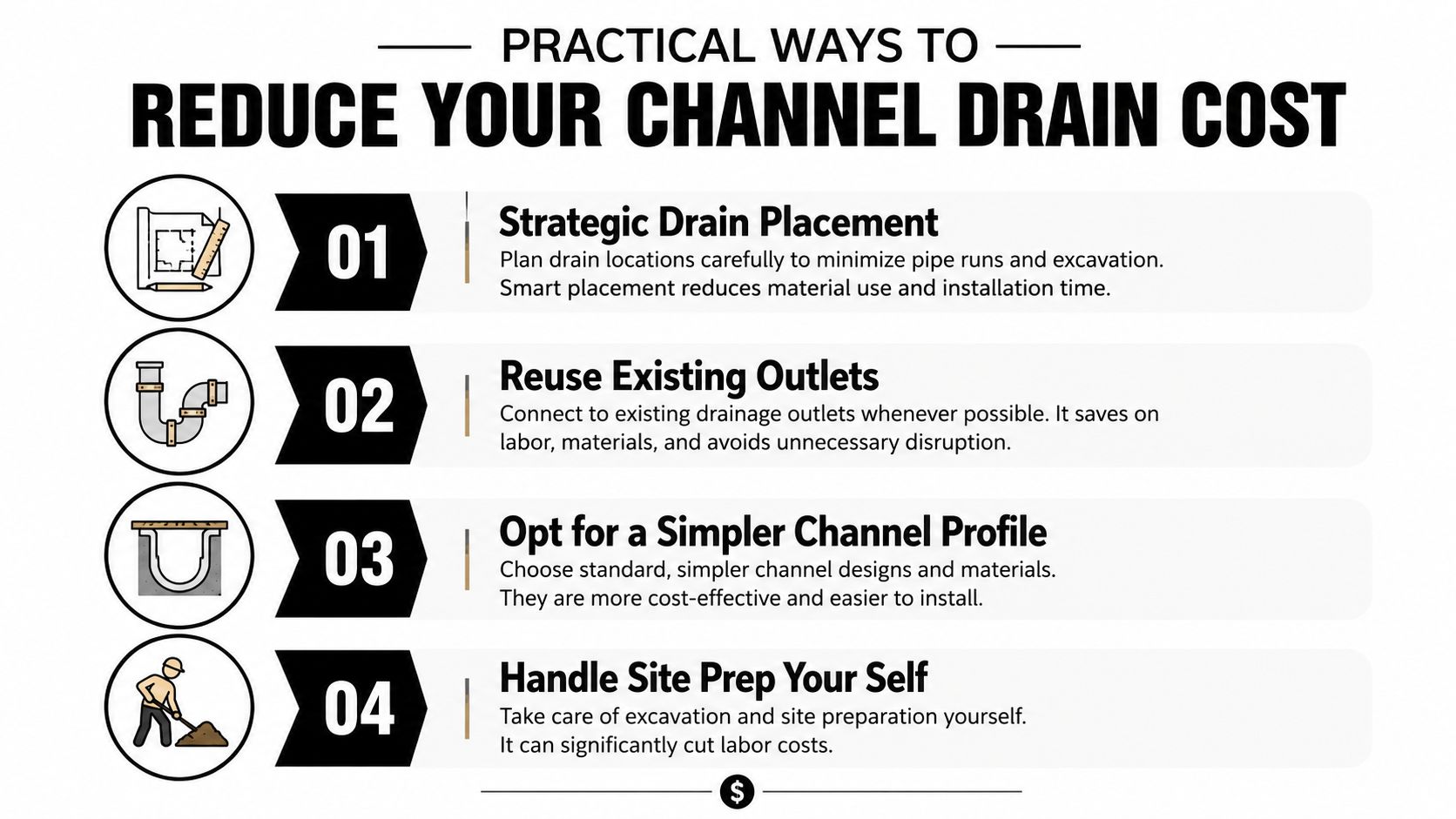
Spend on the right things, not the shiny things
Strategic drain placement trims footage, which can cut both material and labor. Reuse existing outlets whenever the old discharge line is sound, because new trenching and pipe runs add up fast. Choose a simpler channel profile when the site doesn't need heavy-duty hardware. Handle site prep yourself by clearing access, marking utilities, and removing fragile plants before the crew arrives.
If you're trying to lower the bill, start with the layout. A shorter, smarter run almost always beats a discount on the wrong design. After that, confirm whether the outlet can be reused, because that decision alone can keep a job from ballooning.
What actually saves money
- Shorter run: Less trenching, less material, less restoration.
- Existing outlet: Fewer pipe trenching costs and fewer tie-in hours.
- Right-sized grate: No need to over-spec a driveway that won't see heavy traffic.
- Clean site access: Less labor wasted moving obstacles and protecting landscaping.
The point is simple. Most savings happen before the contractor steps out of the truck. Once the cutting starts, labor is the expensive part, and it's hard to shrink that without cutting corners.
Maintenance, Lifespan, and Your Next Step
A well-installed channel drain doesn't need babying, but it does need basic care. Pull the grate seasonally, clear leaves and grit, flush the line, and check the catch basin or outlet after big storms.
Polymer concrete and HDPE systems can last 20 to 30 years when they're installed correctly and kept clear. When they start failing, you usually see slow drainage, surface pooling returning, or visible separation along the channel. Those are repair warnings, not cosmetic issues.
The work is simple enough that most homeowners can keep up with it themselves. The key is not letting debris pack into the system until water has nowhere to go.
If you're in Jackson or anywhere in West Tennessee, a local site visit matters because clay soil, runoff paths, and storm behavior change from property to property. A free on-site estimate from Lawn & Leaf Solutions gives you a real scope, not a guess from a search result.
If you're tired of guessing at drainage numbers, Lawn & Leaf Solutions can walk your property, explain the cut, tie-in, and restoration work, and give you a straight quote that reflects the actual job. If you're in Jackson or West Tennessee and water keeps showing up where it shouldn't, get the estimate before the next storm turns a small problem into a bigger bill.