
Interior French drain installation is a major project, and most homeowners spend $4,000 to $17,000 depending on the basement and system details. The price is high because this job usually means jackhammering the slab, digging below the floor, and tying the drain into a sump pump, which often adds $500 to $2,000.
If you're reading this after finding damp carpet, water along the wall, or that musty basement smell that gets worse after a rain, you're in the same spot a lot of West Tennessee homeowners reach before they call for help. In Jackson, the pattern is familiar. Heavy clay soil holds water, the ground stays loaded, and that pressure looks for the weakest path into the basement.
A proper French drain installation in basement spaces isn't a cosmetic fix. It's a pressure-relief system built under the slab to catch groundwater where it enters and move it to a pump that can send it out of the house. When it's designed and installed correctly, it solves the problem at the point where the water shows up, not after the basement is already wet.
Why Your Basement Has Water and How a French Drain Helps
Most basement leaks don't start with a dramatic wall crack. They start with saturated soil pressing against and under the foundation. That pressure is called hydrostatic pressure, and it's what pushes water through weak points in concrete, through small cracks, and most often through the cove joint, which is where the wall meets the floor.
That matters because the wet spot you see on the floor is usually just the symptom. The underlying issue is the water trapped around and below the foundation with nowhere easy to go.
What an Interior French Drain Actually Does
A true interior French drain is not just a trench cut inside the basement. Historically and functionally, the system uses a perforated pipe called a weeping tile installed underneath the basement floor on the inside perimeter to redirect groundwater. Interior systems, also called tile drains or pressure relief drains, are built to capture water entering at the cove joint and send it to a sump pump for discharge, keeping that water from spreading across the floor, as outlined in this explanation of how interior French drains and weeping tile systems work.
In practical terms, the drain gives groundwater an easier path than your basement floor.
Practical rule: If water keeps showing up where the wall and floor meet, sealing the surface rarely solves it for long. The pressure has to be relieved under the slab.
Why This Matters in Real Homes
In Jackson, I see homeowners spend time and money on paint-on coatings, crack fillers, and dehumidifiers before they address drainage. Those can help manage symptoms, but they don't remove the water pressure under the floor. If the problem is active seepage at the perimeter, the lasting fix is to intercept that water before it runs across the basement.
A lot of homeowners also look for general prevention tips before committing to a drainage project. This guide on how to prevent basement flooding is useful for understanding the outside conditions that make leaks worse, especially gutter overflow and poor grading.
If you're comparing basement moisture problems in different regions, this resource on Restore Heroes for Phoenix homes gives a good example of how climate and construction details change the symptoms, even though the basic moisture mechanics are similar.
The Core Idea to Keep in Mind
An interior system works because it accepts a simple fact. Water around a foundation is normal. Water across your basement floor is not.
The job of the drain is to collect that water at the perimeter, below the slab, and move it to a controlled discharge point before it can spread, soak finishes, or keep the basement damp enough for odor and mold problems to hang around.
Deciding on an Interior System for West Tennessee Homes
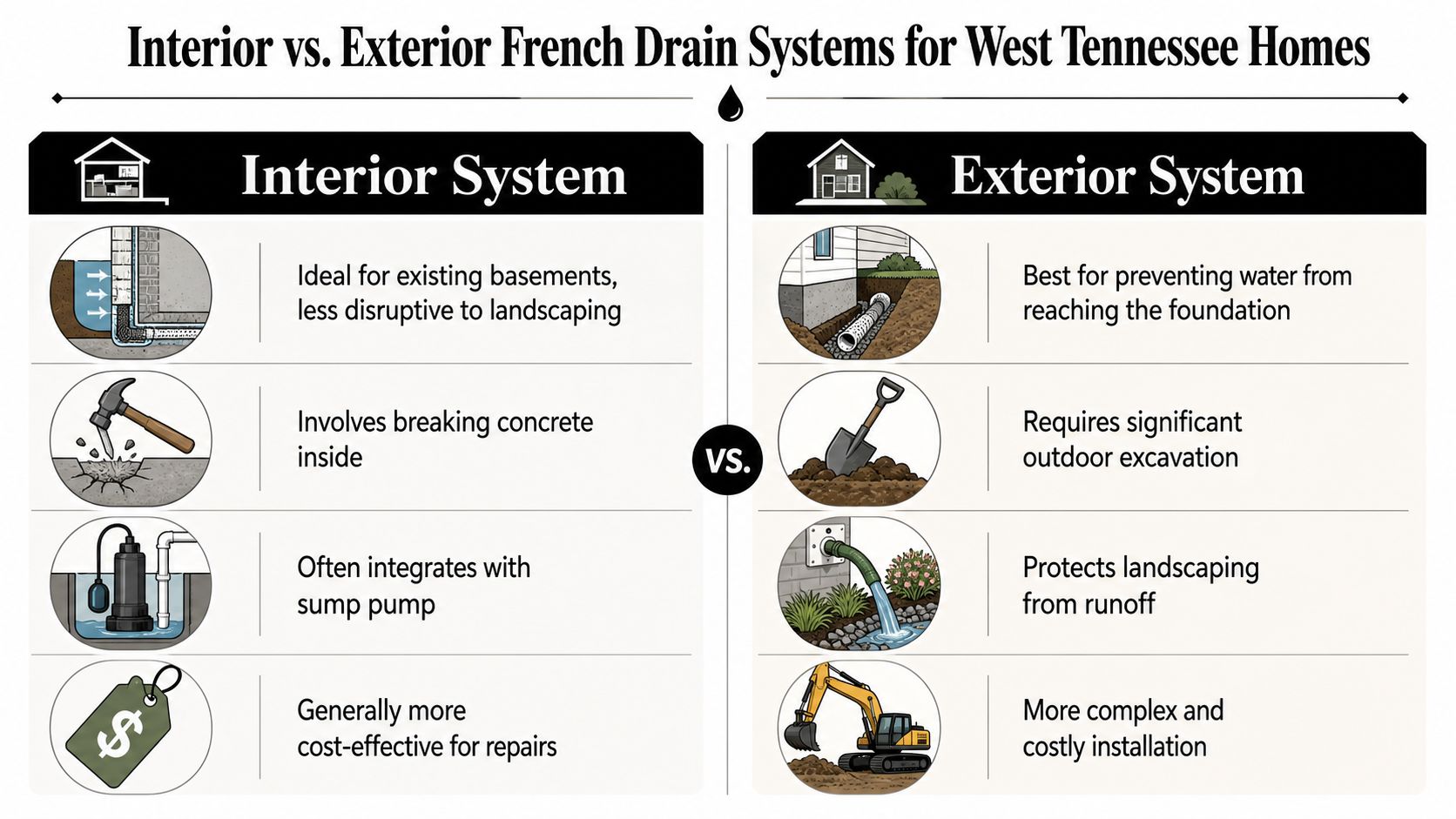
In West Tennessee, the biggest mistake is assuming every basement drain problem should be handled from the outside. Exterior systems absolutely have a place. But for many existing homes in Jackson, an interior system is the more practical answer because it deals directly with the water showing up under the slab and at the cove joint, without tearing up the whole yard.
Why Clay Soil Changes the Decision
West Tennessee clay doesn't drain like loose sandy soil. It holds water longer, swells when wet, and keeps pressure against the house after a storm. That makes basement water problems stubborn. Even when the yard looks like it's drying out, the soil beside the foundation can still be loaded.
An interior system doesn't depend on excavating the full outside perimeter to chase every wet area in that clay. It captures the water where it reaches the basement perimeter and sends it to a pump.
One local factor matters more than most DIY guides admit. Basement floors usually sit below the lot's natural drainage grade, so gravity-only discharge usually isn't realistic. Data cited in this discussion of interior drains, hydrostatic pressure, and pump requirements notes that 68% of basement water issues stem from hydrostatic pressure and that interior drains alone can't relieve it without a powered pump. The same source notes gravity-only outlets are impossible in 90% of urban basements, and 85% of DIY tutorials leave out that pump requirement.
If a contractor talks about an interior basement drain without talking about the sump pump, the plan is incomplete.
Interior vs Exterior French Drain Comparison
| Factor | Interior French Drain | Exterior French Drain |
|---|---|---|
| Primary job | Collects water at the basement perimeter after it reaches the foundation zone | Intercepts water outside before it reaches the wall |
| Best fit | Existing homes with active seepage at the wall-floor joint or under the slab | New construction or major exterior foundation work |
| Disruption | Concrete cutting and interior work inside the basement | Heavy excavation outside, with yard and access disruption |
| Landscaping impact | Minimal impact outside | Significant impact to beds, walks, and lawn near the house |
| Clay soil practicality | Often more workable in older West Tennessee homes | Can be difficult and messy in dense clay around finished landscapes |
| Discharge method | Usually tied to a sump pump | May use exterior drainage routing, depending on site conditions |
Homeowners comparing drainage options often find it helpful to read a side-by-side breakdown of sump pump vs French drain, especially because basement systems often need both working together, not one or the other.
What Usually Works Best Here
For an existing basement in Jackson with perimeter seepage, an interior drain tied to a sump pump is usually the cleaner path to a reliable repair. You avoid full exterior excavation, you don't gamble on a gravity outlet that probably doesn't exist, and you solve the actual basement water entry pattern common in this area.
Exterior work still makes sense in some jobs, especially where foundation access is already open or outside waterproofing is part of a larger repair. But if the goal is to stop water from spreading across the basement floor in an established home, interior drainage is often the system that matches the problem.
The Complete Professional Installation Process
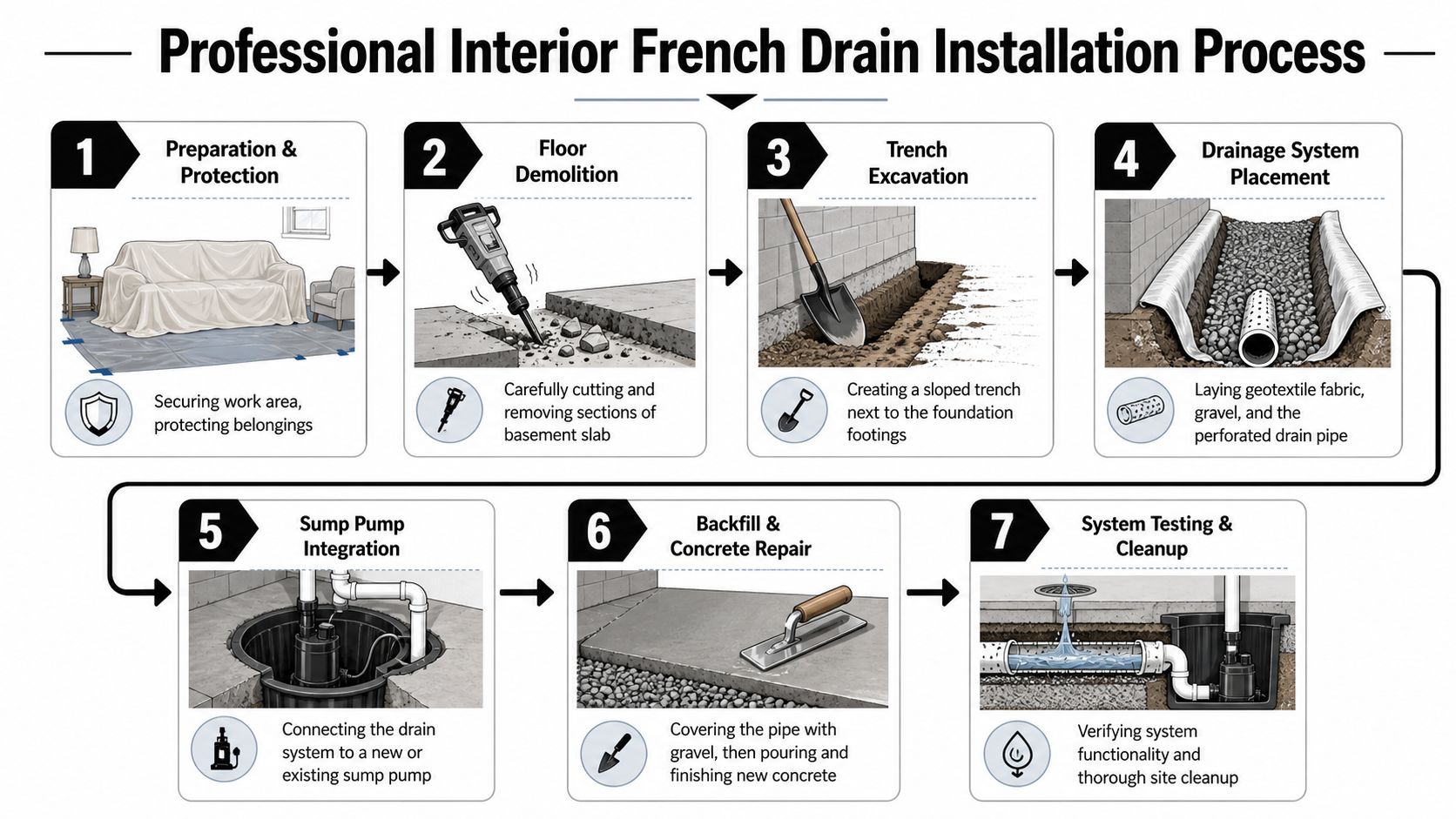
A professional French drain installation in basement spaces follows a clear sequence. The order matters because every step supports the next one. Miss one technical detail, and the whole system can underperform.
The Work Starts Before Concrete Is Cut
The basement gets cleared, surfaces are protected, and the drain path is laid out along the perimeter. In a finished basement, this planning stage is where a careful crew avoids unnecessary demolition and protects stored items, framing, and floor finishes that won't be affected by the drain line.
Then the slab gets opened. This is the part homeowners usually picture, and for good reason. The crew cuts and removes a strip of concrete along the foundation wall so the trench can be dug where the water is collecting.
For homeowners comparing excavation-heavy projects, it can help to look at examples of expert drainage installation for properties to understand how much site control and layout discipline good drainage work requires, even when the system type is different.
The Trench Details Are Not Optional
For basement perimeter French drains, the trench must be 6 inches wide and 18 to 24 inches deep, sloped at a minimum 1% gradient, which equals 1 inch drop per 8 feet, according to this technical walkthrough on proper basement French drain trenching and pipe layout. That same source states that the perforated pipe must be installed with the holes facing downward, and that installers should drill 1/4-inch holes every 6 inches along the foundation base before trenching so water can move from the foundation into the drain system.
Those numbers aren't trivia. They determine whether water moves consistently to the basin or sits in the trench.
A drain line that looks close enough by eye usually isn't good enough. Water only needs one low spot to start standing still.
How the System Is Built
Once the trench is cut to grade, the drainage components go in as a system, not as loose materials tossed together.
- Foundation relief first: The drilled weep holes allow trapped water at the foundation base to enter the trench instead of staying behind the wall.
- Pipe placement second: The perforated pipe is laid at the proper slope with the holes down so sediment doesn't settle into the openings as easily.
- Stone around the pipe: Clean drainage gravel surrounds and covers the pipe so water can move freely through the trench.
- Fabric control: The gravel is wrapped with filter fabric to keep surrounding fines from washing into the stone bed over time.
- Pump connection: The line ties into a sump basin, because the collected water has to be lifted and discharged away from the home.
A detailed overview of what to expect for foundation drainage installation can help you know what questions to ask before the crew starts, especially about dust control, access paths, and how the new concrete will be patched.
Finishing the Basement Floor Correctly
After the pipe, gravel, and connection to the sump pit are complete, the trench is closed back up with concrete. The finish should restore the floor cleanly and leave a solid walking surface that blends with the existing slab as much as the room allows.
The final phase is testing. Water should move to the sump basin without pooling in the trench, and the pump should discharge properly. Cleanup matters too. A professional job doesn't just leave a working drain. It leaves the basement usable again.
What homeowners usually notice after a proper install isn't the pipe. It's the absence of that familiar wet line at the perimeter when the next hard rain comes through Jackson.
Common Installation Mistakes and How to Avoid Them
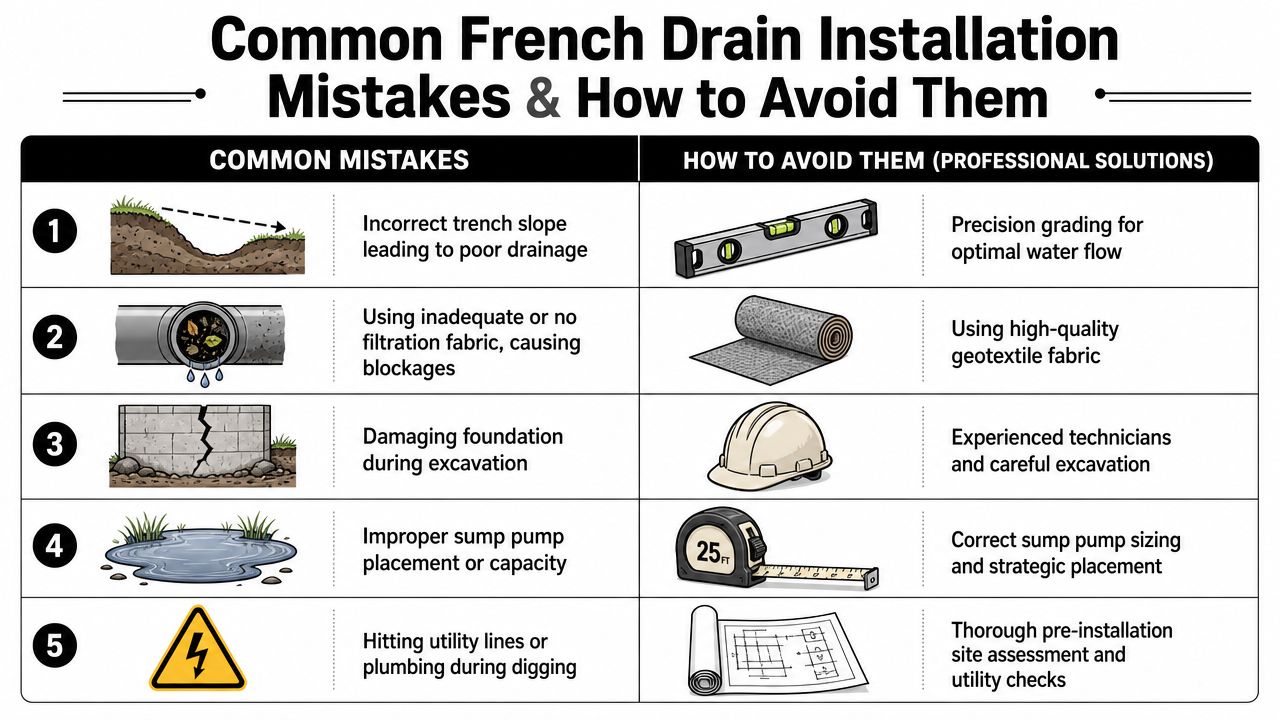
Most failed basement drains don't fail because French drains are a bad idea. They fail because someone copied the rough outline of the job and skipped the details that make the system work.
The Mistakes That Ruin the System
Industry data shows that properly installed interior French drains achieve 90% to 95% success rates, but failure rates rise to 35% to 40% when fabric is omitted or gravel is improperly sized, according to this guide on French drain installation failures and performance. The same source states that neglecting the downward hole orientation in perforated pipe leads to sediment clogging in 60% of DIY failures within the first 5 years.
That lines up with what drainage contractors see in the field. Most bad systems fail subtly at first. They don't always flood right away. They start by slowing down, holding silt, and letting moisture return.
Five Failure Points Homeowners Should Watch For
- Wrong pipe orientation: If the holes face up, sediment finds its way into the pipe openings and the system clogs faster.
- No proper fabric wrap: Gravel without filter separation doesn't stay clean for long in fine soil conditions.
- Poor gravel choice: Dirty fill, mixed soil, or sand-containing material reduces water movement through the trench.
- Bad trench grade: Even a small flat spot can leave water standing instead of moving to the basin.
- Weak sump planning: A drain line without a dependable discharge setup leaves collected water with nowhere to go.
The basement doesn't care whether the installer meant well. It only responds to grade, flow path, filtration, and discharge.
What a Professional Crew Does Differently
A professional approach is less about speed and more about control. The crew checks slope as the trench is dug, keeps the gravel bed clean, sets the pipe correctly the first time, and treats the sump connection as part of the system instead of an add-on.
In Jackson and the surrounding area, clay makes filtration mistakes show up faster. Fine particles migrate. Mud finds openings. That's why details that seem small on paper become big problems a few seasons later.
If you're reviewing bids or considering doing the work yourself, this article on how to build a French drain without common mistakes is a good checklist. It helps homeowners spot whether a plan includes the parts that prevent callbacks and repeat moisture problems.
A Good Test for Any Proposal
Ask one simple question. What keeps sediment out of the system over time?
If the answer is vague, the design probably is too. The drain, stone, fabric, and pump have to work as one assembly. Anything less is usually a short-term fix wearing the label of a permanent one.
Budgeting Your Project Cost and Timeline
Interior basement French drain work is not a small handyman job. National project pricing for 2026 puts most installations between $4,000 and $17,000, with costs commonly running $40 to $85 per linear foot, according to this breakdown of interior basement drain installation costs. The same source lists a national average of about $8,000 and notes that adding a sump pump often costs $500 to $2,000.
For a standard 1,000-square-foot basement with roughly 100 linear feet of perimeter drainage, homeowners typically spend around $5,000, with labor making up $3,500 to $4,000 of that total. That labor share makes sense. This is concrete demolition, trench excavation, drainage assembly, pump integration, and concrete restoration inside an occupied home.
What Pushes the Price Up or Down
The biggest cost factors are usually straightforward:
- Basement perimeter length: More linear footage means more cutting, digging, pipe, gravel, and patching.
- Sump pump needs: If the basement needs a new basin or pump setup, the system cost rises.
- Access and finish conditions: Tight work areas and finished basements require more protection and cleanup.
- Depth requirements: The drain has to sit below the footing zone it is meant to relieve, which increases labor.
The same cost source explains that the trench often needs to reach 18 to 24 inches deep from the basement floor and that this intensive labor is a major reason interior systems cost more than simpler exterior yard drains.
About the Timeline
Every house is different, so I won't pretend there's one universal schedule. A simple unfinished basement moves faster than a tight, occupied lower level with stored belongings, finished walls, or difficult access. The right expectation is controlled disruption for several work phases, not a quick afternoon project.
Homeowners planning for the financial side can use this guide to the cost of French drain installation to compare how scope, layout, and drainage goals affect the final budget.
The useful mindset is this. You're not paying for pipe alone. You're paying for a permanent drainage path under concrete, tied into a discharge system, with the floor rebuilt afterward.
Protect Your Home When to Hire a Professional
If the basement only had a damp smell once a year, such an issue is often overlooked. But water around a foundation doesn't stay politely contained. It ruins finishes, keeps the air heavy, and pushes homeowners into repeated patch jobs that never address the cause.
This is where professional installation matters. The work happens next to the footing, under the slab, and around utilities and structural elements that don't forgive guesswork. The drain has to be at the right depth, the pipe has to be oriented correctly, the gravel and fabric have to stay clean, and the sump system has to be part of the plan from day one.

When It's Time to Call for Help
Call a professional if you notice any of these patterns:
- Water at the wall-floor joint: That usually points to perimeter seepage and pressure under the slab.
- Recurring moisture after rain: If cleanup fixes it only until the next storm, the water path hasn't been controlled.
- Musty basement air that won't clear: Ongoing moisture is often present even when standing water isn't.
- Past DIY repairs that didn't hold: Repeating the same patch rarely changes the result.
- A basement below grade with no pump system: That's a red flag in this part of Tennessee.
One practical option for homeowners in Jackson and West Tennessee is Lawn & Leaf Solutions, a licensed drainage contractor with 18+ years of hands-on experience and Tennessee license #TNPL23317. For this type of work, the value isn't hype. It's having a crew that understands local clay soil, basement drainage behavior, and how to build a complete interior system that includes proper sump discharge.
The right install should let you stop monitoring the weather every time rain is in the forecast.
A wet basement makes people feel like the house has a mystery problem. Most of the time, it doesn't. The water is following pressure and gravity. Once you control that path correctly, the basement can stay dry and usable again.
If you're ready to stop chasing basement water with short-term fixes, contact Lawn & Leaf Solutions for a fast, free estimate. They'll evaluate the basement, explain whether an interior French drain and sump pump setup fits your home, and give you a clear plan for protecting the foundation for the long run.