
A lot of West Tennessee homes disappear at night.
You can have clean beds, healthy turf, a solid front walk, and a house with good lines, but once the sun drops, everything flattens into darkness. The front steps get harder to read. The driveway edge fades out. That oak you like during the day becomes a black mass in the yard. The house doesn't feel finished because, after dark, it isn't.
A well-planned outdoor lighting installation changes that fast. The right system gives a home shape at night. It makes paths safer, entries easier to use, and outdoor spaces more usable. It also changes how the property feels from the street. Instead of one porch light fighting the dark, the whole site works together.
That shift isn't just a niche design trend. The global outdoor lighting installation market was valued at USD 13.20 billion in 2024 and is projected to reach USD 22.01 billion by 2030, with LED technology accounting for 57.6% of the market segment in 2025, according to Grand View Research's landscape lighting market report. Homeowners aren't treating outdoor lighting as an extra anymore. They're treating it like part of a complete property.
Transform Your Home After Sunset
Most homeowners start thinking about lighting after one of three things happens. They pull into a dark driveway one too many times. They notice guests hesitating at the front walk. Or they spend good money on landscaping and realize no one can see it at night.
That's common around Jackson and across West Tennessee. A home can look sharp during the day, then feel oddly blank after sunset. The porch light throws a harsh puddle of light near the door, but the rest of the property fades away. Beds, stone edging, trees, and the front walk all disappear. The house loses depth.
A proper lighting plan fixes more than looks. It helps people move around the property safely, makes entrances easier to identify, and gives the home a settled, cared-for feel. If you've already invested in planting, grading, drainage, or hardscape work, lighting is what lets those improvements keep doing their job after dark. That's especially true on properties where the front elevation has texture, masonry, steps, or changes in grade. If you're already thinking about broader landscaping services in Jackson, TN, lighting usually belongs in the same conversation.
What a homeowner usually notices first
The first thing one responds to isn't brightness. It's balance.
A softly lit walkway feels safer than a flood of white light. A tree with controlled uplighting looks intentional. Stone columns with gentle wash lighting look finished. Good lighting draws the eye where it should go and leaves the rest of the yard calm. That's why strong design matters more than just adding more fixtures.
A beautiful night scene rarely comes from the brightest system. It comes from the one with the best restraint.
If you want to see how another contractor approaches that design-first mindset, this guide to expert outdoor lighting solutions Colorado Springs is a useful example. The location is different, but the design logic carries over.
Why this has become a mainstream upgrade
The broader market reflects what contractors see on the ground. Homeowners want curb appeal, lower-maintenance LED systems, and better visibility around the home. They also expect outdoor spaces to do more than they used to. A backyard patio isn't only for daytime anymore. A front entry isn't only a functional path to the door. People want these areas to look good and work well after sunset too.
That's where outdoor lighting installation earns its keep. Done right, it's part safety upgrade, part design upgrade, and part finishing detail that makes the rest of the property make sense.
Choosing the Right Lighting System and Fixtures
The first big decision is the system type. Most residential projects use low-voltage lighting, but not every property should be treated the same. Some homes need a simple path-and-accent layout. Others need a mix of beam spreads, mounting styles, and more power planning than homeowners expect.
Low-voltage versus line-voltage
For most homes, low-voltage (12V) is the practical choice. It's flexible, easier to adapt to evolving outdoor spaces, and well suited for path lights, uplights, and small-scale feature lighting. Line-voltage (120V) usually comes into play when a fixture needs that power level or when a site includes larger specialty applications.
| Feature | Low-Voltage (12V) | Line-Voltage (120V) |
|---|---|---|
| Typical residential use | Path lights, uplights, garden accents, step lights | Some specialty fixtures and heavier-duty applications |
| Flexibility | Easier to expand and adjust as landscaping changes | Less forgiving once layout is set |
| Installation style | Uses transformer and low-voltage cable | Requires line-voltage wiring methods |
| Best fit | Most homes wanting layered exterior lighting | Specific applications where fixture requirements call for it |
| Homeowner advantage | Good control over light placement and mood | Useful when project demands call for it |
For homeowners, the important thing isn't memorizing electrical categories. It's understanding why a contractor recommends one approach over another. If the proposal doesn't explain that clearly, ask.
The fixture types that do the real work
Fixtures each have a job. Problems start when one fixture is asked to do everything.
- Path lights guide people along walks and bed edges. They should help you read the route, not blind you as you pass.
- Spotlights create tighter accents on columns, trunks, entry features, or house details.
- Floodlights spread wider light and work better when you need broader coverage on facades or larger planting areas.
- Well lights sit lower in the ground and can be useful when you want a concealed source.
- Hardscape and step lights fit retaining walls, seat walls, stairs, and outdoor living features where the light needs to feel built in.
If you're planning a new property or finishing out a fresh outdoor area, these ideas often pair well with broader landscaping ideas for new homes. Lighting works best when it's considered alongside planting and hardscape, not after every other decision is locked in.
Specs that matter more than homeowners expect
Two fixture details deserve attention because they affect both performance and appearance. According to This Old House's guide to landscape lighting, transformer capacity should be calculated by summing all fixture wattages and adding a 25% safety margin, and fixtures should have a CRI of 80 or above and be UL 1838 listed for wet locations.
That matters in real projects. A bad transformer choice creates trouble before the system is even switched on. Poor color rendering makes stone, mulch, and plant material look dull or off-color. And if a fixture isn't rated for wet conditions, it has no business living in a Tennessee outdoor setting.
Practical rule: Buy fixtures for the site you actually have, not the catalog photo you liked. Wet rating, material quality, and transformer sizing matter more than decorative styling.
The same goes for the light source itself. If you're still comparing lamp types, this breakdown on switching to energy-efficient LED is a good outside reference for understanding why so many systems have moved away from older options.
Key Principles of Landscape Lighting Design
Lighting design is part utility and part editing. The goal isn't to make every inch of the yard visible. The goal is to decide what deserves attention and what should stay quiet.
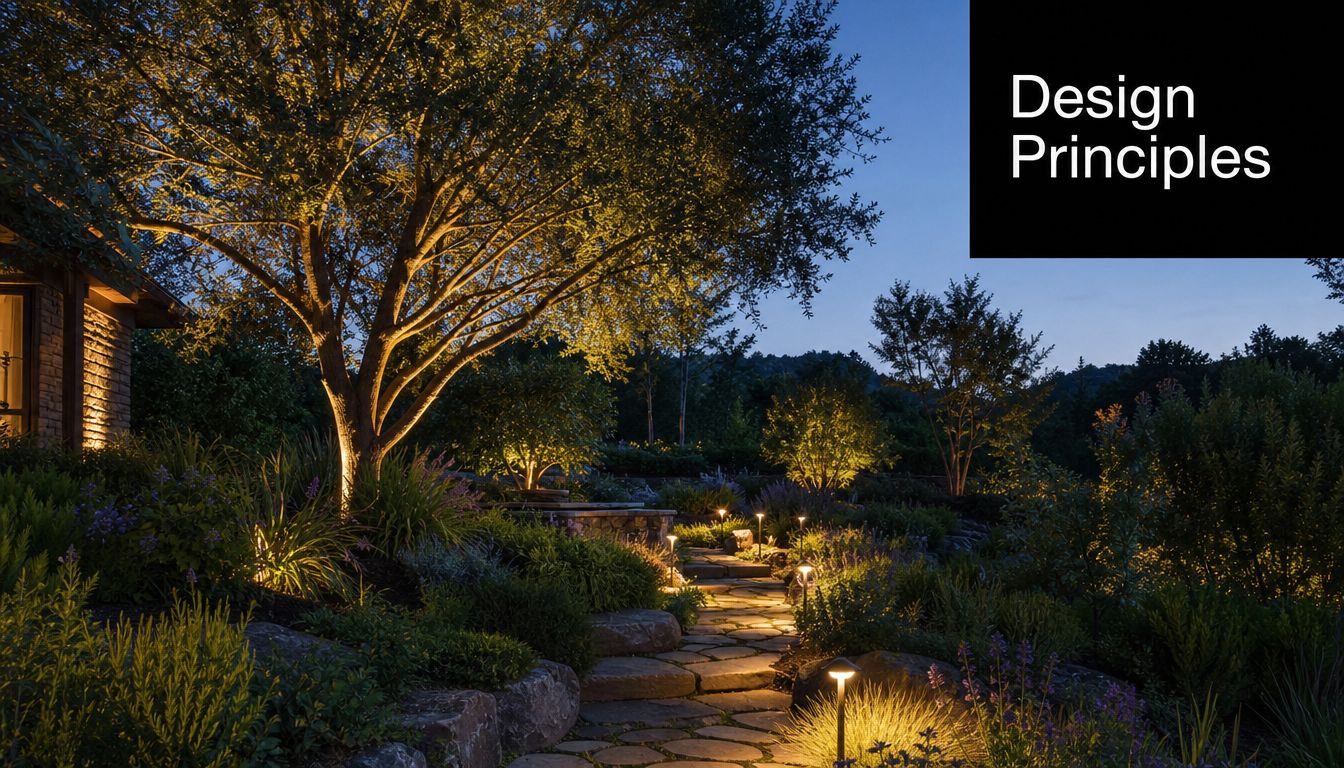
Layer light instead of flooding the yard
A strong plan usually combines several jobs at once. You need light for movement, light for visual interest, and light that gives the house and yard depth. If all three come from the same kind of fixture, the result tends to look flat.
Think in layers:
- Movement lighting helps people walk safely to the door, around steps, and through outdoor living areas.
- Accent lighting draws attention to trunks, specimen plants, stonework, or architectural lines.
- Ambient glow gives the property a calm nighttime presence without making it feel overlit.
One of the easiest mistakes is over-lighting the front walk while ignoring the home itself. Another is blasting the house with a few strong beams and forgetting the spaces in between. Both approaches feel harsh because they skip the middle ground.
Create focal points and depth
Every property needs a visual anchor after dark. Sometimes that's the front entry. Sometimes it's a mature tree, a stone wall, or a layered planting bed. Good design gives your eye somewhere to land first, then somewhere else to travel.
That's why fixture placement matters more than fixture count. A narrow beam can dramatize a trunk. A softer wash can reveal texture in masonry. A tucked fixture can graze a wall and make it feel taller. A poorly placed fixture can also shoot glare into a window or directly into someone's face on the front walk.
Good nighttime design should reveal form, not the fixture itself.
If your outdoor space includes a sitting area, short retaining walls, or grade changes, lighting should support those features instead of competing with them. The same design thinking shows up in compact outdoor layouts too. Homeowners working through small-yard patio design ideas with flagstone often run into the same issue. Space feels larger when light is placed with purpose.
What usually works best in practice
A few design habits hold up on most residential properties:
- Highlight one standout feature first. Don't try to make everything a focal point.
- Use path lights to guide, not dominate. They should mark travel lines without turning the walkway into an airport runway.
- Aim away from common sightlines. A beautiful fixture becomes a bad fixture the second it causes glare at the door, driveway, or patio.
- Let darkness stay in the plan. Contrast is part of what makes a lighting scene look polished.
The best outdoor lighting installation looks natural even though it's carefully controlled. That's usually the sign the design was done right.
A Professional's Project Timeline
Most homeowners picture installation day as the whole project. In reality, the quality of the finished system depends on the decisions made before the trench is cut and after the fixtures are set.
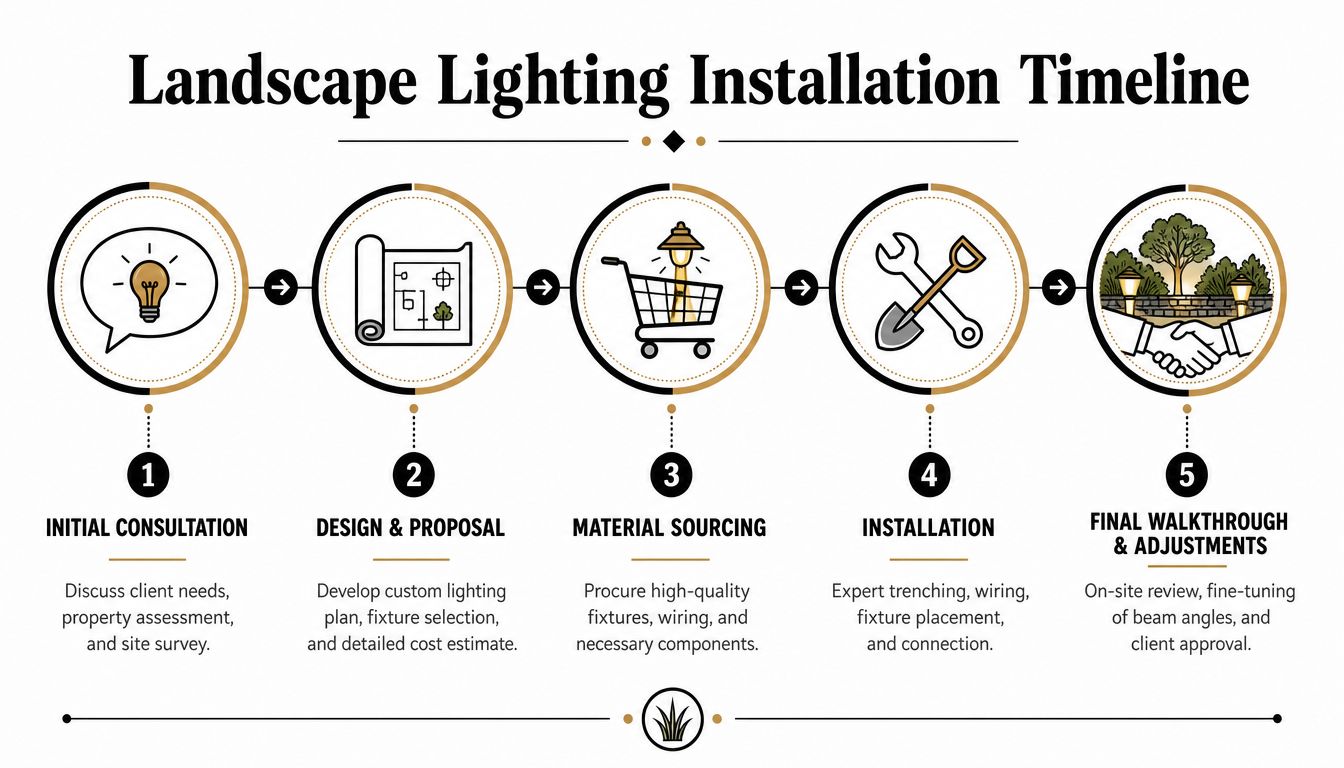
The early phase that prevents rework
A solid project starts with a site walk. The contractor looks at entry routes, grade changes, bed lines, mature trees, drainage patterns, and where power can realistically be brought into the design. At this stage, the plan becomes practical.
Homeowners often focus on where they want light. Installers also have to think about where wire can run cleanly, where sleeves may be needed, and which areas are likely to shift, stay wet, or get disturbed by future groundwork. That's especially important on properties with active drainage problems, recent construction, or beds that haven't fully settled yet.
After that comes the proposal and fixture plan, and for this, you want specifics. Not just “path lights and uplights,” but where they're going, what effect they're intended to create, and what type of control system is being used.
The part of the job homeowners rarely see clearly
Installation itself has several moving parts:
- Layout marking so fixture locations make sense in daylight before anything is disturbed.
- Material sourcing to match the plan with the right fixtures, wire, transformer, and connection hardware.
- Trenching and cable routing with attention to roots, irrigation, edging, and hardscape.
- Connection work at fixtures and transformer.
- Night aiming and adjustment once the system can be seen in its working condition.
Homeowners sometimes compare this to simple fixture swaps, like installing outdoor post lights. That kind of work can be straightforward in the right setting. A full outdoor lighting installation is different because the whole system has to work together across the property.
Where technical discipline matters
Professional habits distinguish a durable system from one that looks good for a few weeks and then starts misbehaving. According to the AOLP landscape lighting guidelines, direct-burial cable must be trenched to a minimum depth of 6 inches, and the voltage at every fixture should be tested with a multimeter to confirm it is between 10.8 and 12.0 volts before final burial.
Those aren't fussy details. They're what keep a system performing properly.
If a contractor doesn't talk about trench depth, voltage testing, and final nighttime aiming, the project probably isn't being treated with enough care.
The handoff matters too. Homeowners should know where the transformer is, how controls operate, what to watch for after heavy weather, and how future planting changes may affect beam paths. The best projects don't just turn on. They stay serviceable.
Understanding Project Costs and Property Value
Lighting projects vary widely because properties vary widely. A small front-entry plan with a few carefully aimed fixtures is a different job from a full-property installation that includes long wire runs, multiple bed zones, steps, masonry features, and backyard living areas.
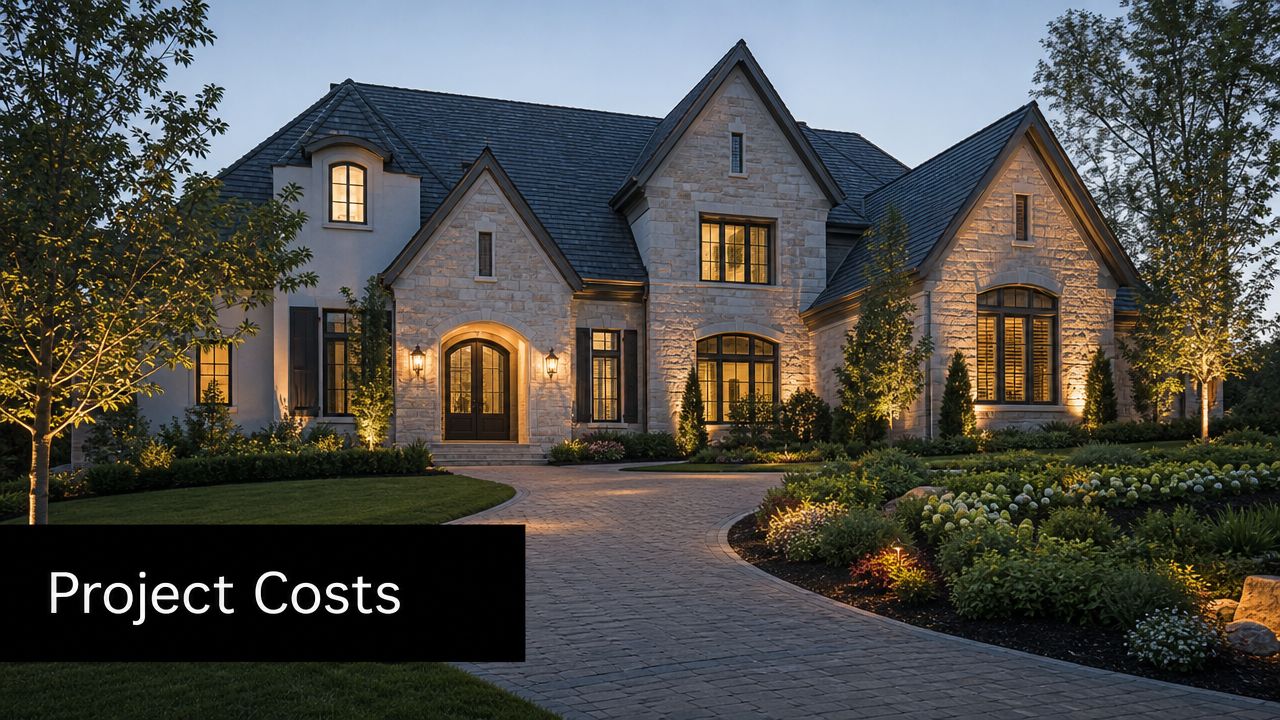
What actually drives the budget
The biggest cost drivers are usually the fixture quality, the number of lighting zones, the complexity of wire routing, and how much design precision the property needs. Soil conditions can affect labor. So can roots, hardscape crossings, and whether the project is being installed into an established outdoor area or alongside new work.
A homeowner should also understand that “more fixtures” doesn't automatically mean “better value.” Sometimes a smaller, better-planned layout with stronger materials is the smarter investment. Cheap fixtures and weak connection methods can lower the initial bill while raising the chance of future service calls.
Here's the practical way to think about cost:
- Entry-level layouts usually focus on path lighting and a few accents.
- Mid-range projects start layering the front elevation, trees, and outdoor living areas.
- Higher-complexity systems include broader coverage, more control, and more demanding installation conditions.
Why homeowners are treating lighting as an investment
The national market supports what contractors are seeing at the property level. In the United States, the residential outdoor lighting market was valued at approximately USD 0.22 billion in 2024 and is projected to grow to USD 0.55 billion by 2033, according to Grand View Research's U.S. outlook for landscape lighting. Homeowners are putting money into customized lighting because it supports curb appeal and perceived value.
That doesn't mean every fixture automatically raises resale. It means a thoughtful lighting plan helps the property present better, function better, and feel more complete. Buyers notice that. Neighbors notice it too.
If you're weighing the broader return on exterior improvements, it helps to look at how landscaping affects home value. Lighting usually performs best when it reinforces strong planting, grading, and hardscape work that's already in place.
A better question than “What does it cost?”
The more useful question is, “What result am I paying for?”
Are you trying to solve a dark and unsafe front walk? Showcase a well-built home? Make the patio usable after sunset? Add nighttime structure to an outdoor space that disappears after dark? Once that goal is clear, the budget discussion gets easier and the fixture choices get smarter.
Pro Installation vs DIY for West Tennessee Homes
DIY outdoor lighting can work on paper. In West Tennessee, paper isn't the problem. Moisture, soil, and time are the problem.
A lot of national how-to guides assume average conditions and short-term success. They show how to connect fixtures, bury cable, and turn the lights on. What they usually don't address is what happens after humidity hangs over the yard, rain works into shallow or poorly sealed connections, and the soil stays damp around splices.
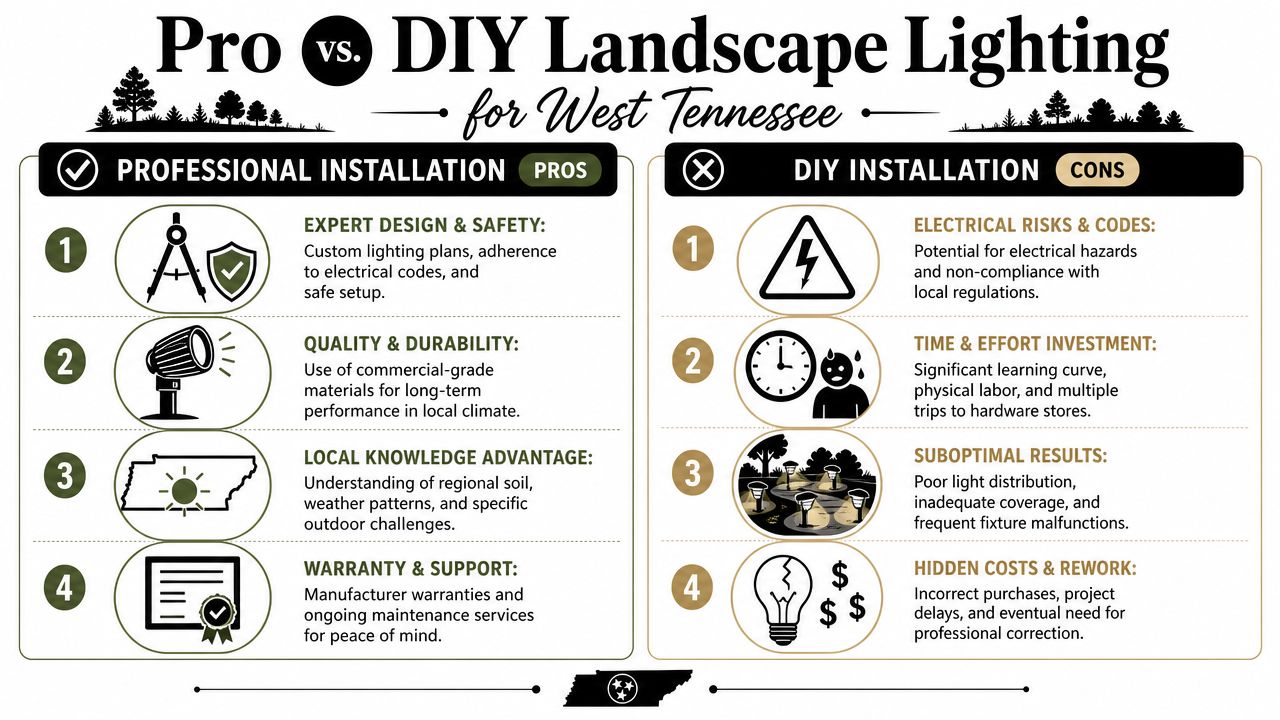
The local issue generic guides miss
In humid climates like West Tennessee's, up to 40% of DIY outdoor lighting failures within two years are caused by wiring connector corrosion, not bulb failure, according to NSL's discussion of landscape lighting issues and fixture choices. That tracks with what many contractors see. Homeowners replace lamps, adjust fixtures, and assume the light itself is the problem when the actual issue is hidden underground at the connection.
The local environment alters the discussion. A splice that survives in a milder, drier setting may not hold up the same way here. West Tennessee yards see heavy moisture, humid summers, and soils that can stay wet around low spots and bed edges. If the connection method is weak, the failure often shows up later, after the install looks “done.”
The system doesn't have to fail all at once to be a bad install. One weak connector can create a string of problems that waste hours in diagnosis.
Where professionals usually earn their money
Professional installation isn't just about labor. It's about reducing the chance of hidden failure and building the system around local conditions.
A qualified installer brings a few advantages DIY work often misses:
- Code awareness so the system aligns with electrical and site requirements.
- Better material selection for fixtures, cable, transformer sizing, and wet-location durability.
- Cleaner troubleshooting because the layout, load planning, and connection points were intentional from the start.
- Regional judgment about where moisture, settling, and soil movement are likely to cause trouble.
That's especially important if you're already sorting through contractor choices and want to know what separates one company from another. This guide on choosing the right landscaping company in Jackson, TN is worth reading because it applies to lighting work too. Good companies explain their process. Weak ones stay vague.
When DIY makes less sense than it first appears
DIY often looks cheaper because the first receipt is smaller. Then come the re-digs, the dim fixtures, the flickering runs, the wet connectors, the transformer mismatch, and the eventual call to fix what should've been built right the first time.
That doesn't mean homeowners shouldn't learn about their systems. They should. It means outdoor lighting installation in this region isn't as forgiving as many online guides make it sound.
FAQ About Landscape Lighting Installation
How long should a lighting plan take to design well
A good plan shouldn't feel rushed. The property needs to be evaluated for circulation, focal points, power access, and moisture conditions. If a contractor can price and design the whole job without really studying the site, that's usually not a great sign.
Can lighting be added after the landscape is already finished
Yes, often very successfully. It just takes more care. Existing beds, roots, edging, irrigation components, and drainage features all have to be protected during routing and installation. Retrofitting is common, but it requires cleaner planning than many homeowners expect.
Will brighter fixtures make the home look better
Usually not. Better aiming and better fixture selection matter more than raw brightness. Most bad-looking systems aren't too dim. They're uneven, glary, or poorly balanced.
What maintenance should homeowners expect
Expect periodic adjustment, cleanup around fixtures, and occasional inspection after seasonal growth or storms. Shrubs grow into beam paths. Mulch shifts. Soil settles. A lighting system isn't high maintenance, but it isn't completely hands-off either.
Can lighting and drainage work affect each other
Absolutely. Drainage patterns affect where cable runs stay dry, where fixtures remain stable, and where connectors are at higher risk. On problem properties, lighting should be planned with grading and water movement in mind from the start.
What should I ask before hiring an installer
Ask how they size transformers, how they handle underground connections in wet conditions, how they test the system before burial, and what support looks like after the install. You want clear answers, not general promises.
If you want an outdoor lighting installation that fits West Tennessee conditions instead of fighting them, Lawn & Leaf Solutions can help. Their team serves Jackson and surrounding areas with practical outdoor expertise rooted in real site conditions, from drainage and grading to the finishing details that make a property work after dark. Reach out for a quote if you want a lighting plan that looks sharp, performs reliably, and respects the way Tennessee outdoor environments behave.