
Living in West Tennessee means your yard can swing from dusty and stressed to soggy and soft in the same week. One stretch of hot weather leaves turf struggling, then a hard rain sends water rushing off the driveway, pooling near the foundation, and flattening flower beds. Most homeowners feel like they're solving two separate problems. In reality, it's one yard problem with one smarter answer.
The best water conservation landscaping ideas don't just cut irrigation. They also help your property handle heavy rain, hold moisture where plants need it, and move excess water away from the house. That matters in Jackson and across West Tennessee, where clay soils, humidity, summer heat, and sudden storms create real trade-offs. A planting plan that works in a dry desert yard can fail here if it ignores drainage.
At Lawn & Leaf Solutions, we approach water-wise landscaping as a full system. Plant choice matters. Mulch matters. Irrigation layout matters. Grade, runoff paths, and drainage matter just as much. If you only swap in a few drought-tolerant plants but leave a low spot holding water for days, you haven't built a resilient yard. You've just changed the symptoms.
That's why the ideas below focus on what works in this region. Some reduce watering directly. Some help your soil absorb water better. Some control runoff before it turns into erosion or foundation trouble. If you're pricing a larger redesign, tools like Exayard landscaping estimating software can help contractors build clearer proposals, but the primary value starts with choosing the right strategy for your site.
1. Xeriscaping
A Jackson homeowner cuts back irrigation, swaps part of the lawn for gravel and drought-tolerant plants, and expects lower water bills. Then July brings a week of heat, followed by a hard storm that leaves water standing in the planting bed. In West Tennessee, xeriscaping only works when dry-weather planning and wet-weather drainage are built together.
Xeriscaping here means designing a yard to need less supplemental water without setting it up to fail in clay soil and summer humidity. The core ideas are still sound: reduce high-demand turf, group plants by water needs, improve soil, mulch exposed ground, and water efficiently. The local difference is drainage. A low-water yard still has to shed excess runoff and keep roots from sitting in saturated soil.
The University of Arkansas System Division of Agriculture guide to water-wise landscaping outlines the same practical framework used by good contractors across the Mid-South: plan first, match plants to site conditions, and avoid wasting water on areas that do not need it. That approach fits West Tennessee well, especially on properties with compacted subsoil or low spots near the house.
What works in West Tennessee
Start with the parts of the yard that struggle. Narrow side yards, steep slopes, thin strips along driveways, and patchy areas under heat stress are usually better candidates for conversion than the main play area. Keep usable turf where it earns its space. Replace the rest with planted beds that fit the sun exposure, drainage pattern, and maintenance level the homeowner will keep up with.
Plant selection needs to follow moisture conditions, not just appearance. Black-eyed Susan, purple coneflower, redbud, serviceberry, and native grasses can perform well here, but only if they are placed in the right soil and light. On a site with slow drainage, I would rather see moisture-tolerant plants in a swale or basin than watch a dry-site planting decline because the bed stays wet after every storm.
Irrigation still matters. Even a water-wise planting needs help during establishment, and some beds need a more precise watering plan than others. Homeowners sorting through watering options should compare sprinkler system choices for West Tennessee homes before they commit to a full redesign.
Common mistake
The most common xeriscaping failure is cosmetic conversion without site correction. Decorative stone over hard clay often makes the yard look cleaner, but it can increase heat around plants and speed runoff if the grade and soil were never fixed. The better sequence is simple: correct drainage, loosen or amend problem soil where appropriate, shape the bed, then plant and mulch.
That is where the West Tennessee approach differs from a desert-style template. A low-water garden here has to conserve irrigation in August and handle a pounding rain in the same season. If the yard cannot do both, it is not a finished system yet.
2. Drip Irrigation Systems
Spray heads are convenient, but they're wasteful in many beds. They throw water onto leaves, pavement, mulch, and windy air. In shrub borders, foundation beds, and vegetable gardens, drip irrigation is usually the better tool.
A major benchmark comes from outdoor test plots where soil moisture sensor based irrigation control saved 28% to 92% compared to time-based schedules, as documented in the Alliance for Water Efficiency report on outdoor irrigation. That's a strong reminder that precision matters more than watering on a timer alone.
Where drip is worth it
Drip works especially well in:
- Foundation beds: Water stays near the root zone instead of wetting siding and walkways.
- Sloped planting areas: Slow delivery reduces runoff better than overhead spray.
- Mixed ornamental beds: You can separate shrubs, perennials, and annuals into different zones.
- Vegetable gardens: Consistent root-zone moisture improves reliability without soaking foliage.
In West Tennessee clay, drip has one big advantage and one big caution. The advantage is control. The caution is infiltration speed. If soil is tight or the bed sits on a slope, water can puddle before it soaks in. In those spots, pulse irrigation works better. Run a short cycle, let the water absorb, then run another short cycle.
For homeowners comparing layouts, Lawn & Leaf Solutions breaks down the pros and limits of different systems in this guide to choosing the best lawn sprinkler system for your home.
What not to do
Don't assume drip fixes bad drainage. It reduces overwatering, but it won't solve a bed that already stays saturated after rain. Also, don't bury emitters so far under mulch that you can't inspect them. In real yards, clogs, cuts, and shifted lines are common.
A drip system should match the soil, slope, and plant group. If those three don't line up, the hardware won't save the design.
3. Rain Gardens and Bioretention Areas
Some of the best water conservation design concepts start with stormwater. If a downspout dumps into the same spot every rain and that area turns into mud, a rain garden can turn a recurring problem into a useful garden amenity.
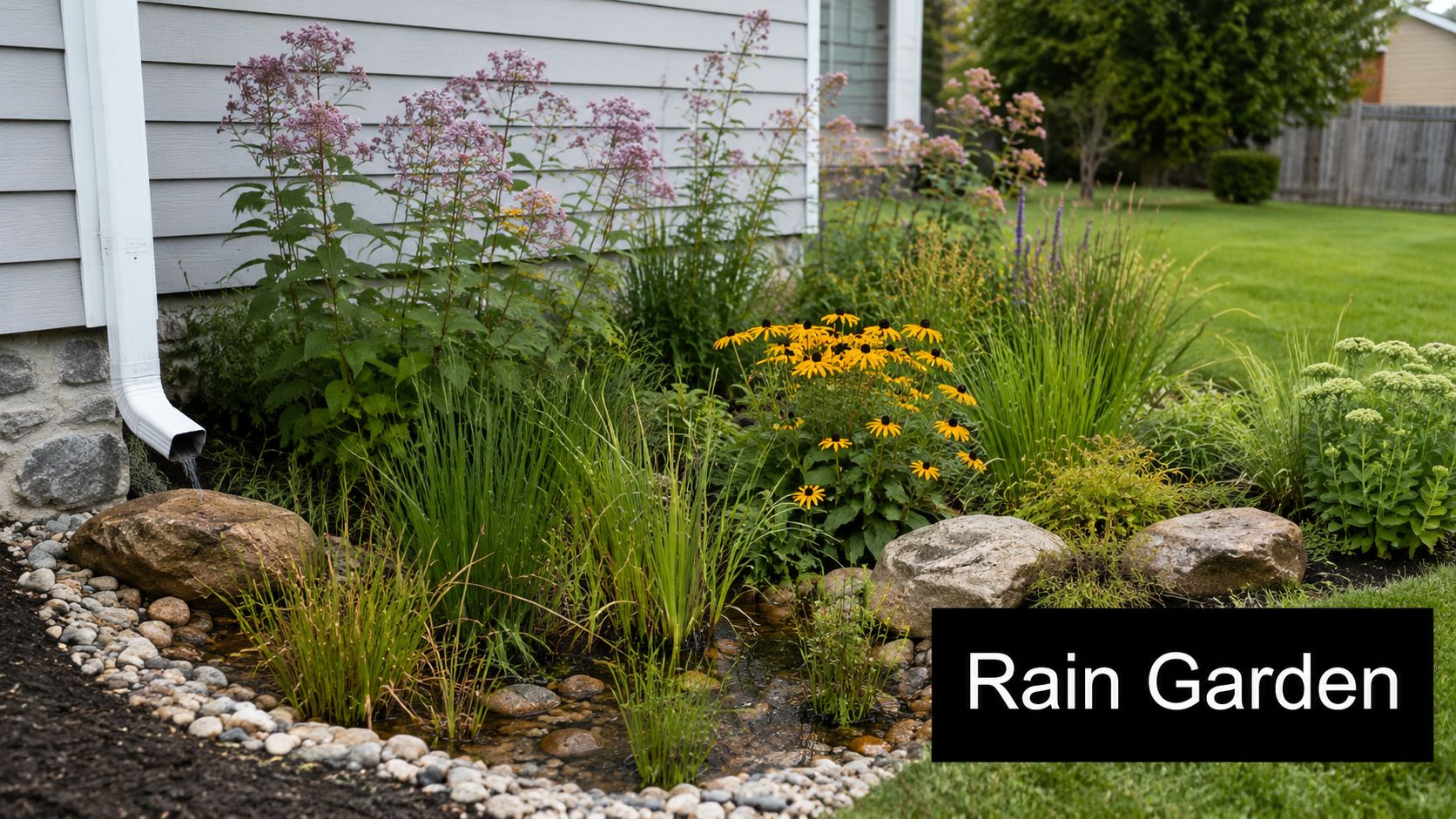
A rain garden is a shallow planted basin that catches runoff and lets it soak in gradually. In West Tennessee, it's often most effective where roof water, driveway runoff, or a shallow slope already funnels water toward one area. The key is placement. Too close to the house, and you create a foundation issue. Too shallow, and it just becomes a soggy bed.
Why this matters here
Standard low-water advice often skips a key challenge many local homeowners face. In humid or variable climates like West Tennessee, hydrozoning can conflict with seasonal flooding and drainage issues. Research highlighted by Proven Winners on drought-resistant landscaping points out that many guides talk about drought tolerance but don't explain how to manage excess water with swales or infiltration areas.
That gap is exactly why rain gardens matter. They give overflow a place to go. They also let you match plants to moisture patterns instead of fighting them.
Better design choices
Use moisture-tolerant plants in the basin and plants that prefer drier feet on the shoulder and berm. Joe-Pye weed, native sedges, and black-eyed Susans can all play a role, depending on the exact drainage pattern. A well-built rain garden should collect water, drain down, and return to being a planting bed rather than a permanent bog.
If your yard has chronic pooling or water movement across the surface, pair the basin with a broader drainage plan. Lawn & Leaf Solutions explains that system approach in their guide to yard drainage solutions.
What doesn't work is digging a hole in compacted clay and hoping for the best. If infiltration is poor, the basin may need amended soil, an overflow path, or integration with a drain system.
4. Native Plant Selection and Replacement
If you want lower water use without a yard that looks stripped down, native plants are usually the smartest place to start. They fit the local climate better, and once established, they generally ask for less intervention than imported ornamentals that were chosen for appearance alone.
Many West Tennessee yards improve fast. Replacing scattered high-demand plants with better-adapted species often reduces stress, cleanup, and irrigation at the same time. Redbud under taller canopy trees makes more sense here than forcing sun-loving ornamentals to survive in dry shade. Serviceberry gives you structure and seasonal interest without the constant babysitting that many non-native shrubs require.
Smarter replacements
A practical swap list looks like this:
- For thin shady turf: Use sedges or shade-tolerant native plant groupings instead of trying to keep grass dense under mature trees.
- For decorative but thirsty beds: Replace high-input annual-heavy areas with coneflower, black-eyed Susan, bee balm, or native grasses.
- For nonfunctional lawn strips: Use little bluestem or switchgrass where foot traffic is low.
- For wet pockets: Choose plants that can handle periodic saturation instead of trying to dry the spot with extra irrigation elsewhere.
The strongest native gardens are still edited gardens. They aren't random. Repetition, edging, and clean bed lines make them look intentional.
For region-specific planning, Lawn & Leaf Solutions offers more guidance on landscaping in Tennessee.
The trade-off homeowners should expect
Native plantings usually look better in year two and year three than they do right after installation. That establishment window matters. People pull plants too early, overwater them to “help,” or assume a looser planting style means the bed isn't finished.
Native plants reward patience. Most failures come from treating them like annual color beds instead of long-term structure.
5. Mulching and Soil Amendments
A common West Tennessee problem looks like this. The bed is freshly planted in spring, the topsoil bakes hard by July, and after the next heavy rain the surface seals up and sheds water instead of holding it where roots need it. Good mulch and better soil structure fix more of that than another round of replacement plants.
Mulch cuts surface evaporation, softens temperature swings, and protects soil from crusting during hard rain. Soil amendments affect what happens below that layer. They help the root zone hold moisture longer in dry periods without staying soggy after a storm. On many properties here, that balance matters because our soils often have enough clay to drain slowly, compact easily, and crack during hot weather.
The University of California Agriculture and Natural Resources xeriscape guidance includes mulching and soil improvement among the core practices that reduce irrigation demand and improve plant performance over time. That lines up with what we see in the field on West Tennessee jobs. Beds with the right mulch depth and workable soil stay more stable through both summer heat and sudden downpours.
Organic mulch is usually the better fit around shrubs, perennials, and young trees. Shredded hardwood, pine bark, and composted wood products insulate the soil and gradually add organic matter as they break down. Stone has its place, especially near drainage outlets, edging details, and some hardscape transitions, but it tends to store heat and does nothing to improve the soil. In planting beds, that trade-off usually works against you.
Application matters as much as material choice. Spread mulch evenly, keep it off trunks and crowns, and avoid piling it thick enough to hold constant moisture against bark. A light refresh is normal as organic mulch settles and decomposes. For material-specific guidance, Lawn & Leaf Solutions breaks down options in their guide to the best mulch for flower beds.
Soil amendments also need a measured approach. Compost can improve structure in many beds, but it will not solve standing water caused by grade problems or trapped runoff. If a low area stays saturated after every storm, that is usually a drainage design issue, not a mulch issue. On those properties, we treat mulch, soil, plant selection, and water movement as one system so the bed can hold up.
Garden fabric is another place where homeowners often create long-term maintenance problems. It may suppress weeds for a while, but once debris collects on top, weeds root into that layer anyway. Then planting gets harder, cleanup gets messier, and the soil underneath improves more slowly.
If you are also comparing bed edges, walkways, or other adjacent surfaces, this guide offers expert advice on paving materials.
6. Permeable Paving and Hardscaping
A lot of water problems start with surfaces that don't absorb anything. Traditional concrete patios, long driveways, and tightly compacted walkways push runoff into the lawn and beds. Then homeowners wonder why the mulch washes out and the side yard stays muddy.
Permeable hardscaping changes that pattern. Instead of forcing all rainwater to run off the top, it lets water move through joints or porous material into a prepared base below. That's especially useful on properties where runoff from roofs or pavement collects in the same trouble spots again and again.
Best uses around the home
Permeable pavers are often the most flexible option for residential work. They fit patios, walkways, and some driveway applications, and they look intentional rather than purely utilitarian. Pervious concrete can work too, but installation quality matters. If the base, slope, and drainage plan are wrong, the surface won't perform the way it should.
This kind of hardscape works best as part of a system:
- Near patios: It reduces splash and runoff into adjacent beds.
- Along side yards: It helps with muddy pass-through areas where turf never thrives.
- At downspout discharge zones: It can slow and spread water before it reaches planting areas.
- Beside drainage upgrades: It supports a cleaner transition between usable outdoor space and water-control infrastructure.
For material comparisons and design considerations, this article on expert advice on paving materials is useful background reading.
The real trade-off
Permeable paving isn't maintenance-free. Fine debris can clog joints or pores if the surface is neglected. It also doesn't replace subsurface drainage on every site. In heavy clay, some installations need a managed base and a discharge strategy instead of relying on infiltration alone.
That said, for the right areas, it solves two problems at once. You get more usable outdoor space and less runoff pressure on the rest of the yard.
7. Smart Irrigation Controllers and Timers
A lot of West Tennessee yards get watered at the worst possible time. The system runs at sunrise because that is how it was programmed years ago, even after an overnight storm has already soaked the root zone. That wastes water, drives up utility bills, and often adds runoff to areas that already stay too wet.
Smart controllers fix that scheduling problem by adjusting irrigation to current conditions instead of repeating the same timer every week. They make the most sense on properties with multiple planting areas, partial turf coverage, or beds that dry out differently based on sun, slope, and soil. On a typical residential job, I see the best results when the controller is paired with zoning that matches the outdoor area, not a one-size-fits-all spray layout.
EPA WaterSense explains the value well in its guidance on weather-based irrigation controllers. The controller helps reduce unnecessary watering, but the hardware is only part of the system. If one zone contains shallow-rooted turf, established shrubs, and newer perennials, the schedule will still be wrong for somebody.
Best setup practices
Start with separate zones for turf, shrubs, and ornamental beds. Then check sprinkler coverage, head alignment, and pressure before you rely on the controller to save water. A smart timer cannot correct a spray head that is watering the driveway or a low spot that stays saturated after every cycle.
A few settings usually matter more than homeowners expect:
- Cycle and soak programming: Helpful in West Tennessee clay, where water often runs off before it sinks in.
- Seasonal schedule reviews: June demand is different from October demand.
- Rain and soil inputs: These help prevent watering after a storm.
- Plant-based runtimes: Deep-rooted shrubs and native plantings usually need a different schedule than turf.
This also connects to drainage planning. On sites with downspout discharge issues, wet side yards, or erosion near foundations, overwatering can make an existing water problem worse. If you are already reviewing runoff paths, this Vancouver downspout installation guide is a useful reference for understanding how roof water and irrigation water can compound each other.
The trade-off is simple. Smart controllers save the most water on systems that were designed well in the first place. If the layout is poor, the controller still helps, but it will not replace proper zoning, drainage corrections, or plant choices that fit West Tennessee conditions.
8. Rainwater Harvesting Systems
Rain barrels and cisterns make sense in West Tennessee, but only if you're realistic about what they can and can't do. They're useful for storing roof runoff for dry periods. They are not a cure for poor drainage by themselves.
For homeowners who want a manageable first project, a simple barrel setup is often enough to support container plants, flower beds, or a vegetable garden during dry spells. It also slows the rush of water leaving a downspout during a storm, which can help reduce erosion at discharge points.
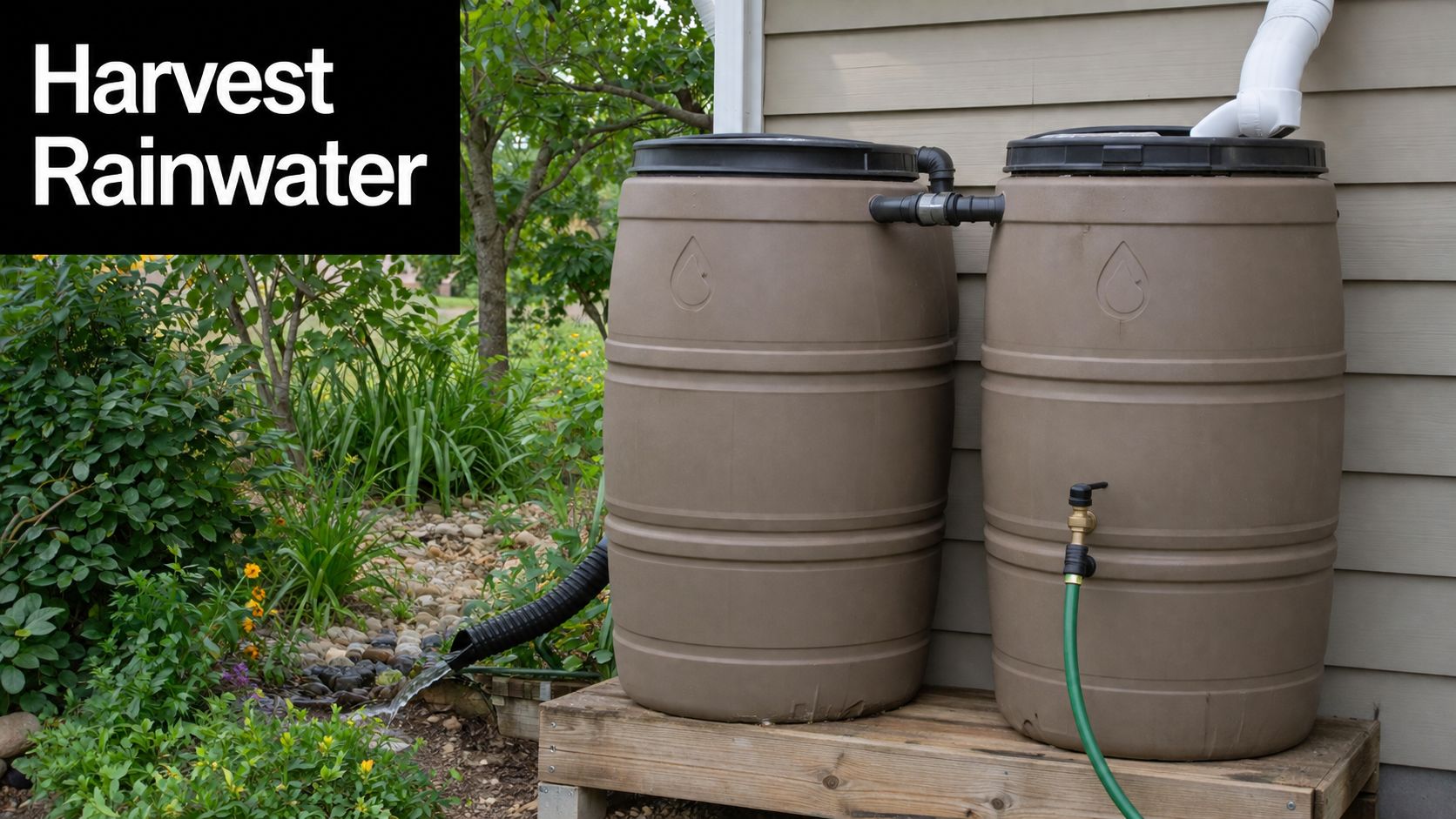
How to make a simple system useful
The best locations are near beds where you'll use the water. If the barrel sits far from any planting area, people stop using it. Screens help keep debris and mosquitoes out. A stable base matters more than many DIY installers expect, because a full barrel gets heavy fast.
Overflow planning is just as important as storage. During a strong storm, the excess needs somewhere to go. That could be a splash block, a controlled discharge area, or a rain garden that accepts the overflow without flooding the foundation.
A practical primer on gutter and runoff handling is this Vancouver downspout installation guide, which is useful for understanding flow paths even outside that local market.
Where homeowners get frustrated
The most common disappointment is assuming a barrel will dramatically change the whole yard. It won't. What it does well is capture part of the roof runoff and provide free irrigation water for targeted areas. As part of a broader system with mulch, drip irrigation, and drainage planning, it's worthwhile. On its own, it's a modest tool.
9. Reducing Turf Grass and Lawn Areas
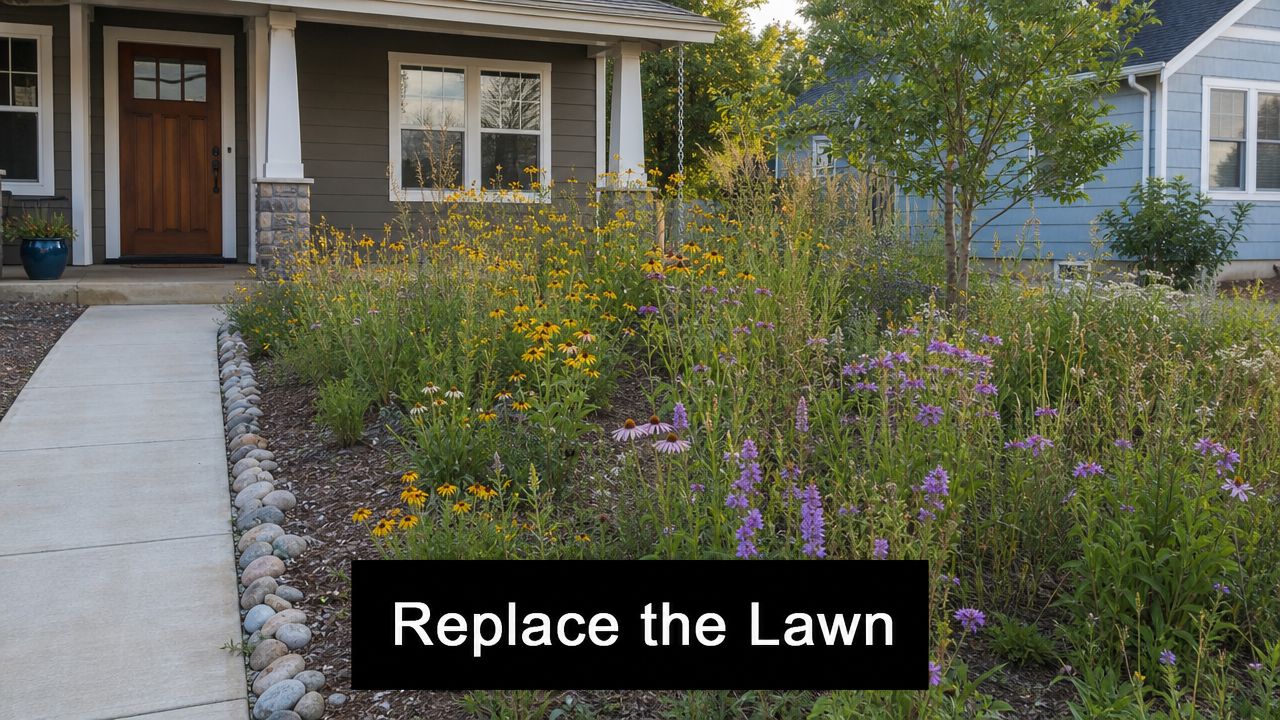
This is one of the most effective water conservation landscaping ideas because turf is usually the biggest demand in the yard. It also tends to be the least questioned. Homeowners keep grass in places nobody plays, nobody sees much, and nobody enjoys maintaining.
The smarter approach is to keep turf where it performs a job. That might be the backyard play area, the front entry view, or a clean patch near a patio. Outside those functional zones, beds, native plantings, pollinator gardens, gravel transitions, or permeable spaces often make more sense.
The measurable case for reducing lawn
Water-conserving outdoor designs such as xeriscapes achieve long-term water savings of 50% or more and can reduce maintenance costs by up to 30%, according to a landscape water use efficiency summary from Rancho Water. The same summary notes that homes in the Florida-Friendly Landscaping program used 50% less irrigation water annually than conventionally planted homes, with the strongest examples reaching 76% compared with high-quality turfgrass areas.
Those are compelling results, but the local lesson is simple. The less unnecessary lawn you maintain, the less water, mowing, fertilizing, and repair work you're signing up for.
What looks good and what doesn't
Good lawn reduction still needs structure. Crisp edging, repeated plant masses, and deliberate transitions keep the yard from looking abandoned. The worst conversions are the ones where turf is removed in random patches with no visual plan.
A few reliable replacements include:
- Pollinator beds: Best in sunny front or side yard zones.
- Native meadow sections: Better in larger, lower-traffic spaces.
- Sedges in shade: A better answer than forcing dense grass under trees.
- Mulched shrub islands: Useful where mowing is awkward and turf always struggles.
The goal isn't “no lawn” for everyone. It's “less lawn, used well.”
10. French Drains and Erosion Control
Homeowners don't always think of drainage work as part of water conservation landscaping, but in West Tennessee it absolutely is. If runoff strips mulch, exposes roots, saturates beds, or sends water toward the house, you aren't conserving anything. You're losing water control.
French drains solve a specific problem. They intercept and redirect water moving through or across the soil. They are especially useful along foundations, in side yards, at the base of slopes, or anywhere water repeatedly collects below the surface. Erosion control handles the companion issue by stabilizing the soil so water doesn't carry it away.
Why drainage belongs in the plan
This region's challenge isn't only drought. It's the swing between dry spells and heavy rain. That's why a full outdoor design plan has to account for both. A French drain can move excess water away from a soggy zone, while rain gardens, plant beds, and soil improvements help the property absorb and use water in better places.
Slope matters, outlet location matters, and filter fabric matters. A drain installed without enough fall or without a protected outlet often clogs or underperforms. Erosion control has the same issue. If you stabilize only the visible bare patch but ignore the water source above it, the damage comes back.
For slope-specific guidance, Lawn & Leaf Solutions explains practical approaches in their article on how to prevent soil erosion on slopes.
What professionals look for first
Before recommending a French drain, experienced crews trace where the water starts, where it travels, and where it can safely exit. That sounds obvious, but many failed DIY systems skip that step.
Water should leave your yard in a controlled way. It shouldn't be trapped beside the house, dumped onto a neighbor, or sent across bare soil that erodes after every storm.
French drains don't replace good grading, and grading doesn't replace every drain. On many West Tennessee properties, the best answer is both.
10 Water-Conserving Landscaping Ideas Compared
| Strategy | Implementation complexity | Resource requirements | Expected outcomes | Ideal use cases | Key advantages |
|---|---|---|---|---|---|
| Xeriscaping (Drought-Resistant Landscaping) | High, design, plant selection, phased installation | Moderate–high initial cost; native plants, mulch, smart irrigation, design time | 50–75% outdoor water reduction; lower long‑term maintenance; improved curb appeal | Homeowners seeking permanent water reduction and attractive, low‑maintenance yards | Large water savings, reduced mowing, native habitat, long‑term cost savings |
| Drip Irrigation Systems | Medium, layout, emitter placement, filtration, winterization | Moderate cost; tubing, emitters, filters, controllers; routine maintenance to prevent clogging | 30–50% water reduction for plantings; precise root‑zone watering, improved plant health | Flower beds, vegetable gardens, shrub borders, slopes and irregular beds | Efficient water delivery, reduced evaporation, custom zonation |
| Rain Gardens and Bioretention Areas | Medium–high, site assessment, excavation, engineered soils | Moderate cost; native plants, amended soil, possible underdrain, excavation | Captures/infiltrates 90%+ of contributing runoff; reduces flooding and filters pollutants | Properties with drainage or runoff problems; downspout discharge areas | Stormwater control, pollutant filtration, groundwater recharge, habitat support |
| Native Plant Selection and Replacement | Low–medium, species selection and phased planting | Low–moderate; sourcing natives, initial irrigation during establishment | Eliminates supplemental irrigation after 2–3 years; supports pollinators and soil health | Long‑term conservation, low‑maintenance landscapes, ecological restoration | No ongoing irrigation, pest resistance, biodiversity and ecosystem benefits |
| Mulching and Soil Amendments | Low, application and annual replenishment | Low cost; organic mulch, compost, labor for application | 25–50% reduced watering frequency; 50–70% reduction in soil evaporation; improved soil structure | All landscape types, especially clay soils and mulched beds | Low cost, quick benefits, weed suppression, improved moisture retention |
| Permeable Paving and Hardscaping | High, engineering, proper base, professional installation | High initial cost; specialized materials, base aggregate, periodic cleaning | Eliminates ~90% runoff from treated surfaces; recharges groundwater; reduces ponding | Driveways, patios, walkways, properties replacing impermeable surfaces | Major runoff reduction, pollutant filtration, durable attractive surfaces |
| Smart Irrigation Controllers and Timers | Low–medium, install and configure, sensor calibration | Moderate cost ($200–$800+); Wi‑Fi or cellular, sensors, occasional maintenance | 20–40% irrigation water reduction; automated weather‑aware adjustments | Existing sprinkler systems; homeowners seeking immediate, automated savings | Automated, data‑driven watering; remote control; prevents overwatering |
| Rainwater Harvesting Systems | Low–high, simple barrels to complex cisterns | Variable cost ($100–$3,000+); barrels/cisterns, diverters, filters, storage space | Captures ~0.6 gal/sqft/in rainfall; supplements irrigation and reduces runoff | Properties with sufficient roof area; supplementing irrigation during dry periods | Free stored water, scalable systems, reduces municipal demand |
| Reducing Turf Grass and Lawn Areas | Medium, design, phased conversion, possible permitting/HOA review | Moderate initial cost for conversion; native plants, hardscaping, seed/plug costs | 50–80% water reduction for converted areas; lower mowing and input needs | Large or underused lawns; homeowners wanting biodiversity and low maintenance | Significant water and maintenance savings, increased biodiversity, lower emissions |
| French Drains and Erosion Control | Medium–high, site assessment, trenching, outlet design | Moderate–high cost; perforated pipe, gravel, geotextile, excavation; periodic inspection | Reduces standing water, prevents erosion and basement seepage; protects structures | Properties with poor drainage, slope erosion, or foundation seepage | Effective subsurface drainage, slope stabilization, integrates with green infrastructure |
Build Your Resilient West Tennessee Landscape Today
A water-wise design isn't a collection of trendy upgrades. It's a coordinated system. Soil holds moisture. Mulch slows evaporation. Plants match the site. Irrigation delivers water precisely. Drainage moves excess water away before it becomes damage. When those parts work together, the yard looks better and asks less from you.
That systems approach matters even more in West Tennessee than it does in drier regions. Here, the problem usually isn't just lack of water. It's uneven water. One part of the property bakes in summer sun while another stays wet after every storm. One bed drains well while another sits on tight clay. That's why generic advice often falls short. You need a plan that treats drought stress, runoff, and drainage as connected issues.
The good news is you don't have to rebuild the entire yard at once. In fact, phased projects usually produce better decisions. Start with the biggest pain point. If water stands near the house, fix drainage first. If beds dry out too fast, improve the soil and mulch. If your irrigation is wasteful, upgrade the zones or switch key beds to drip. If you have a large area of lawn nobody uses, convert that section into something more attractive and less demanding.
That order matters. Homeowners sometimes start with plants because plants are the visible part. But the hidden work often determines whether those plants succeed. A redbud planted in the wrong drainage zone will struggle no matter how good it looked at the nursery. A rain barrel without overflow planning can create a muddy mess. A smart controller won't rescue a badly mapped sprinkler system. The outdoor design has to function before it shines.
Lawn & Leaf Solutions brings that practical perspective to every project. With over 18 years of hands-on experience in Jackson and West Tennessee, the team understands how local soils, grades, rainfall patterns, and maintenance realities affect performance over time. That includes the visible improvements homeowners want, such as mulching, bed design, native planting, and turf upgrades. It also includes the structural work many properties need, such as French drains, channel drains, erosion control, and custom water-management solutions.
If you're not sure where to begin, start small and strategic. A mulched native bed near the front walk can cut maintenance and improve curb appeal. A rain garden can turn a problem downspout area into a feature. A French drain can protect your foundation and make the rest of the grounds more usable. One smart project often reveals what the property needs next.
A resilient yard should do more than survive the season. It should handle a dry spell without constant watering, handle a storm without turning into a swamp, and still look like a place you want to spend time in. That's the standard worth aiming for.
If your yard stays too wet, dries out too fast, or costs too much time and water to maintain, Lawn & Leaf Solutions can help you build a smarter outdoor space. From drainage corrections and French drains to mulching, planting, irrigation planning, and full outdoor improvements, the team delivers practical solutions designed for West Tennessee properties. Request your free, no-obligation estimate and get a yard that looks better, functions better, and works with your property instead of against it.