
A hard rain in Jackson can turn a normal backyard into a mess in one afternoon. You look out the window, and the mulch you spread last weekend is halfway down the hill. Red clay is smeared across the sidewalk. Water is cutting a fresh path toward the driveway, the patio, or worse, the foundation.
That's the moment most homeowners start searching for how to prevent soil erosion on slopes. The good news is that slope erosion usually can be fixed. The bad news is that the wrong fix often makes it worse, especially in West Tennessee where clay soil seals up fast, sheds water, and gets slick when saturated.
I've seen the same pattern over and over on local properties. People reseed without fixing runoff. They throw straw on a bare bank with no anchoring. They plant a few shrubs on a slope that really needs drainage and grade correction first. Then the next storm undoes the work.
A better approach starts with diagnosing the slope, matching the solution to the grade, and deciding early whether the job is a simple yard project or a structural one. If your yard is already showing washouts, exposed roots, or muddy runoff after storms, this guide will help you sort out what works, what doesn't, and when it makes sense to bring in professional help. If you're dealing with active runoff around the house, this guide on how to stop yard erosion is also a useful starting point.
Your West Tennessee Yard Doesn't Have to Wash Away
One of the most common local scenarios goes like this. A homeowner buys a house with a backyard slope that looks manageable in dry weather. Then spring storms hit, and the yard starts changing fast. The topsoil thins out, seed washes away, and little channels appear in the bank where there used to be a smooth grade.
That happens because West Tennessee red clay behaves differently than loose garden soil. When it's dry, it can get hard and compacted. When it gets saturated, water often runs over the surface instead of soaking in cleanly. On a slope, that runoff gains speed and starts carrying soil with it.
The encouraging part is that erosion is usually a water-management problem first and a planting problem second. Once you slow water down, spread it out, and give roots a chance to hold the soil, the slope becomes far more stable. Effective erosion control strategies can reduce soil loss by up to 90% when they're properly installed, according to this overview of effective methods for preventing soil erosion.
What homeowners usually get wrong
Most failed DIY fixes come from using a single method on a problem that needs layers.
- Seed without protection. Seed on bare clay usually doesn't stay put in a hard rain.
- Mulch without drainage. Mulch helps, but it won't solve concentrated runoff.
- Retaining wall without outlet planning. A wall that traps water can create a bigger failure later.
- Decorative rock only. Rock can help in channels and outlets, but rock over unstable soil isn't a full system.
Practical rule: If water is moving fast enough to carve a line in the slope, plants alone probably won't solve it.
What a durable fix looks like
A good slope repair usually combines several pieces at once. That might mean regrading the surface, correcting drainage at the top, applying mulch or blankets for temporary protection, and establishing grass or groundcover for long-term hold.
On some yards, the answer is simple. On others, especially where runoff is pointed toward the house or the bank is steep, the right plan includes drains, terraces, or retaining features. The slope doesn't have to stay in a cycle of wash, patch, and wash again.
How to Assess Your Slope's Erosion Risk
Before you buy anything, figure out what kind of erosion you have. A lot of homeowners treat every slope problem the same, but a lightly thinning lawn bank and a failing embankment are not the same job.

Start by looking for the type of damage
Walk the slope after a good rain, not during a dry stretch. You want to see how water is moving.
Here's the simple field version:
- Sheet erosion. Soil is washing off in a thin layer. You may notice bare spots, exposed roots, or mulch that keeps migrating downhill.
- Rill erosion. Small channels are starting to form. These are early warning signs that runoff is concentrating.
- Gully erosion. Larger cuts or washouts are visible. At this stage, the slope often needs grading, drainage correction, and possibly structural support.
If the bottom of the slope stays muddy while the upper part turns hard and bare, that usually means runoff is carrying sediment downhill and depositing it lower on the property. In red clay, this can happen quickly because surface sealing pushes water to run across the bank rather than into it.
Measure the slope with basic tools
You don't need survey equipment for a first pass. Use a string, two stakes, and a level.
- Drive one stake into the top of the slope and one into the bottom.
- Tie a string to the uphill stake.
- Pull the string level to the downhill stake and use a level to make sure it's flat.
- Measure the vertical drop from the string down to the ground at the lower stake.
- Measure the horizontal distance between stakes.
That gives you a practical sense of whether your yard is gentle, moderate, or steep. For planning purposes, slope category matters because solutions change fast as grade increases. On slopes between 25% and 50%, a combination of plant systems, erosion blankets, and drip irrigation is necessary, while slopes above 50% often need deep-rooted shrubs plus structural support like retaining walls or geocells, as noted in guidance on preventing soil erosion on steep slopes.
Check where the water starts
Many homeowners focus on the middle of the bank because that's where the damage is visible. The actual problem is often uphill.
Look for these triggers:
- Downspouts dumping near the slope edge
- Driveway runoff entering one concentrated spot
- Roof water crossing lawn areas before reaching the slope
- Low spots that overflow during heavy rain
- Neighboring grade that pushes water onto your lot
If you can trace muddy water to one entry point, you've found a major part of the problem. That's why drainage correction usually comes before planting. If you want a clearer idea of how water should be redirected across a property, this guide on grading a yard for drainage is worth reviewing.
A slope rarely fails for no reason. Water gets concentrated first, then the soil starts moving.
Use this quick decision table
| What you see | What it usually means | First move |
|---|---|---|
| Thin bare spots and minor soil loss | Early-stage surface erosion | Improve cover, mulch, and water control |
| Small channels after storms | Runoff is concentrating | Correct drainage path and stabilize surface |
| Deep washouts or undermining | Advanced erosion | Consider grading, drains, and structural help |
| Soggy clay that slumps | Saturation problem | Move water off the slope before replanting |
| Erosion near patio, walk, or foundation | Property risk | Treat as drainage and protection issue, not just a lawn issue |
Pay attention to warning signs near the house
Some slopes are mostly cosmetic. Others can affect hardscapes, fence posts, sheds, and foundations. If erosion is exposing footing edges, washing under a walkway, or sending water toward the home, don't treat it like a simple reseeding project.
In West Tennessee, clay expansion and contraction can add stress when water repeatedly soaks one zone and leaves another dry. Uneven moisture around structures is a problem all by itself. When you see both erosion and drainage trouble together, the repair needs to address both.
Your Toolbox of Erosion Control Solutions
A Jackson slope usually fails in a predictable order. First the rain starts cutting paths through bare soil. Then the red clay seals over, water runs faster, and the bank gets harder to plant. After that, seed, straw, or a few shrubs will not keep up unless the water is controlled.
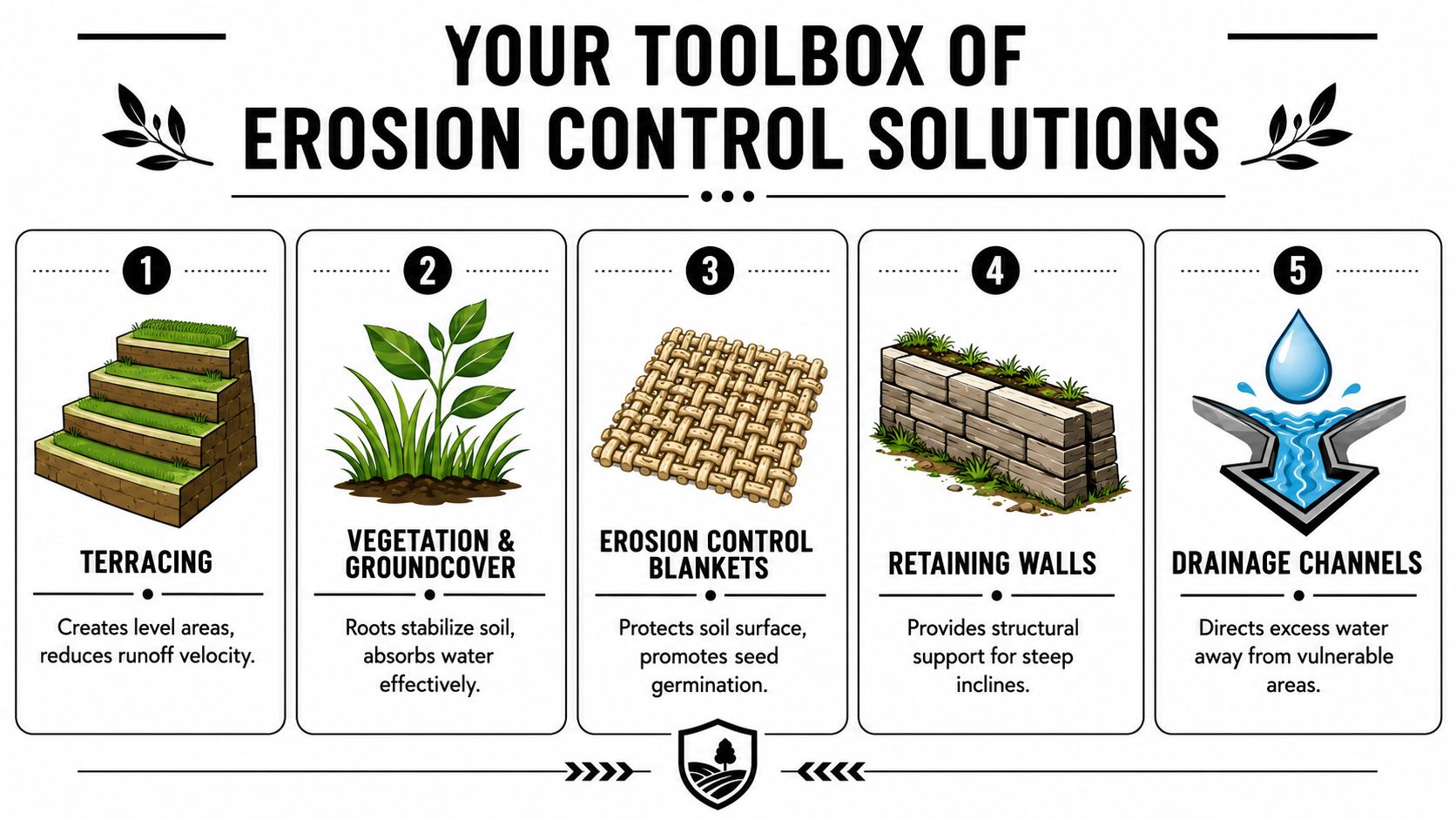
The fix is usually a combination of tools, not a single product. One part slows or redirects water. One part protects exposed soil right away. One part gives the slope enough roots or structure to hold through our hard spring and summer storms.
Vegetation that actually holds a slope
Plants can do real work on a slope, but only if they can get established before the next washout. Guidance on erosion control for steep slopes and embankments notes that partial plant cover can cut erosion significantly. That lines up with what I see here. You do not need a fully mature slope before you start getting benefit, but you do need quick cover and decent root contact with the soil.
On West Tennessee clay, that usually means some prep first. If the bank is baked hard and slick, seed sits there until the first heavy rain carries it off. Loosen the surface, add organic matter where you can, and choose plants that tolerate clay and runoff.
Vegetation works best when:
- The slope is mild to moderate
- Runoff is spread across the surface instead of concentrated in one channel
- The soil has been loosened enough for rooting
- You can protect seed or plugs during establishment
For many yards, turf or low groundcover is enough on easier grades. Mixed planting usually holds better on harder banks. Shrubs with deeper roots can help on steeper areas, but they are support, not a substitute for drainage control.
Common mistakes on local slopes:
- Seeding straight into compacted red clay
- Using ornamental spacing that leaves too much bare dirt
- Planting right ahead of a storm system
- Assuming roots will solve a slope that is still taking concentrated runoff from above
Mulch and erosion blankets for immediate cover
Freshly exposed soil needs cover right away. Waiting on plants alone is how a repair turns into another cleanup job.
Mulch helps on lighter slopes and around new planting. Straw, wood fines, and compost can soften rainfall and reduce crusting. The problem is simple. Loose mulch on a steeper clay bank often ends up at the toe of the slope after one storm.
That is where blankets earn their cost. On banks that are already eroding, or on jobs timed during a wet stretch, blankets hold seed and soil in place long enough for roots to take over. The details matter. If the blanket is not trenched, overlapped, and pinned correctly, water can get under it and peel it back.
Use mulch when:
- The slope is relatively gentle
- Runoff is light and spread out
- You need cover around seed or new plants
Use blankets when:
- The slope is steep enough that mulch will slide
- The soil is already washing
- You need immediate surface protection
- You are seeding during a rainy period
DIY can make sense here on a small bank. On a long or steep slope, paying for proper blanket installation is often cheaper than reseeding twice.
Structural options for slopes that keep moving
Some banks need more than surface cover. If the slope is long, steep, or slumping in sections, structural work may be the only repair that lasts.
Terracing
Terracing breaks a long run into shorter sections so water loses speed before it gains enough force to cut channels. It also creates flatter planting areas, which helps on yards that are hard to mow or impossible to use.
The trade-off is labor and layout. Terraces need room, careful grading, and a place for overflow to go. If water gets trapped behind them, the clay stays wet and heavy, and the slope can still fail.
Retaining walls
A retaining wall is the right tool when the bank needs support, not just cover. This comes up on narrow side yards, steep drop-offs, and spots where erosion is threatening a driveway, patio, steps, or fence line.
A true retaining wall is an engineered build, even when it looks simple from the yard. Base prep, backfill stone, drainage, and wall height all affect whether it lasts. For homeowners comparing systems, this guide to retaining wall installation step by step shows the parts that matter.
If the grade is severe or the build affects drainage near structures, it also helps to review how sloping block construction specialists approach difficult sites. The soil and codes are different there, but the planning logic carries over.
Riprap and stone armoring
Rock works well in the right place. I use it most often where water is supposed to move, such as swales, discharge points, and channel bottoms.
Stone fails when it is used as a cover-up. If water is still cutting under the rock or around the edges, the washout just changes shape. Filter fabric, correct sizing, grade control, and a stable outlet all matter.
Drainage usually decides whether the repair lasts
The success or failure of many slope projects depends on this critical factor. On Jackson properties, the red clay can shed water fast once the surface seals up. A nice planting plan will still fail if roof water, driveway runoff, or uphill drainage keeps crossing the same bank.
The goal is to intercept water before it picks up speed and send it somewhere safe. Depending on the yard, that might mean:
- French drains for collected or shallow subsurface water
- Channel drains where concrete or asphalt sheds water toward the slope
- Swales that redirect surface flow without cutting the bank
- Downspout extensions that keep roof water out of the problem area
- Protected outlets so the fix does not create a new washout lower down
On many local slopes, the better system looks like this:
| Slope condition | Weak fix | Better fix |
|---|---|---|
| Mild bare bank | Seed only | Seed, mulch, and runoff control |
| Moderate bank with channels | More mulch | Drainage correction, blanket, and planting |
| Steep clay slope | Shrubs only | Drainage, blankets, deeper-rooted planting, possible wall |
| Slope below downspout | Decorative rock | Redirect roof water first, then stabilize |
| Washout near structure | Repeated patching | Regrading and controlled drainage path |
Lawn & Leaf Solutions handles this kind of work by combining drainage installs with slope stabilization. That approach fits a lot of West Tennessee yards better than a one-step fix.
What works, and what wastes money
Homeowners usually save money by matching the fix to the slope early.
Usually worth doing
- Fix the water source before replanting
- Cover bare soil immediately
- Use temporary protection and long-term rooting together
- Match the method to the slope's steepness and runoff pattern
- Check where the water exits, not just where the soil is missing
Usually a waste of time
- Throwing seed on hard clay and hoping for a gentle week
- Using geotextile fabric on an exposed slope as if it were erosion control
- Adding decorative stone without correcting runoff
- Planting sparse shrubs into active washouts
- Patching the same spot after every storm
For a small, mild slope, DIY seed, mulch, and drainage correction can be enough. For a steep clay bank or anything near a structure, hiring a local crew often costs less than redoing a failed repair.
Planning Your Project Costs Permits and Professional Help
Most homeowners don't need another list of slope solutions. They need to know what they're getting into. How much can be handled with seed, mulch, and labor? When does it become a drainage job or a wall job? And when is DIY likely to fail?
The price gap between light repair and structural work
There's a wide cost spread because “slope repair” covers everything from surface stabilization to retaining construction. For a 1,000 sq ft slope, DIY mulch and seed might cost $200 to $500, while professionally installed terraces or retaining walls can run $2,000 to $5,000 according to this discussion of ways to prevent erosion on a slope.
That range makes sense in the field. Surface treatments use lower-cost materials but depend heavily on correct timing and conditions. Structural work costs more because it includes excavation, base prep, drainage details, hauling, and labor that can't be skipped.
Why cheap fixes get expensive
The low upfront cost of DIY can be real. So can the cost of failure.
The same source notes that professional installation can reduce failure rates on steep slopes from 40% in DIY projects to under 10% when the work is done correctly in high-risk situations. That matters most when erosion is affecting a foundation area, pushing water toward the home, or undermining hardscape.
A failed slope repair costs more than the first repair because you pay twice. First for the materials, then for the cleanup and the real fix.
A practical DIY versus pro breakdown
| Situation | DIY may be reasonable | Call a pro sooner |
|---|---|---|
| Light sheet erosion | Yes | If water is entering from multiple sources |
| Newly bare mild slope | Yes | If the soil keeps washing after basic cover |
| Small planting project | Yes | If the bank stays saturated |
| Channeling or rills | Maybe | Usually, especially if runoff is concentrated |
| Gully erosion | Rarely | Yes |
| Near foundation or retaining feature | Cautious | Yes |
| Very steep clay bank | Limited | Usually yes |
For homeowners trying to budget drainage work specifically, this page on the cost of French drain installation helps frame where drainage fits into the overall project.
Permits and approvals in the Jackson area
Simple mulching, seeding, and planting usually don't raise permit issues. Structural work can. Retaining walls, major grade changes, drainage discharge changes, and work near easements or property lines may trigger city, county, HOA, or utility requirements.
Before you build anything substantial, check:
- Property line limits
- Utility locations
- Drainage easements
- Whether redirected water affects a neighboring lot
- Whether a wall or grade change needs approval
This is one reason steep-slope projects often benefit from professional planning. The visible erosion may be in your yard, but the runoff path can involve roof water, side yards, sidewalks, and adjacent grades.
When outside expertise becomes worth it
There's a point where you're no longer doing landscaping. You're solving a site problem. That's especially true on sloping lots where drainage and support systems interact.
If you want a broader perspective on how builders approach difficult grades, these sloping block construction specialists offer a useful example of how drainage, retaining, and site design need to work together on challenging terrain.
Here are the strongest signals that professional help is the smart choice:
- The slope is steep enough that you don't feel safe working on it
- Water runs toward the house or under a structure
- You already tried mulch and seed, and it failed
- The bank shows slumping, not just surface wash
- A wall, terrace, or drain outlet is part of the fix
- You can't tell where the water should go once you collect it
Many homeowners delay seeking professional advice because they assume every solution requires a major reconstruction. While that is true in some cases, the fix is often limited to intercepting water at the top of the grade and protecting the slope while vegetation establishes. The challenge lies in identifying the correct approach before spending money in the wrong place.
Long-Term Slope Maintenance and Protection
A repaired slope still needs attention. Not constant work, just regular observation. Most erosion systems fail gradually first. A clogged outlet, a bare patch, or a lifted blanket edge starts small and becomes obvious only after the next storm.

Protect plant cover during establishment
Vegetation does the long-term holding, but it needs time to take over. Plant roots bind soil particles together, and leaves and stems can reduce raindrop velocity by 50% to 80%, as noted earlier in guidance on steep slope practices. The same guidance also stresses that steep slopes should never be left bare because exposed soil accelerates erosion rapidly during heavy rain.
That principle matters most in the first establishment period. If grass is thin or new plantings haven't spread yet, the temporary cover still matters.
Use a simple maintenance routine
After every major rain, walk the slope and check the same areas.
- Top of slope. Look for new water entry points, especially from downspouts or paved surfaces.
- Middle of slope. Watch for fresh channels, exposed seed, blanket lift, or areas where mulch has thinned.
- Bottom of slope. Check for sediment buildup, soggy spots, or erosion where water exits.
- Drainage features. Remove debris from inlets, grates, and daylight outlets.
If you're fighting wet clay across the property, not just on the bank, improving subsoil movement can help. This guide on how to improve clay soil drainage gives a practical look at that side of the problem.
Don't judge a slope repair only by how it looks in dry weather. Judge it by what happens after the next hard storm.
Seasonal checks matter more than heavy intervention
Most of the time, you're not rebuilding anything. You're doing small corrections early.
In spring, inspect for storm damage and reseed weak spots quickly. In summer, make sure young plants are getting enough water to root well without overwatering the slope. In fall, clear leaves and debris that can block drains or smother new cover. In winter, pay attention to runoff patterns during wet periods when dormant growth leaves more soil exposed.
For walls, edging, stone channels, or riprap, inspect the edges. If water starts going around the feature instead of through it, erosion usually restarts at the sides first.
Frequently Asked Questions About Soil Erosion
Is straw mulch effective on a slope
Yes, if you use it for the right job. Straw helps shield bare soil from hard rain and slows surface wash long enough for seed to take hold. On a Jackson-area slope with red clay, that temporary cover can make a big difference after a storm.
It has limits. Straw will not fix water dumping from a downspout, a steep bank that is slipping, or runoff cutting a channel from the top of the hill. It works best on milder slopes and fresh seedbeds, especially when you tack it down so the first thunderstorm does not blow it into the neighbor's yard.
Can I just plant grass and call it done
Sometimes. If the slope is gentle, the water flow is light, and you prep the soil well, grass can hold fine.
On West Tennessee clay, grass fails when seed sits on a hard crust and water starts concentrating in one path. If you already see rills, muddy streaks, or exposed roots, grass alone is usually a cheap fix that turns into a second project.
What's the biggest mistake homeowners make
They treat the bare spot instead of the water source.
The problem is often a downspout, driveway edge, compacted clay surface, or grade break higher up the yard. I see this all the time around Jackson. A homeowner throws out seed and straw on the slope, then the next heavy rain sends the same runoff right through it.
That same pattern shows up with home maintenance in general. Small flow problems get expensive when they sit too long. This article on how regular plumbing maintenance saves money makes that point from another angle.
Are erosion blankets worth the money
Usually, yes. They cost more than seed and straw, but on steeper slopes they often save money because you are less likely to reseed after every hard rain.
They are especially useful on red clay banks that crust over fast. The catch is installation. If the blanket is loose, poorly trenched at the top, or not stapled tightly to the soil, water gets under it and lifts it.
For a small slope, DIY can make sense. For a larger bank or one near a driveway, foundation, or property line, paying a local crew is often cheaper than redoing a failed repair.
When should I stop trying DIY fixes
Stop and get help if any of these apply:
- The slope gets worse after each storm
- Soil is washing toward the house, driveway, sidewalk, or neighboring lot
- Small channels are turning into deeper cuts
- Your first seed-and-mulch repair already failed
- The fix may need regrading, a drain, or a retaining wall
At that stage, the job is not just about covering dirt. It is about controlling water, holding the soil in place, and keeping the repair from failing again.
Will rock solve erosion by itself
Rock works in specific spots. It is good at downspout outlets, drainage swales, splash areas, and places where water exits fast.
It is not a full-slope cure by itself. If the runoff is still too strong or the clay underneath stays soft, the stone can sink, spread, or wash out at the edges. I usually recommend rock as one part of the fix, not the whole fix.
What's the fastest way to stabilize a bare slope before a storm
Cover the soil and slow the water the same day. Straw mulch, an erosion blanket, or wattles can buy time. If runoff is pouring in from above, redirect that flow first.
Speed matters here. Bare red clay does not give you much margin once a heavy West Tennessee rain starts.
If the slope is already washing out, staying slick, or sending water where it should not go, Lawn & Leaf Solutions can inspect the site and tell you whether a DIY repair is still reasonable or whether grading, drainage, or structural work will cost less in the long run.