
For a lot of us here in Nashville, a retaining wall is much more than a simple garden accent. It's a critical piece of property protection. With Middle Tennessee’s signature rolling hills and heavy clay soil, a professionally built wall often moves from the “nice-to-have” list straight to the “must-have” column.
Why Retaining Walls Are a Nashville Necessity
Living in Nashville means you get to enjoy our beautiful, hilly terrain. The flip side is that those same slopes can cause major headaches for homeowners. Gravity is a constant, powerful force, and when you combine it with Tennessee’s frequent downpours, the land on your property is under relentless pressure. Without something to hold it back, that pressure usually leads to big problems.
Think of your sloped yard as a slow-moving river of soil. Every time we get a heavy rain, a little more of your property—valuable topsoil, expensive mulch, and carefully planted landscaping—gets washed downhill. It ends up on the sidewalk, in the street, or worse, pushed up against your home’s foundation. That’s soil erosion, and it’s the number one reason Nashville properties need the structural support a retaining wall provides.
Taming the Tennessee Terrain
A retaining wall is your best defense against this slow-motion landslide. It acts like a dam, strategically holding back the earth to solve several problems at once.
- Prevents Soil Erosion: A well-designed wall completely stops the gradual loss of your yard. It protects the investment you've made in your landscaping and keeps mud and debris off your driveway and out of city storm drains.
- Manages Water Runoff: When built with a proper drainage system (and this is key), a retaining wall can redirect rainwater safely away from your house, preventing a flooded basement and other expensive water damage.
- Creates Usable Space: This is one of the best benefits. A wall can turn a steep, unusable hill into beautiful, functional tiers. Suddenly you have a flat spot for a patio, a garden, or a safe play area for the kids.
- Protects Your Foundation: By stabilizing the soil, a retaining wall relieves the immense hydrostatic pressure that can build up against your foundation. This is a leading cause of foundation cracks and serious structural issues.
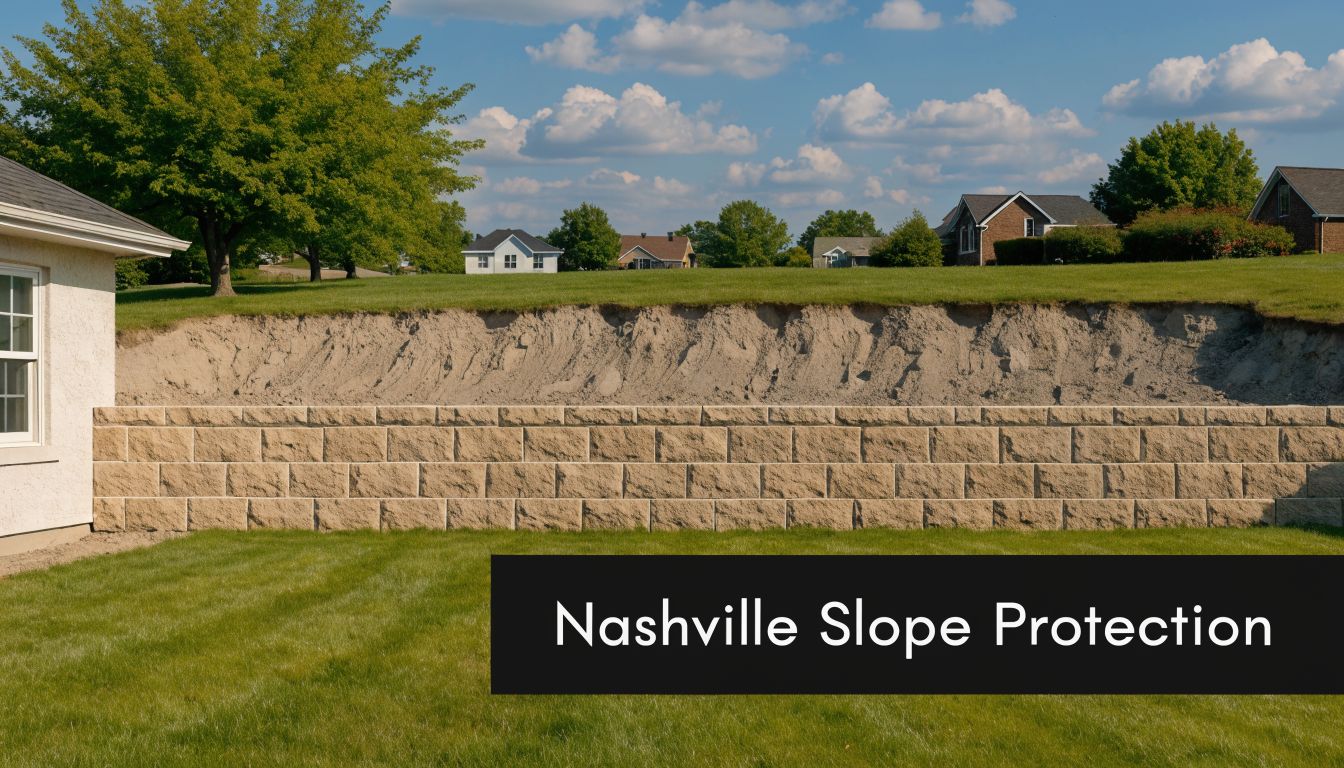
A History of Holding Back the Hills
The need for strong retaining structures is woven into Nashville’s history. It's a cool piece of local trivia, but Centennial Park actually contains some of the earliest reinforced concrete retaining walls and bridges in the entire South, dating all the way back to 1906-1910. The fact that they're still standing over a century later is a testament to what expert engineering can achieve against Tennessee's challenging geology.
A professionally installed retaining wall is a long-term solution for safeguarding your property. It's an investment in stability, usability, and the overall value of your Nashville home.
At the end of the day, a retaining wall isn't a passive feature; it's an active defense for your property. It’s a workhorse solution that transforms a difficult landscape into a safe, beautiful, and valuable asset. If your yard is dealing with slopes and washouts, it’s time to think about a permanent fix. You can learn more about how to stop yard erosion and what your options are.
Learn how to stop yard erosion with effective strategies
A Nashville Homeowner's Guide to Retaining Wall Materials
Deciding on the right material for your retaining wall is one of the biggest choices you'll make. It’s about more than just looks; it's a long-term investment that has to stand up to Nashville’s specific climate—from our hot, humid summers to the occasional freeze-thaw cycle in winter.
Think of it this way: you’re choosing the foundation of your new landscape. The material you pick will dictate the wall's strength, its lifespan, and how well it blends with the style of your home. Let's walk through the most common options we see here in Middle Tennessee so you can find the perfect fit.
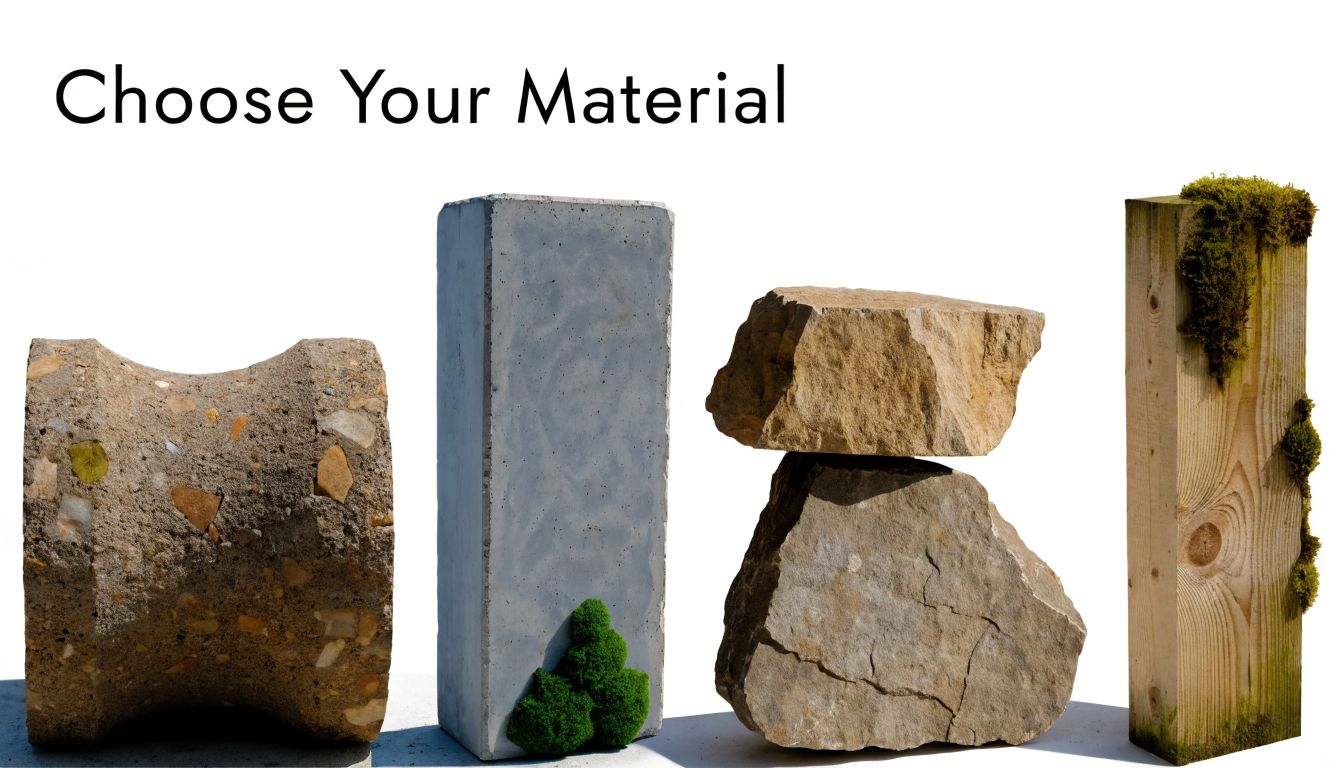
Segmental Concrete Blocks: The All-Around Champion
There’s a reason interlocking concrete blocks are the most popular choice for building retaining walls in Nashville, TN. Think of them as the LEGOs of the hardscaping world. These engineered blocks are designed to lock together, creating a remarkably strong wall that has just enough flexibility to handle the natural shifting and settling of our clay soil.
Because they are factory-made, they offer incredible consistency. You get a huge variety of colors, textures, and sizes, making it easy to match any home style, from a modern build in The Gulch to a classic brick home in Belle Meade. They truly are the perfect blend of performance, style, and value.
Poured Concrete: The Heavy-Duty Solution
When you need uncompromising strength, nothing beats poured concrete. This isn't just a wall; it's a solid, monolithic structure reinforced with steel rebar, much like a dam or a commercial foundation. We recommend this approach for very high walls or properties dealing with serious soil pressure and water runoff.
While a plain concrete finish can look a bit industrial, many people use it as a powerful structural core that can be dressed up later. You can apply all sorts of attractive finishes, with options like natural stone cladding for residential projects giving you a high-end look without compromising on brute strength.
For projects that absolutely cannot fail, a professionally engineered poured concrete wall provides a level of permanence that other materials just can't touch. It’s a true lifetime solution.
Natural Stone: Timeless Tennessee Beauty
If you want a wall that looks like it was always meant to be part of the Tennessee landscape, natural stone is the only way to go. Every piece of Tennessee fieldstone, limestone, or granite is unique, creating a one-of-a-kind feature with unmatched character and organic beauty.
Building with natural stone is a craft, though. It’s far more labor-intensive than using uniform blocks and requires a skilled mason who knows how to fit all those irregular shapes into a stable, interlocking pattern. The initial cost is higher, but the result is a breathtaking wall that adds significant curb appeal and property value.
Treated Timber: A Rustic and Budget-Friendly Choice
Pressure-treated wood or railroad ties can create a warm, rustic look, and their lower upfront cost makes them an attractive option for certain projects. They work well for smaller, decorative garden walls or in landscapes where you want a more natural, woodland feel.
However, you have to be realistic about wood in our climate. Nashville's humidity and heavy rains mean that even treated timber is vulnerable to rot and insects. A timber wall here typically has a much shorter lifespan—usually 10 to 20 years—compared to stone or concrete. To get the most out of it, proper drainage and installation are absolutely critical from day one.
Choosing your material is a huge first step. For a quick reference, the table below breaks down the key differences to help you weigh your options for our local area.
Retaining Wall Material Comparison for Nashville Properties
| Material | Average Cost per Sq. Ft. | Typical Lifespan | Best For |
|---|---|---|---|
| Segmental Concrete Blocks | $40 – $70 | 50-100+ Years | Versatile use, DIY-friendly for smaller walls, wide style variety. |
| Poured Concrete | $55 – $90 | 100+ Years | Maximum strength, tall walls, severe erosion control. |
| Natural Stone | $60 – $110 | 100+ Years | High-end aesthetics, timeless appeal, boosting property value. |
| Treated Timber | $25 – $50 | 10-20 Years | Budget-conscious projects, low walls, rustic/natural look. |
Ultimately, the best choice balances your budget, your property's needs, and the look you want to achieve. Each material has its place in creating beautiful, functional outdoor spaces.
You can get more ideas for transforming your yard in our complete guide to landscaping in Tennessee.
Navigating Retaining Wall Costs and Permits in Nashville
For most homeowners here in Nashville, any big landscape project boils down to two key questions: "How much will this actually cost?" and "What are the rules?" When you're talking about retaining walls, the answers to both are completely connected. The final price and the legal hoops you need to jump through depend entirely on the size, materials, and complexity of your wall.
Getting a handle on these factors is the first step. It helps you build a real-world budget and ensures your project is safe, legal, and built to last. Let's break down what really drives the cost and when you need to get city officials involved.
Decoding the Price of Your Retaining Wall
There's no simple, flat-rate price for a retaining wall. The final number is a sum of its parts, and each project is unique. Think of it less like buying something off the shelf and more like commissioning a custom piece of furniture—the size, the wood you choose, and the intricacy of the design all shape the final cost.
Here’s what you can expect to influence the price of a retaining wall in the Nashville area:
- Wall Size (Height and Length): This is the big one. The total square footage of your wall's face is the single largest cost driver. Taller, longer walls don't just use more material; they require significantly more labor, deeper excavation, and beefier engineering to handle the load.
- Material Choice: As we covered earlier, your choice of material makes a huge difference. Treated timber is often the most budget-friendly option, while natural stone is a premium, long-term investment. Segmental concrete blocks are that popular sweet spot right in the middle for many folks.
- Site Accessibility: How easy is it to get to your backyard? If we can roll in a mini-excavator without a problem, things move quickly. But a steep lot or a tight space might mean more work by hand, which adds time and, naturally, cost.
- Engineering and Drainage: This is where you absolutely cannot cut corners, especially for structural walls. The cost includes a proper footing, clean gravel backfill, perforated drainage pipes, and geogrid fabric for reinforcement. These are the critical components that keep a wall from failing under pressure.
Building a reliable retaining wall in Tennessee isn't cheap, but the numbers reveal why skimping can cost you dearly. Residential projects typically range from $50 to $80 per square foot, factoring in materials, site access, and essential drainage features—yet a well-constructed segmental wall can endure 30+ years with proper care. Many experts note that Middle Tennessee's steep slopes demand these 'hidden heroes' to combat erosion. Discover more about how professionals view the importance of walls in the local landscape on PuryearFarms.com.
Proper drainage is the number one defense against the immense force of water pressure, so it’s a huge part of the overall cost. To get a better sense of how these systems work, you can check out our guide on French drain installation costs.
When a Permit Becomes Mandatory
Alright, let's talk rules. Here in Nashville and across Davidson County, the regulations for retaining walls are straightforward and exist for one reason: safety. A small, two-foot-high decorative wall in your garden likely won't need any paperwork. But once that wall starts getting taller, the city needs to get involved.
The magic number is four feet.
Any retaining wall that measures four feet or taller—measured from the bottom of the footing to the very top of the wall—requires a building permit. This isn't just some arbitrary rule. It's based on pure physics. As a wall's height increases, the lateral pressure from the soil behind it grows exponentially. A four-foot wall has to fight against immensely more force than a simple two-foot garden wall.
Getting that permit means submitting detailed plans for a formal review to prove they meet local building codes. When thinking about permits, it’s always a good idea to know the codes. You can learn more from this essential guide for luxury custom homes.
A professional contractor will handle this entire process for you, from drafting the engineered plans to coordinating with city inspectors. This is honestly one of the biggest reasons to hire an experienced crew. We know the local codes inside and out and make sure your project is compliant from day one, saving you from potential fines or—even worse—a tear-down order later. For any wall even approaching that four-foot mark, professional guidance isn't just a good idea; it's a must.
How Drainage and Engineering Prevent Wall Failure
A retaining wall might look simple from the outside, but its real strength lies in what you can't see. Most people think walls fail because the ground pushes them over. The real culprit? Water. When water gets trapped in the soil behind a wall, it creates an immense force called hydrostatic pressure, and that’s what can bring even the sturdiest-looking wall tumbling down.
Think of it like a dam holding back a lake. If there’s no spillway, the water keeps rising until the pressure gets to be too much. That’s why any professionally built retaining wall is designed with its own "spillway" system. It's all about giving water an escape route.
This whole process—from design to drainage—has a big impact on your project's budget and timeline. The infographic below gives you a clear picture of how costs, permits, and engineering requirements all fit together here in Nashville.
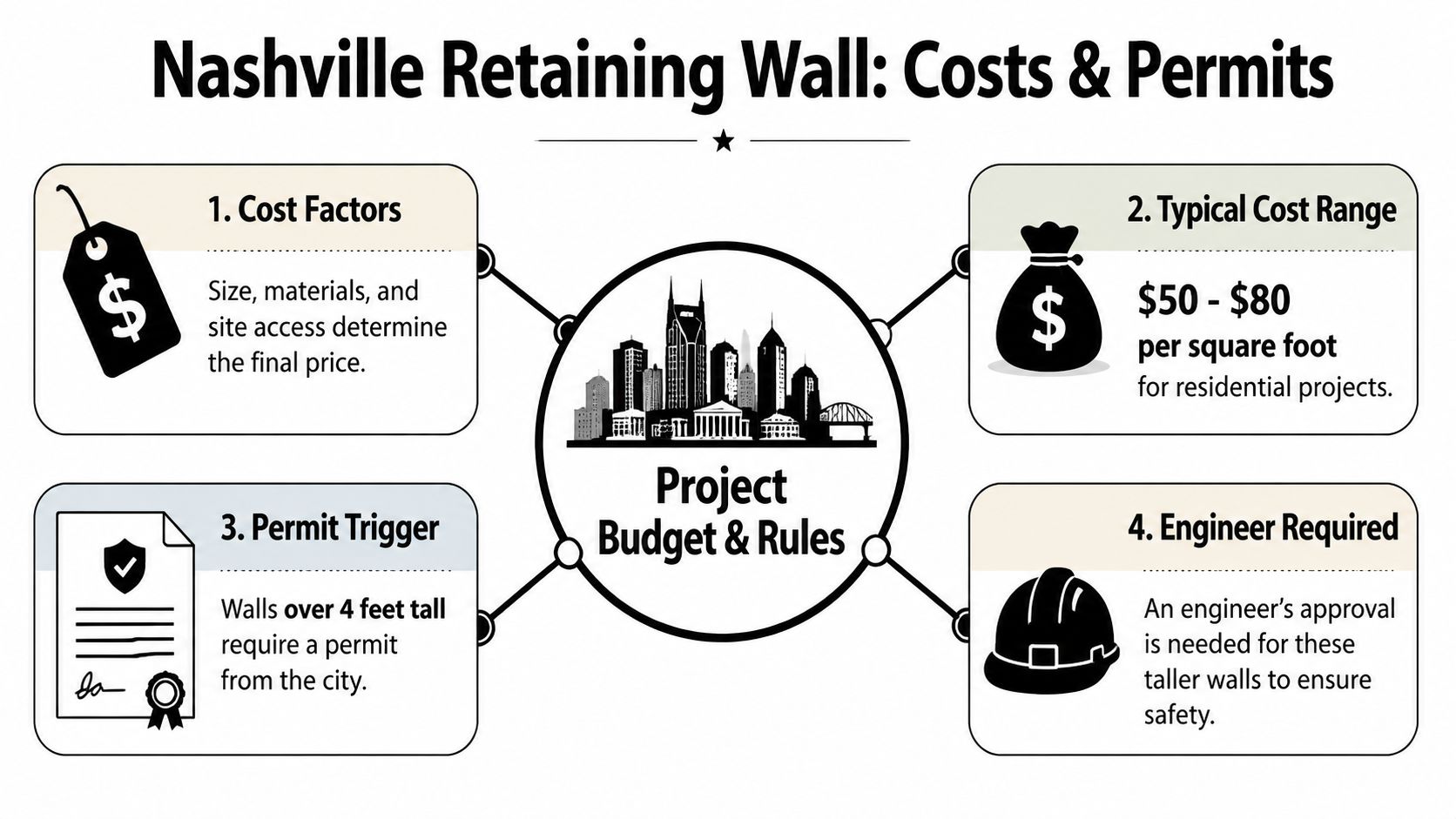
As you can see, the moment you plan for retaining walls in Nashville TN that are over four feet tall, you’re looking at mandatory permits and professional engineering. That height is the trigger point where the city steps in to ensure the structure is safe.
Creating a Pressure-Relief System
To handle that hydrostatic pressure, a professional crew builds a multi-part drainage system right behind the wall. This isn't an afterthought; it's a fundamental part of the structure.
Here’s how it works:
- Clean Gravel Backfill: We never backfill with the heavy clay soil common in our area—it acts like a sponge. Instead, we use a thick layer of clean, crushed stone. Water flows easily through the gaps, heading down instead of pushing out.
- Perforated Pipe: At the base of the gravel, we lay a perforated drain pipe (you might know it as a French drain). This pipe collects all the water that trickles down and channels it safely away from the wall's foundation.
- Filter Fabric: To keep the system from getting clogged, we wrap the gravel in a special geotextile fabric. This acts as a barrier, stopping dirt and silt from working their way into the drainage channel, which keeps it flowing freely for years.
This combination creates a permanent pressure-relief valve for your wall. If you're curious about the mechanics, check out our guide on how to install a French drain system.
Why Taller Walls Need Advanced Engineering
Once a retaining wall gets over four feet high, the forces it has to manage grow exponentially. Simple gravity and basic drainage just aren't enough anymore. At this point, getting a structural engineer involved is absolutely critical for safety.
We saw a sobering local reminder of this back in 2003. A 25-year-old retaining wall along the I-40 West on-ramp at Jefferson Street collapsed without warning. The cause? Corroded internal supports. The incident was a wake-up call that prompted the Tennessee Department of Transportation (TDOT) to launch a statewide wall management program. It's a stark lesson for homeowners: a poorly engineered wall isn't just an eyesore, it's a serious hazard.
For taller walls, an engineer will add several layers of reinforcement:
- A Deeper Foundation: The footing must be wider and dug deeper (below the frost line) to give the wall a solid anchor and prevent it from sliding or tipping.
- Geogrid Reinforcement: This is a high-strength polymer mesh that we lay in horizontal layers, extending from the wall back into the slope. It essentially laces the wall into the earth behind it, creating a single, incredibly strong, reinforced soil mass.
- Engineered Backfill and Compaction: The engineer’s plan will specify the exact type of backfill to use and dictate how tightly it must be compacted at every stage. This isn't guesswork; it's a precise science to guarantee stability.
For taller structures, an engineer’s plan is not an optional expense—it is the essential blueprint that transforms a simple stack of blocks into a permanent, safe, and reliable structure.
Trying to cut corners on engineering is a recipe for failure. The physics don’t change, whether you’re in Tennessee or Australia; you can read about some common retaining wall design errors in NSW to see how universal these principles are.
Deciding Between a DIY Project and a Pro
It's the classic question every homeowner asks before tackling a big project: "How much could I save by doing this myself?" With a retaining wall, the temptation to go the DIY route is strong, especially with so many tutorials just a click away. But here in Nashville, with our rolling hills and heavy rains, what looks like a simple weekend project can quickly turn into a costly and dangerous mistake.
Let’s be clear. If you’re looking to build a small, decorative garden wall—something under two feet high on perfectly level ground—you can absolutely handle that yourself. Think of it more like a raised planter box. The forces at play are minimal, and if something goes wrong, the stakes are pretty low.
The game changes entirely the second that wall has to hold back an actual slope, even a small one. It's no longer a decorative feature; it's a structural one. This is where the physics of Middle Tennessee's heavy clay soil and our infamous downpours become major players.
The Common Pitfalls of DIY Walls
A DIY wall that gives way doesn't just crumble. It can cause serious property damage, create a massive erosion problem, and become a genuine safety hazard. Most of the time, these failures aren’t from one big catastrophe but a series of small, overlooked mistakes that add up. These are the ones we see most often.
A Weak Foundation: Any structure is only as good as its base. A DIYer might scratch a shallow trench in the dirt, but a pro knows the footing has to be excavated deep below the frost line. It must then be filled with compacted gravel to create an unshakeable foundation that won't shift.
No Plan for Water: This is the number one cause of wall failure, without a doubt. Amateurs often just shovel the excavated dirt back behind the wall. This traps water, creating immense hydrostatic pressure that will relentlessly push, bulge, and crack the wall until it collapses.
Skipping the Compaction: Professionals use heavy plate compactors to pound the base and every layer of backfill until it's rock-solid. Just tamping it down with your feet or a hand tool simply isn't enough to stop the ground from settling and causing the wall to shift.
These problems might not surface right away. A poorly built wall can look perfectly fine for a year or two. Then the telltale signs begin to show: a slight lean, a bulge in the middle, or cracks that start to widen. By that point, the only real solution is a complete teardown and rebuild, wiping out any initial DIY savings and then some.
A professional contractor isn't just stacking blocks; they are managing the immense forces of gravity and water. Their expertise lies in understanding local soil, engineering proper drainage, and using commercial-grade equipment to build a structure that is safe, secure, and valuable for years to come.
The Professional Advantage in Nashville
When you hire a professional for your retaining walls in Nashville TN, you’re buying peace of mind and a guaranteed result. A seasoned pro brings an intimate understanding of local conditions, from how our clay soil behaves when saturated to the specific permitting rules in Davidson County.
They show up with the right equipment for the job—laser levels, mini-excavators, and heavy-duty compactors—tools that are non-negotiable for a precise, stable build. More importantly, they bring the experience to see problems before they even start. They know exactly how much geogrid reinforcement is needed for a five-foot wall and how to design a drainage system that will perform for decades.
This expertise is your best insurance against failure. If you're weighing the options, our guide on a professional French drain installation versus DIY delves deeper into this critical component. For any wall that's actually holding back soil, investing in a professional means you only have to build it once.
Your Top Questions About Nashville Retaining Walls Answered
Even after you've done your homework on retaining walls, a few big questions usually remain. We get it. This is a major project, and you want to be sure you're making the right calls for your home. We've built countless walls around Nashville, and over the years, we've heard it all.
Let's walk through the three questions that come up most often:
- How long will this thing actually last in our crazy Tennessee weather?
- How can I tell if my old wall is on its last legs?
- Is this investment really going to pay off when I sell my house?
Getting straight answers here will give you the peace of mind to move forward. So let's dig in.
How Long Does a Retaining Wall Typically Last in Tennessee?
The lifespan of a retaining wall really comes down to two things: what it’s made of and who built it. A properly engineered segmental block or poured concrete wall, built with the right drainage, is a long-term solution. You can expect it to stand strong for 30 to 50 years, and honestly, maybe even longer.
On the other hand, treated timber walls have a much shorter fuse in Middle Tennessee’s heat and humidity. Between the moisture and the termites, you're typically looking at a lifespan of only 10 to 20 years. For any type of wall here, the secret ingredient is always water management. Without a bulletproof drainage plan, even the strongest wall is living on borrowed time.
What Are the Signs That My Existing Retaining Wall Is Failing?
You don’t have to be a structural engineer to know when something’s wrong. Your wall will give you clues that it’s in trouble, and catching them early is crucial.
Start by looking for the obvious: is the wall leaning or bowing outwards? Are cracks starting to spiderweb across the concrete or masonry? Have the blocks started to separate from each other? Another huge red flag is any sign of drainage failure—like water constantly pooling at the base or soil washing out from between the cracks.
If you see any of these signs, don't put it off. A leaning or cracking wall is a serious safety hazard. It’s time to call a professional to assess the damage before a small problem becomes a catastrophic (and expensive) collapse.
Can a Retaining Wall Increase My Property Value in Nashville?
Without a doubt. In a city with as many hills as Nashville, a well-built retaining wall is a feature that smart buyers look for. It’s not just an expense; it’s a tangible upgrade that adds real, measurable value to your property.
Think about it from a buyer's perspective. The wall instantly improves curb appeal, giving your property a solid, well-manicured look. It also solves a major problem by preventing erosion and protecting the home's foundation from water damage. But the biggest win is often the space it creates. That useless, sloping part of your yard can suddenly become a flat, functional patio, a garden, or a safe place for kids to play. You’re not just building a wall—you’re buying more usable square footage for your property.
Ready to turn that tricky slope into a stable, beautiful, and valuable part of your home? The team at Lawn & Leaf Solutions has the local expertise to design and build a retaining wall that stands the test of time. Schedule your free, no-obligation estimate today, and let us build a permanent solution for your Nashville property.