
Saturday morning in West Tennessee usually starts the same way. The grass looks a little too tall, the mower comes out, and the goal is simple. Knock it down and make the yard look clean again. Then a few weeks later, the lawn turns patchy, the tips brown out, or the yard never seems to thicken up the way you hoped.
That pattern is common in Jackson and across West Tennessee because our lawns don't grow on a neat national schedule. Clay soil holds water differently. Humidity pushes growth hard in spring. Summer heat can stall turf fast. A mowing routine that looks disciplined can still be rough on the lawn if the timing and height are wrong.
The Unspoken Rhythm of a Healthy Tennessee Lawn
A healthy lawn has a rhythm to it, and most homeowners feel that rhythm before they know how to explain it. In early spring, the yard seems to grow overnight. By midsummer, the same lawn can look tired and stalled. In some spots, especially where drainage is poor or soil stays compacted, the grass never quite looks settled.

A lot of people answer the question of how often should lawn be mowed with one word: weekly. That's understandable. About 70% of American homeowners mow weekly or more often, which has become the default standard for lawn care, according to this lawn mowing survey analysis. The problem is that a fixed weekly routine can work against the grass when weather, soil, and turf type aren't cooperating.
In West Tennessee, mowing smarter matters more than mowing more. The lawn in a shady low spot with sticky clay soil won't respond the same way as a sunny Bermuda yard that dries out fast in July. That's why the best-looking lawns aren't always the ones cut most often. They're the ones cut at the right moment, at the right height, for the conditions in front of you.
The rule that keeps lawns out of trouble
The simplest way to think about mowing is this. Don't focus first on the calendar. Focus on how much leaf blade you're taking off.
That's where the one-third rule comes in. If you remove too much at once, the lawn has to recover instead of grow. If you remove the right amount, it stays dense, greener, and more even through the season.
A Tennessee lawn usually tells you what it needs. The mistake is forcing it onto a schedule it hasn't earned.
Homeowners who want a stronger lawn year-round usually get better results when mowing is treated as part of overall turf health, not just cleanup. If you want a broader foundation beyond mowing alone, this guide on how to maintain a healthy lawn ties the rest of the pieces together.
Mastering the One-Third Rule for a Resilient Lawn
The one-third rule is the mowing principle that separates a lawn that survives from a lawn that becomes lush and holds color. The rule is simple. Never remove more than one-third of the grass blade in a single cut.
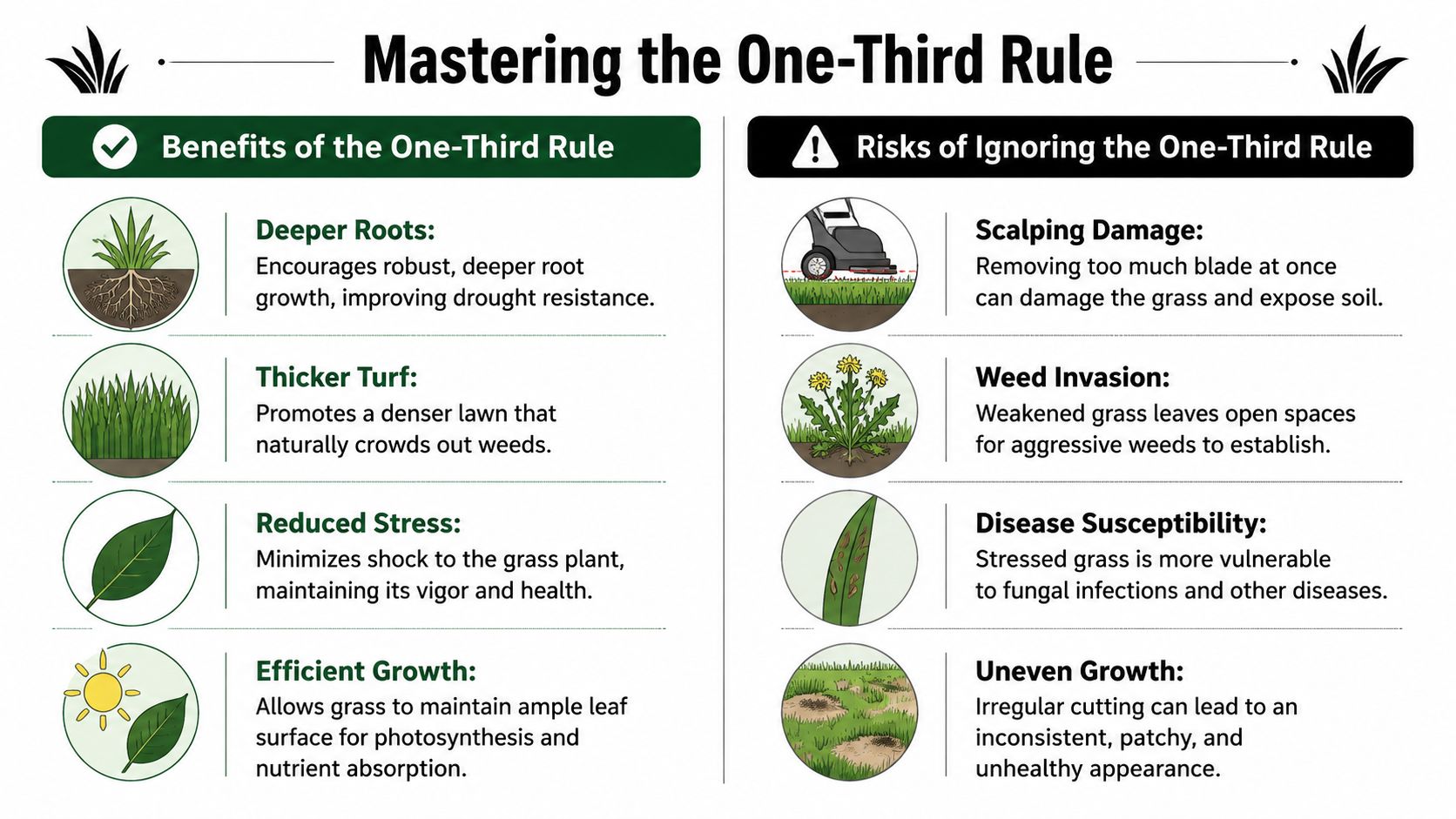
That sounds basic, but it changes everything. Grass blades aren't just there for appearance. They're the plant's food-making surface. When you cut too much off at once, the plant loses a chunk of its ability to feed itself. The lawn responds with stress, slower recovery, weaker roots, and a thinner stand.
What happens when you cut too much
Scalping is one of the fastest ways to set a lawn back. In West Tennessee, I see it happen most often after rain delays. A homeowner skips a mow, the yard shoots up, then the mower is dropped low to “catch up.” The result is a lawn that looks shaved instead of trimmed.
The downside shows up quickly:
- Brown or white-looking patches because too much leaf tissue was removed
- More visible soil between blades, which invites weeds
- Slower rebound in heat because stressed turf can't protect itself well
- A rougher cut when long blades fold under the deck instead of standing upright
The physiology behind this is well established. The one-third rule is a scientifically backed principle, and adherence can lead to 40 to 60% fewer disease incidents, according to this explanation of the mowing rule.
How to apply it in real life
You don't need lab equipment. You need a quick habit before mowing.
Check the current height
Look at the actual grass height in a representative area, not just the tallest patch by the driveway.Calculate the allowable cut
If the grass is around 3 inches tall, remove only about 1 inch and leave about 2 inches standing.Adjust the deck before you start
Don't guess. Use your mower's height positions intentionally.Split the cut if needed
If the lawn got away from you, raise the deck for the first pass. Bring it down later, not all at once.
Practical rule: If you're trying to “fix” an overgrown lawn in one mow, you're usually creating next week's problem.
Why this works in Tennessee yards
Our humidity creates ideal conditions for growth, but it also creates ideal conditions for stress-related disease when grass is damaged. A lawn cut within the one-third rule keeps more leaf area, more shade over the soil, and a steadier growth habit.
That thicker, steadier turf also makes your aeration and overseeding work pay off better. If you're trying to rebuild thin areas, timing aeration and overseeding correctly matters, but mowing discipline is what protects that progress.
Your West Tennessee Mowing Calendar
West Tennessee lawns don't move through the year evenly. Spring pushes growth hard. Summer can either accelerate warm-season turf or stall stressed grass depending on heat and moisture. Fall often gives cool-season lawns a second wind. Winter slows almost everything down.
For common local lawns, Bermuda and Zoysia often need weekly mowing in summer at 1 to 2.5 inches, while Fescue generally does better every 10 to 14 days at 2.5 to 4 inches, based on grass-type mowing guidance from Seascape.
How the seasons change the schedule
Bermuda and Zoysia usually drive the mowing pace in sunny West Tennessee yards. They respond quickly when heat, rainfall, and fertility line up. Fescue behaves differently. It usually wants a taller cut and less frequent mowing, especially once summer pressure builds.
That's why “every Saturday” is too blunt for many properties here. A lawn near a low-lying back fence may stay wet longer and grow unevenly. A front yard in full sun may speed up in one month and stall in the next.
Spring rewards attention. Summer rewards restraint.
If you're dialing in seasonal work beyond mowing, this step-by-step spring lawn care checklist is useful because spring mistakes tend to ripple through the rest of the season.
Sample Monthly Mowing Schedule for West Tennessee
| Month | Bermuda/Zoysia Frequency | Fescue Frequency | Notes & Tips |
|---|---|---|---|
| January | Usually minimal or none if dormant | Usually minimal or none if growth is inactive | Don't force a mow just to tidy the yard. Only cut if growth is present and conditions are dry enough. |
| February | Usually minimal, depending on weather | Minimal to light as needed | Watch for soggy ground in clay-heavy areas. Ruts can do more harm than tall grass. |
| March | As growth begins, mow as needed based on blade growth | As growth picks up, mowing may begin more regularly | Early spring growth can be uneven. Follow blade growth, not the date. |
| April | Often moves toward a regular schedule | Often active and may need regular mowing | This is where many Tennessee lawns start outrunning a casual schedule. |
| May | Often weekly during active growth | Often every 10 to 14 days, depending on growth | Fast spring growth means the one-third rule matters most now. |
| June | Often weekly during peak warm-season growth | Often every 10 to 14 days, adjusted for stress | Raise the deck if heat builds and the lawn starts showing stress. |
| July | Often weekly if actively growing, but adjust for heat stress | Often less frequent if summer pressure slows growth | Don't mow by habit in harsh heat. Check actual growth first. |
| August | Similar to July, growth may vary by rainfall and heat | Similar to July, often slower in hot periods | Clay soil can swing from too wet to brick-hard. Both affect mowing quality. |
| September | Often regular while warm-season turf is still active | Growth may improve as conditions ease | Good month to clean up mowing quality after rough summer conditions. |
| October | Growth usually slows | Often active again and may need consistent mowing | Fescue often looks better now than it did in midsummer. |
| November | Light mowing as needed before dormancy | Light to moderate mowing depending on growth | Don't scalp for winter. Keep cuts clean and measured. |
| December | Usually dormant | Usually limited growth | Mow only if needed. Wet winter ground and mower traffic can scar soft areas. |
The local adjustments that matter most
A monthly chart helps, but the lawn still gets the final say. In West Tennessee, these conditions change mowing frequency fast:
- Clay soil that stays wet can delay mowing because the lawn may be growing while the ground is too soft to support equipment well.
- High humidity can make a lawn look lush while also increasing stress if cuts are too aggressive.
- Mixed lawns with Bermuda in sun and Fescue in shade need different expectations in the same yard.
- Drainage trouble spots often grow differently from the rest of the property and may need separate handling.
When homeowners ask how often should lawn be mowed, the best answer around here is usually seasonal, grass-specific, and weather-aware.
Essential Mower Settings and Safety Practices
A good mowing schedule won't save a lawn if the mower is set wrong. Most problems blamed on weather are really cut-quality problems. Deck too low, blade too dull, turns too tight on wet soil, or mowing before the turf is ready.

Set the deck with a purpose
Start by measuring the lawn, not by using the same notch every week. If the grass is taller than normal, raise the deck so the first cut stays within the one-third rule. On many mowers, a small change in wheel position makes a big difference in what the blade removes.
Use this quick process:
- Measure before mowing by checking the height in a few typical spots.
- Choose the tallest practical setting that still gives the yard a clean, maintained look.
- Make a second pass later if the lawn is overgrown, instead of dropping the deck too low in one afternoon.
Sharp blades are not optional
A sharp mower blade slices. A dull blade tears. That torn leaf tip dries out, turns tan, and leaves the whole lawn looking stressed even when the timing was right.
In humid West Tennessee conditions, ragged cuts are more than cosmetic. They leave the turf looking frayed and struggling. If you've ever finished mowing and the yard looked pale instead of crisp, blade condition is one of the first things to check.
Dull blades don't just make the lawn look bad. They make recovery harder.
Safety that actually matters in the yard
The practical side of mowing safety isn't just protective glasses and closed-toe boots, though both matter. It's also about controlling the site before you start.
- Walk the yard first and remove sticks, toys, gravel, and hidden debris.
- Avoid mowing saturated ground because slipping, rutting, and scalping become much more likely.
- Mind slopes and edges where traction changes fast.
- Check wheels and movement if you use carts or hauling gear around the property. Uneven ground and poor wheel selection make yard work harder than it needs to be. For homeowners moving mulch, tools, or debris across turf and gravel, Lounge Wagon's guide to wheels gives useful context on matching wheel style to terrain.
For more practical upkeep habits that improve cut quality and lawn health, these lawn care tips for homeowners are a good next read.
How to Mow in Special Conditions
Standard mowing advice breaks down when the weather turns harsh or the lawn is still getting established. That's where many homeowners lose ground. The schedule seems right on paper, but the lawn isn't in normal condition.
During extreme heat and drought
When heat gets severe, grass may slow down or stop growing. During extreme heat over 120°F or drought, grass growth slows or stops, and continuing a regular mowing schedule can severely damage or kill the turf. A higher mowing height is recommended to shade the soil and protect the roots, according to this guidance on mowing under heat stress.
That matters in West Tennessee because summer lawns often go from vigorous to stressed in a short stretch. A yard that needed regular cutting in late spring can suddenly need patience instead of another pass with the mower.
When the lawn is under heat or drought pressure:
- Raise the mower height so more blade stays in place to shade the soil.
- Skip a mow if growth has stalled instead of cutting just because it's “time.”
- Avoid mowing in the hottest part of the day when the turf is already under pressure.
- Watch for footprints that linger or a dull blue-green cast. Both can signal stress.
After heavy rain and poor drainage
West Tennessee clay changes the rules after rain. The grass may be growing fast, but the soil underneath can stay soft enough to rut. Mowing a wet lawn doesn't just clump clippings. It can smear the soil surface, leave tire marks, and scalp high spots where the mower sinks.
In yards with standing water or recurring low areas, drainage has to be part of the mowing conversation. If the ground stays wet long after a storm, the mowing schedule will always be inconsistent because the site itself isn't shedding water well.
The first mow on new sod or seeded areas
New lawns need a different kind of patience. The transition from installation to normal maintenance is delicate. You're not just trimming blades. You're protecting young roots that haven't fully anchored yet.
Fresh sod can shift if it's mowed too early. Newly seeded areas can get uprooted or gouged if the equipment is too heavy or the turn radius is too tight. Waiting too long isn't ideal either, because overgrown young grass can flop, shade itself, and become harder to cut cleanly.
A safer approach is to look for readiness instead of forcing a date:
- Check root hold on sod before mowing. If the turf still feels loose underfoot, it's too early.
- Use a sharp blade and gentle turns on the first cut.
- Keep the first mow light. Don't try to make it look “finished” in one pass.
- Stay off soggy new areas because traction damage can undo establishment work.
If you're setting up a storage area for mower gear, hoses, and lawn supplies during a renovation or new-lawn phase, Van Dyke Outdoors' shed designs can help homeowners plan a more functional backyard work zone.
When to Partner With a Lawn Care Professional
Some lawns are straightforward. Others fight back all season. If you've adjusted height, watched the weather, and stayed disciplined but the yard still looks thin, patchy, or uneven, the issue may be bigger than mowing frequency.
That's especially true when the lawn has multiple stress factors at once. Clay soil, drainage trouble, shade, compaction, and a new sod or seed installation can create conditions where “just mow it weekly” becomes expensive guesswork.
Signs the lawn needs more than DIY mowing
A professional is worth considering when you're dealing with problems like these:
- New sod or seeded areas that need careful first cuts and a smooth transition into a regular maintenance pattern
- Recurring wet spots or runoff issues that keep delaying mowing and damaging turf quality
- Thin grass despite regular care, especially where the yard never seems to fill in
- Limited time or equipment, which often leads to delayed mowing and catch-up cuts
The establishment phase is one of the clearest examples. Professional guidance is essential when transitioning a new installation into a mature lawn, because mowing too early can damage shallow roots and waiting too long can also stress the grass, as noted in this discussion of mowing new lawns.
Hiring help isn't giving up. It's often the more practical way to protect the money already invested in sod, seed, drainage work, and regular upkeep. If you're weighing that decision, this overview of the benefits of hiring a professional lawn service in Jackson TN lays out where professional maintenance makes life easier and results more consistent.
Frequently Asked Questions About Lawn Mowing
Should I bag clippings or mulch them
Mulching usually works well when the lawn is being cut on time and the clippings are short. Short clippings break down faster and don't smother the turf. If the lawn got too tall, bagging can be the cleaner option because heavy clumps left behind can block light and make the yard look messy.
A simple rule works. If the cut is light and dry, mulching is usually fine. If the grass is overgrown, wet, or coming off in thick windrows, collect it.
How should mowing and watering work together
Don't think of them as separate chores. Watering affects growth rate, and growth rate affects how often should lawn be mowed. A lawn that's actively growing may need closer monitoring, while a stressed lawn may need less mowing, not more.
Try not to mow when the grass is still wet from irrigation. Wet blades cut less cleanly, clippings clump, and the mower can mark soft ground. For best results, let the lawn dry enough that the mower can cut cleanly and travel without rutting.
Does poor drainage change how often I should mow
Yes, sometimes dramatically. A lawn with poor drainage often grows unevenly because some areas stay saturated while others dry out faster. The wet areas can become too soft for mowing even when the grass is tall enough to need it.
That creates a frustrating cycle. Homeowners wait because the yard is wet, then end up cutting too much once it finally dries. If you keep battling that pattern, the problem may not be your mowing schedule. It may be the drainage underneath it.
A healthy lawn in West Tennessee needs more than a fixed weekly habit. It needs timing, height control, and a plan for heat, clay soil, drainage, and new turf establishment. If you want experienced help protecting your yard and keeping it on a smart mowing schedule, Lawn & Leaf Solutions provides lawn care, sod and seeding, and drainage solutions for Jackson and West Tennessee properties.