
If you're in Jackson or anywhere across West Tennessee, you’ve probably looked out at your yard this week and seen one of three things. Grass growing fast in one spot and thin in another. Damp soil that stays soft too long after rain. Or a lawn that looks fine from the street but feels weak when you walk across it.
That’s normal for this region. Our lawns deal with red clay, humidity, long summer heat, heavy spring growth, and drainage issues that generic lawn advice doesn’t account for. Bermuda and Zoysia can thrive here, but they only do it when the basics are handled in the right order.
A healthy lawn isn’t built with one fertilizer application or one Saturday of hard work. It comes from matching your mowing, watering, feeding, and soil care to the season. That’s how to maintain a healthy lawn in West Tennessee without wasting time or making the yard work harder than it needs to be.
Build Your Lawn from the Ground Up
Most lawn problems in West Tennessee start below the grass line. Homeowners often focus on what they can see, such as color, weeds, bare spots, and mowing height. The bigger issue is usually the soil.
Our red clay holds water, compacts easily, and can turn hard when it dries. That creates two opposite problems in the same yard. One area stays wet too long, while another bakes and cracks. Grass roots struggle in both.

Why soil matters more than most lawn products
You can put out seed, fertilizer, and weed control on schedule and still get poor results if the soil is tight and water can’t move correctly. That’s why some lawns never seem to respond the way the label says they should.
Compacted soil can restrict root expansion, and prevent essential nutrients from reaching the grass, which slows growth and causes long-term damage. In plain terms, the lawn can’t use what you’re giving it because the root zone is fighting for air, water movement, and space.
Healthy turf starts with roots that can actually spread. If the soil is sealed up, everything above it struggles.
Many West Tennessee lawns face a common problem. The grass isn’t always dying because the homeowner skipped a treatment. Sometimes the lawn is failing because the foundation is compacted from foot traffic, mowing patterns, construction activity, or years of clay settling.
A quick way to check your soil at home
You don’t need lab equipment to get a first read on what’s happening.
Try this:
- Push a screwdriver into moist soil. If it slides in easily, the soil is more open. If it stops quickly or takes force, compaction is likely.
- Watch standing water after rain. If puddles sit in low spots or near downspouts, drainage is limiting root health.
- Pull up a small plug of turf. Look for shallow roots, dense hard soil, or roots growing sideways instead of down.
- Check whether the lawn greens unevenly. Spotty response often points to soil inconsistency, not just a feeding issue.
A real soil test still helps because it shows pH and nutrient balance. That matters when you’re deciding what to add and what not to add. Guessing with fertilizer is expensive, and in clay soil it can mask the underlying problem for a short time without fixing it.
If you’re starting from scratch, choosing the right turf matters too. Grass selection should fit the site, sunlight, and soil conditions, not just what looks good in a neighbor’s yard. This guide to grass seed options for new lawns is a useful place to compare what works for different situations.
Aeration is not an extra in clay soil
In this region, aeration is often the turning point between a lawn that survives and a lawn that thickens. Homeowners sometimes treat it like a bonus service. It’s closer to a structural repair.
When clay compacts, roots lose oxygen and water movement slows down. Fertilizer can sit there. Seed can struggle to establish. Water either runs off or lingers too long. Aeration opens space in the soil so the rest of your lawn program can work.
Look for these signs:
| Sign in the lawn | What it usually points to |
|---|---|
| Water puddles after normal rain | Poor infiltration or grade issues |
| Thin turf in traffic areas | Compaction from use |
| Grass wilts fast in heat | Shallow roots |
| Patchy growth after fertilizing | Nutrients not reaching the root zone well |
| Soil feels hard underfoot | Dense, compressed clay |
That’s why drainage and compaction belong at the front of the conversation. In West Tennessee, they aren’t side issues. They decide whether the lawn has a chance.
A Seasonal Lawn Care Calendar for West Tennessee
A good lawn doesn’t need the same thing all year. That’s where many schedules go wrong. Homeowners either do too much in the wrong season or miss the short windows that matter most.
In Jackson and surrounding areas, the calendar needs to fit warm-season lawns, heavy humidity, spring flush growth, and summer stress. Bermuda and Zoysia behave differently than fescue, so timing matters.
This year-round guide to seasonal lawn maintenance in Jackson works as a companion to the calendar below if you want a service-based version of the same rhythm.
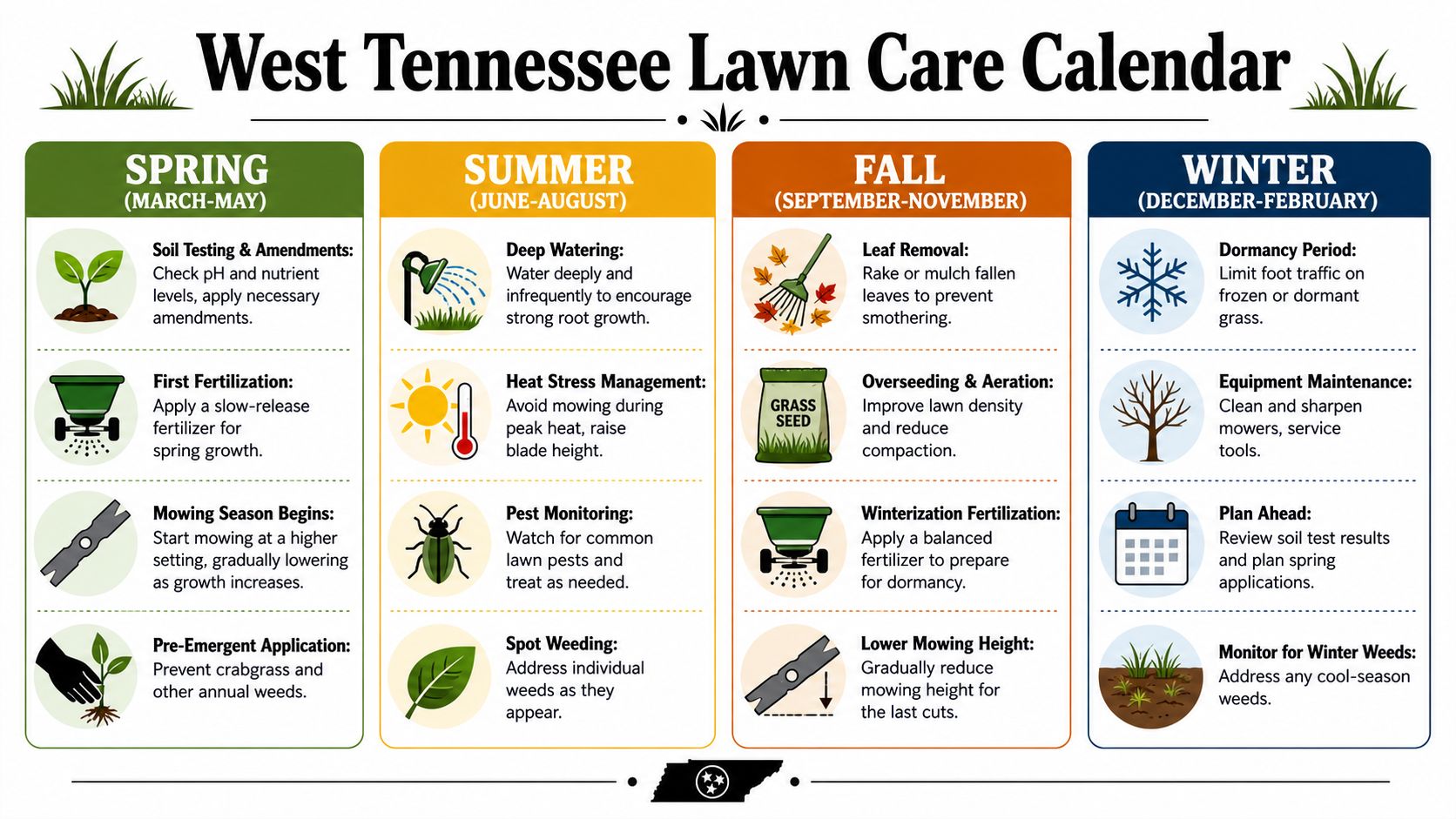
Early spring
Early spring is cleanup and preparation season. Don’t rush to force growth before the lawn is fully waking up.
Start by removing winter debris, checking for drainage trouble, and walking the yard slowly. Look for matted spots, compacted paths, washout areas, and thin zones near driveways or shaded edges. If the lawn had standing water over winter, address that before you think about feeding.
For warm-season grass, this is also the time to think about weed prevention before summer weeds get moving. You want a clean base before active growth really kicks in.
Focus on these jobs:
- Clear the surface so sunlight and air can reach the turf.
- Inspect grades and runoff paths around patios, downspouts, and low spots.
- Sharpen mower blades before your first regular cuts.
- Plan pre-emergent timing for annual weeds based on weather patterns, not the calendar alone.
- Test soil if the lawn struggled last year so your feeding plan has a reason behind it.
If you have fescue patches in shade, treat them differently from Bermuda or Zoysia. A mixed lawn almost always needs a split strategy.
Don’t judge a West Tennessee lawn too early in spring. Warm-season grass often wakes up unevenly, especially where clay stays cooler and wetter.
Late spring and early summer
This is when warm-season lawns start doing their real growing. Bermuda and Zoysia respond best when the soil is warming and the grass is actively pushing new growth.
Late spring is the right time to feed actively growing warm-season turf. It’s also the season when mowing discipline starts to matter. If you let the lawn get too tall, then cut it hard in one pass, you create stress right when the grass should be building density.
This is also the season when a lot of homeowners get fooled by quick top growth. A lawn can look greener and still have weak rooting if the soil underneath remains compacted or waterlogged.
A practical late spring checklist:
- Feed active warm-season grass according to soil needs and label directions.
- Mow often enough to avoid heavy removal in one cut.
- Watch wet areas closely because repeated spring rain can expose compaction and grade problems.
- Spot-treat weeds early before they spread through thin turf.
- Check irrigation coverage so dry edges and soaked centers don’t develop.
If the lawn looks uneven after feeding and mowing improve, go back to the soil. That pattern usually means the yard has a root-zone issue, not a cosmetic one.
High summer
Summer separates healthy lawns from overmanaged lawns. In West Tennessee, heat and humidity punish shallow roots, scalped turf, and bad watering habits.
This is the time to back off from cosmetic obsession. You want resilience, not a golf-course look. A slightly taller canopy protects the crown, shades the soil, and gives the lawn a better chance through long hot stretches.
Watering should shift toward deeper soakings instead of quick daily sprinkles. Frequent shallow watering trains the lawn to stay shallow rooted. In our heat, that usually leads to wilt, thin spots, and more weed pressure.
Here’s what to prioritize:
| Summer condition | Better response | What usually backfires |
|---|---|---|
| Fast top growth | Mow on schedule | Letting it get tall, then cutting too low |
| Heat stress | Raise mowing height | Scalping for a “clean” look |
| Dry patches | Deep, less frequent watering | Light daily watering |
| Humid nights | Improve airflow and avoid excess stress | Heavy cutting on soggy grass |
| Weed pressure | Strengthen turf and spot-treat | Blanket reaction without fixing thin areas |
Summer is also when pest damage can show up fast. If grass browns suddenly, don’t assume it only needs water. Check the roots, inspect the blades, and see whether the damage follows irrigation patterns or appears in irregular patches.
Fall
Fall looks quieter, but it sets up next year. For warm-season lawns, growth slows down and mowing gradually tapers. For cool-season fescue, fall is a stronger repair window.
This is a smart time to aerate compacted areas, especially where the lawn struggled all summer. Open soil now helps recovery and improves the odds that future treatments won’t sit on the surface. If you maintain fescue in shadier areas, this is also when overseeding makes the most sense.
Leaf management matters more than many people think. A thin layer mulched into the lawn is one thing. Wet leaves packed over turf are another. In shaded areas, they trap moisture, block light, and create avoidable decline.
A solid fall routine includes:
- Aerate high-traffic or tight-soil areas
- Overseed fescue sections if needed
- Lower mowing height gradually for final cuts
- Keep leaves from matting over the turf
- Evaluate drainage after fall rains so you know what needs work before spring
The homeowners who use fall well usually have fewer surprises next year. They aren’t trying to rescue the lawn in July because they handled structure and density when conditions were more forgiving.
Winter
Winter in West Tennessee isn’t usually severe, but it still affects turf. Dormant warm-season grass can handle the season better when it enters winter clean, not smothered with debris or rutted from traffic.
This is the season to inspect, not force. You’re looking for drainage failures, erosion lines, low areas holding water, and places where compaction worsened through the year.
Use winter for tasks that don’t require active growth:
- Service mowers and sharpen blades
- Clean up limbs and leftover debris
- Map out thin areas and wet spots
- Review what parts of the yard never responded well
- Plan drainage or grading corrections before spring demand starts
A homeowner who pays attention in winter usually makes better decisions in spring. They’re not just reacting to weeds or color. They know where the lawn’s weak points really are.
Mastering the Core Lawn Maintenance Techniques
In Jackson and across West Tennessee, lawn results are usually won or lost in the routine. Bermuda and Zoysia can handle heat, humidity, and hard use better than a lot of homeowners expect, but only if weekly care supports how those grasses grow in our red clay soils.
A calendar tells you when to act. Technique decides whether that work helps or sets the lawn back.

Mowing without stressing the lawn
The fastest way to thin a good lawn is to scalp it and call that maintenance. I see it every year. A yard starts the season fairly dense, then repeated low cuts expose the soil, heat the crown, and open space for weeds.
The one-third rule is still the right standard. If the lawn gets ahead of you, bring it back down over several mowings instead of trying to reset it in one pass.
Height matters, but it is not one-size-fits-all. Bermuda usually handles a lower cut than Zoysia, and both need a little more leaf surface during the hottest stretch of summer. In practical terms, I tell homeowners to avoid chasing the “golf course” look unless they have the mower, the time, and the irrigation to support it. For most residential yards in West Tennessee, slightly taller turf performs better through July and August.
A few habits make a visible difference:
- Keep blades sharp so the grass is cut cleanly instead of torn
- Mow when the lawn is dry to avoid clumping and wheel rutting
- Change mowing direction occasionally so the turf stays more upright
- Slow down on uneven ground to reduce scalping on high spots
Watering for roots, not surface color
West Tennessee lawns do better with deeper, less frequent watering than with light daily sprinkling. Short, shallow cycles leave moisture near the surface, and that is exactly where roots stay. Then a hot week hits, and the lawn fades fast.
Watering needs also change yard to yard. Red clay holds moisture longer than sandy fill, but clay also creates runoff if water is applied too fast. A flat backyard may stay wet for too long while a slope dries out first. One irrigation setting rarely fits the whole property.
Watch for signs before changing the timer:
- Bluish-gray color
- Footprints that stay visible
- Dry soil a few inches down
- Runoff before the ground has time to absorb water
- Yellowing in areas that already stay damp
That last point matters. Homeowners often water a weak spot harder when the actual problem is poor drainage or compacted soil.
Trees complicate this too. Shade lowers evaporation, roots compete for moisture, and canopy coverage can block irrigation from reaching the lawn evenly. If you want a wider perspective on how tree placement and sprinkler patterns affect planted areas, this piece on managing trees in desert climate is a useful comparison, even though Phoenix conditions are very different from ours.
Feeding without guessing
Fertilizer should match the grass, the season, and the condition of the yard. It should not be used like a rescue treatment for every problem.
A Bermuda lawn in active growth can use nutrients well. A Zoysia lawn with soggy roots, mower stress, or compacted clay will not respond the same way, even with a good product. That is the trade-off many homeowners miss. Feeding at the wrong time can push weak top growth without fixing the reason the lawn is underperforming.
The safest approach is straightforward:
- Use a soil test when possible
- Apply during active growth
- Follow label rates instead of adding extra
- Match the product to warm-season turf
- Avoid fertilizing heavily during severe heat or drought stress
For a region-specific breakdown, this guide to the best fertilizer for southern lawns covers the timing and product choices that trip up a lot of West Tennessee homeowners.
Use the clippings when they help
Bagging every mowing is usually unnecessary. If the lawn is being cut at the right interval and the clippings are not heavy or matted, leave them.
Clippings break down quickly and return some nutrients to the soil. They also save time and cut down on hauling. The exception is a lawn that got too tall, a wet mowing that leaves piles behind, or a yard dealing with disease pressure where cleanup makes more sense.
For homeowners who want that routine handled on a steady schedule, Lawn & Leaf Solutions includes mowing, fertilization, and weed control in customized maintenance plans. That kind of consistency often matters more than any single treatment.
Troubleshooting Common West Tennessee Lawn Problems
Most lawn problems don’t announce themselves clearly. You just see yellowing, thinning, or a patch that wasn’t there last week. The trick is reading the pattern before you treat the wrong issue.
A brown spot in a West Tennessee lawn might be drought stress, root damage, disease pressure, mower injury, or drainage trouble. The grass gives clues if you slow down long enough to look.
What the pattern usually tells you
If the problem follows sprinkler coverage, the cause is often moisture related. If it shows up in heavy traffic areas, compaction is a stronger suspect. If it appears in circles or irregular blotches during humid weather, disease moves higher on the list.
Use this quick field guide:
| Symptom | Likely cause | First thing to check |
|---|---|---|
| Grass wilts and footprints stay visible | Drought stress | Soil moisture below the surface |
| Yellowing in soggy areas | Poor drainage or overwatering | How long water sits after rain or irrigation |
| Thin turf near walkways | Compaction | Soil hardness and root depth |
| Sudden ragged patches after mowing | Dull blades or scalping | Mower height and blade sharpness |
| Isolated weeds in weak turf | Thin canopy | Why the grass is open there |
Brown patches are not all the same
A common mistake is treating every brown area as a fertilizer issue. If roots are damaged or the soil stays saturated, fertilizer may do nothing useful. In some cases, it adds stress.
Pull on the grass gently. If it lifts easily with weak roots attached, you may be dealing with root feeding pests or root rot conditions. If the blades are still anchored but the top looks scorched, check mowing practices and heat stress first.
If a lawn stays wet, don’t keep treating the symptom on top. Fix the water movement underneath.
That’s especially true in yards with low spots, runoff channels, or places where downspouts dump too much water into one section. If those conditions sound familiar, these standing water solutions for yards show the types of drainage fixes that usually solve the actual cause.
Weeds, pests, and false diagnoses
Weeds usually move into weak turf. They’re often the result, not the starting problem. If you kill the weeds but leave thin grass, poor drainage, or compacted soil in place, the opening stays there for the next round.
Pests create different patterns. Chewing damage often appears fast. Root-feeding damage can mimic drought because the lawn can’t take up water normally. Disease often thrives where air movement is poor, mowing is rough, and the canopy stays wet too long.
When the diagnosis isn’t obvious, check these in order:
- Moisture pattern
- Mowing damage
- Root strength
- Traffic and compaction
- Weed or insect activity on the surface
That order prevents a lot of wasted applications.
When Your Lawn Needs a Professional Partner
Some lawn work is worth doing yourself. Routine mowing, cleanup, leaf management, and basic observation all fit that category. Other problems keep costing more the longer they’re handled as weekend experiments.
Persistent drainage issues are the clearest example. If water keeps standing in the yard, pooling against the house, or washing channels through the lawn, that’s no longer a simple turf problem. It’s a site problem. The same goes for erosion, repeated soggy spots, and grade issues that keep killing grass no matter what product you apply.
Heavy soil compaction can also move past DIY territory. Store-bought tools and rental equipment can help in minor cases, but badly compacted clay often needs a more deliberate plan. That may include aeration, grading correction, drainage work, or re-establishing turf after the water issue is fixed.
Large renovations are another point where calling a pro usually saves money. Starting over with sod, seeding a big area, correcting runoff, or rebuilding a lawn after construction damage takes more than effort. It takes sequencing. If the order is wrong, the lawn fails and you end up paying twice.
A good service company should also know where lawn care stops and site work begins. That distinction matters in West Tennessee because many “bad lawn” complaints are really water-management problems wearing a grass mask.
For homeowners weighing that decision, this article on the benefits of hiring a professional lawn service in Jackson, TN lays out where professional equipment, experience, and consistency make the biggest difference.
If you do bring in help, ask practical questions. Ask how they diagnose drainage. Ask how they handle compaction in clay soil. Ask whether they’re licensed and whether the work is being done by people who understand this region. Lawn & Leaf Solutions operates with License # TNPL23317, which matters when the project moves beyond simple mowing and into drainage, grading, or larger outdoor projects.
Frequently Asked Questions About Lawn Care
What grass type usually works best in Jackson and West Tennessee
A lawn in Jackson can look solid in May and struggle by late July if the grass choice does not match the site. For full sun, Bermuda and Zoysia usually hold up best in West Tennessee because they handle heat, humidity, and heavy summer growth better than cool-season options.
The better pick between the two depends on the yard. Bermuda fills in fast and handles traffic well, but it needs more mowing and can spread into beds. Zoysia gives a denser, cleaner look and usually needs less frequent mowing, but it establishes slower and can thin out in deeper shade. If a yard has a lot of tree cover, the answer may be reducing turf area or using a different planting plan in those spots.
Should I choose sod or seed for a new lawn
Choose based on timing, slope, budget, and how much risk the site has.
Sod makes sense when you need fast coverage, especially on bare red clay, new construction lots, or slopes that can wash in a hard summer rain. Seed costs less up front, but it needs tighter watering, better weed control, and better timing. In this region, I usually tell homeowners to be honest about how closely they can manage the first several weeks. That answer often decides it.
What’s the first step if my yard stays wet
Follow the water.
Check where runoff starts, where it stalls, and whether downspouts, grading, compacted clay, or a low outlet are part of the problem. A lot of wet-lawn complaints in West Tennessee are site-drainage issues first and turf issues second. Grass will not fix standing water by itself.
Should I bag clippings or leave them
Leave clippings if the lawn is dry enough to mow cleanly and you are not taking off too much at once. Short clippings break down fast and return nutrients to the soil.
If the lawn got away from you and the mower leaves heavy rows, bag that cut and get back on schedule next time. The U.S. Environmental Protection Agency guidance on composting and yard trimmings supports keeping organic yard material out of the waste stream when it can be managed on site. In practice, that means mulch-mowing works well on healthy lawns, while bagging is better after a growth surge or during disease-prone stretches of humid weather.
How often should I mow in peak season
Mow by growth rate, not by the calendar.
For Bermuda and Zoysia in summer, weekly is common, but some stretches call for mowing every five to six days. Fast growth after rain and heat can make a fixed schedule too slow. The goal is to avoid scalping the lawn and to keep the surface even, especially on clay soils that already put turf under stress.
If your yard needs more than routine upkeep, Lawn & Leaf Solutions helps homeowners across Jackson and West Tennessee with lawn establishment, maintenance, drainage corrections, and erosion control. If you’re dealing with thin turf, compacted clay, standing water, or a lawn that never seems to respond the way it should, schedule a fast, free estimate and get a plan that fits your property.