
You can spot the problem fast in West Tennessee. The edge of the driveway has yellow blooms, the mailbox bed is full of dandelions, and the bare spot you meant to seed is still sitting there waiting for attention. That's where broadleaf weed control gets tricky, because killing weeds and growing new grass don't always line up on the same calendar.
A good lawn plan has to respect both jobs at once. Rutgers and Purdue note that herbicides on new sod should be delayed 4 to 6 weeks so establishment isn't set back, and that timing conflict shows up every spring in Jackson yards that need repair and weed cleanup at the same time Rutgers turf guidance. In practice, the right move depends on what's growing, how stressed the turf is, and whether you're trying to renovate, not just clean up.
Introduction to Broadleaf Weed Control
A homeowner in West Tennessee often hits the same wall in early spring. The lawn looks thin after winter, broadleaf weeds are already visible, and the family wants to overseed before summer heat settles in. If you spray too early on new turf, you can slow establishment. If you wait too long, the weeds get bigger and harder to manage.
That's why broadleaf weed control works best as a schedule, not a one-time rescue. The local climate matters because warm spells can push weeds ahead of the grass, while renovation work adds another layer of timing pressure. A plan that works on established turf won't always fit a yard that's being seeded or sodded.
Practical rule: if the lawn is newly installed, protect establishment first, then go after weeds on the proper waiting schedule.
The goal is to match the treatment to the yard's condition. In West Tennessee, that usually means deciding whether the lawn needs a weed knockdown, a renovation pause, or a combined approach that balances both.
Identifying Common Broadleaf Weeds
Before a sprayer comes out, the weed has to be named correctly. Dandelion, white clover, broadleaf plantain, chickweed, henbit, and wild violet all behave differently, and they don't all respond the same way to timing or follow-up. A quick visual check saves wasted product and keeps you from treating the wrong target.
What each weed usually looks like
Dandelion is easy to spot by its yellow flower and rosette growth. It sits low to the ground, which is why mowing alone doesn't solve it. The root structure is the reason hand-pulling often leaves part of the plant behind.
White clover stays low and spreads through the lawn instead of standing upright. In thin turf, it can fill open spaces fast. That's one reason dense grass matters so much in the first place.
Broadleaf plantain has wide leaves and a low, flat habit. It's a classic sign of compacted or heavily trafficked ground. If it keeps showing up near walkways or play areas, soil condition deserves attention too.
Chickweed and henbit usually show up in cooler windows and can cover bare soil quickly. Both can look soft and harmless at first, then spread into larger patches. Wild violet is the one many homeowners underestimate, because it can blend into the turf until it starts taking over shaded edges.
Why identification matters before treatment
The product choice depends on the weed, the turfgrass, and the site. A selective broadleaf herbicide can work well on one patch and miss another if the target was misidentified. For a practical local reference on dandelion behavior and control, see this dandelion lawn guide from Lawn & Leaf Solutions.
If you can't name the weed, you're guessing at the solution.
That's the mistake that burns time in West Tennessee yards. A clean ID upfront makes the rest of the program more precise.
Planning Treatments with a Seasonal Calendar
Spring in Jackson can move fast. A few warm days and weeds are already visible, while the turf may still be waking up. Timing has to follow plant growth, not just the calendar on the wall.
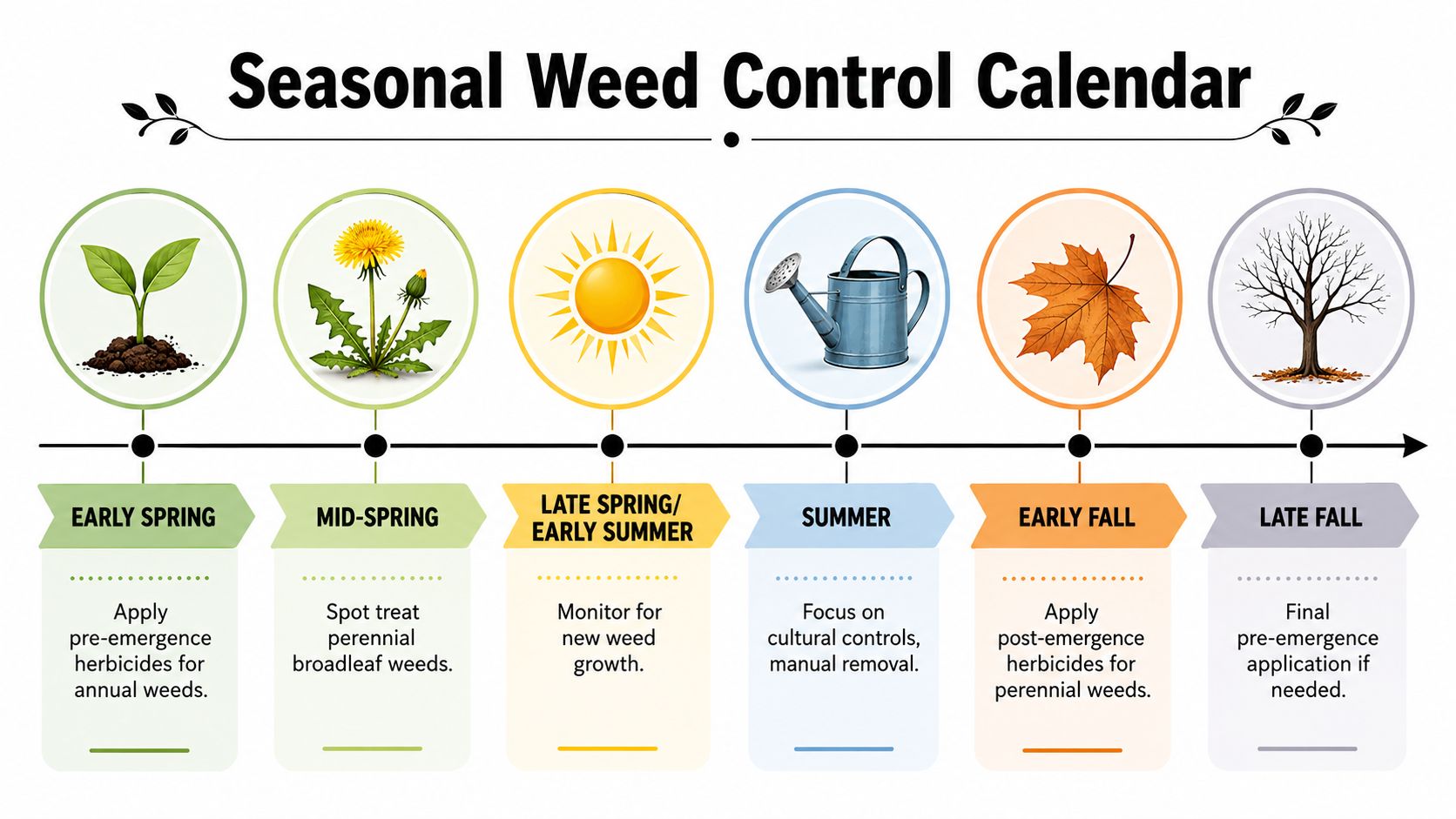
Early spring through early summer
April is the month to think about preemergence suppression on lawns that are not being renovated. Spring preemergence programs work best as part of a broader maintenance plan, especially when they are paired with steady mowing and fertilizer routines. Once seedlings or escapes appear, the focus shifts to postemergence spot work.
By late spring, the target is still the same, weeds while they are small. Purdue's extension guidance says to treat weeds when they are under 3 to 6 inches tall and when turf is not drought-stressed, with rain unlikely for 24 hours Purdue weed control guidance. That timing window matters in West Tennessee, where the weather can turn wet, then hot, in a short stretch.
Summer and early fall
Summer is not the season to force weak turf into a fight. If the lawn is stressed, it is smarter to back off hard spraying and rely on mowing, hand removal, and irrigation corrections until the grass rebounds. A carefully timed follow-up usually does more than a rushed blanket spray.
West Tennessee homeowners who want a season-by-season home lawn plan can use Jackson seasonal lawn care guidance as a practical local reference. It fits the same timing logic, especially where renovation work, thin turf, and weed pressure overlap.
By early fall, perennial weeds often respond better to treatment because they are moving resources differently. That is also when many lawns in this region recover well from summer stress.
Applying Cultural Controls for Prevention
A thick lawn does a lot of the work before a herbicide ever touches the yard. University guidance points to the same cultural basics again and again, because they make turf less open to invasion and more competitive against broadleaf seedlings. In West Tennessee, that matters because heat, traffic, and uneven moisture can thin out turf quickly, and renovation work can leave bare spots that weeds move into fast.
Mowing, feeding, and watering the right way
Keep mowing at 3.0 to 3.5 inches, not scalping the grass down to a low buzz cut. That height helps shade soil, which makes it harder for broadleaf weeds to germinate and spread. It also leaves more leaf area on the turf, so the grass can recover faster after stress.
Fertilizer timing matters too. Strong long-term programs put most nitrogen into the fall instead of trying to force growth at the wrong time. That helps the lawn fill in and crowd out new weeds before the next season starts, especially after overseeding or other renovation work.
Water thoroughly, but not constantly. Shallow, frequent watering encourages weak turf and creates the kind of surface moisture broadleaf weeds like. Deep watering trains roots to grow downward instead of sitting at the top. If the soil stays open and thin after watering, that is a sign the lawn needs more than a spray program, especially in areas that have been disrupted by patching or dethatching. In those cases, a service like Lawn & Leaf Solutions' dethatching service can help clear out buildup so the grass can recover.
Drainage and diagnosis
Standing water changes the game. If a low spot stays wet after rain, broadleaf weeds often gain a foothold there before the grass can recover. Drainage work, grading corrections, or a French drain can do more for weed prevention than another spray bottle.
Dense turf is the cheapest long-term weed barrier you can build.
If you've got thin, patchy areas, dethatching and cleanup may also be part of the solution. Homeowners should be realistic about the trade-off. Cultural fixes take longer than a quick herbicide pass, but they reduce repeat weed pressure and make spot treatments work better when you do need them.
Executing Spot Treatments Safely and Effectively
When a few weeds break through, the smartest move is usually a targeted one. Mechanical removal, organic products, and selective herbicides all have a place, but they solve different problems. The right choice depends on patch size, weed age, and how much turf you can afford to disturb.
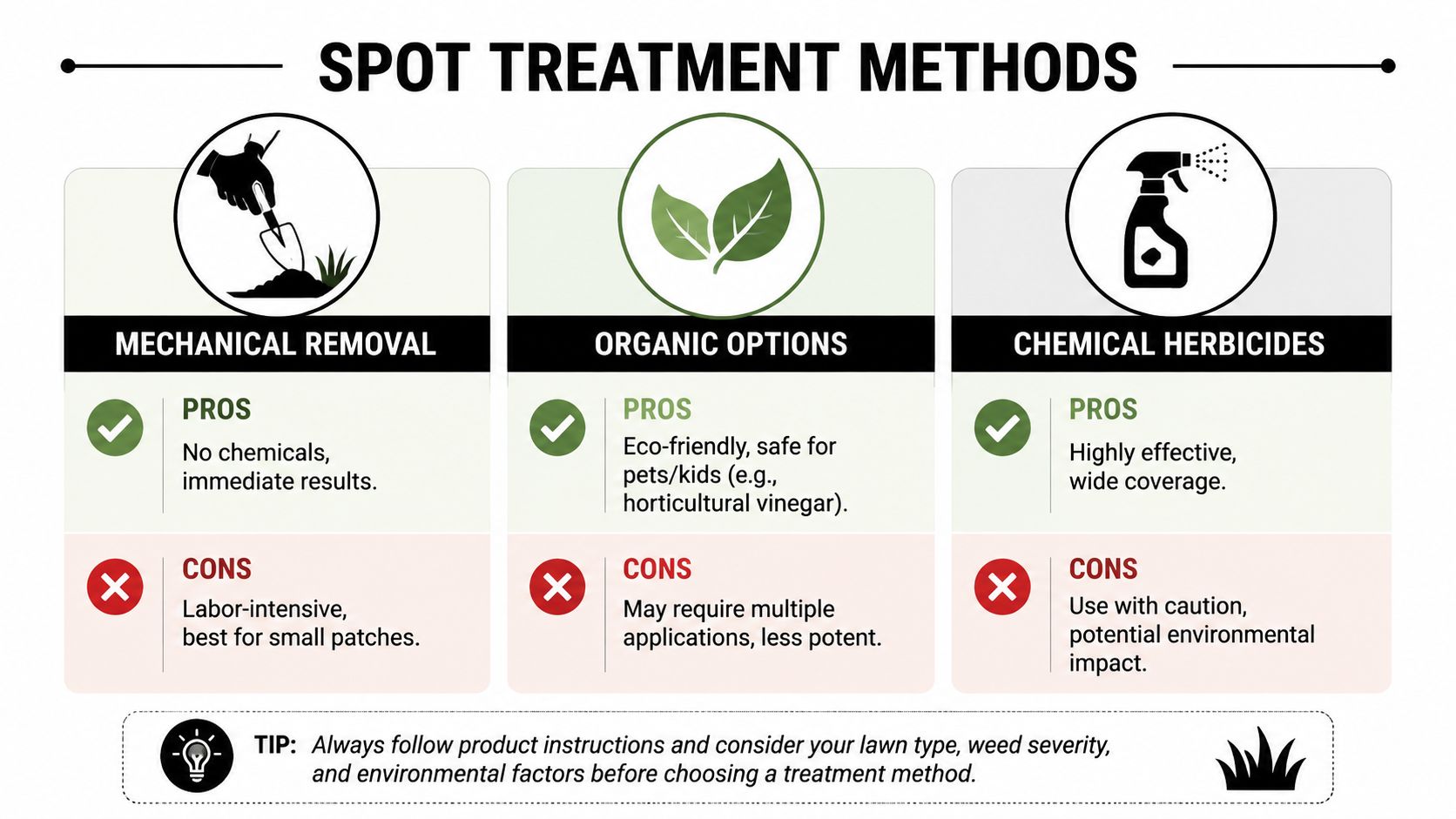
Comparing the main spot-treatment options
Mechanical removal works best on small patches, especially where you can get the root out cleanly. It's immediate and doesn't leave a chemical footprint, but it gets tedious fast if the yard has a larger infestation. Use it for isolated clumps near beds, sidewalks, and driveways.
Organic options can help with very young weeds, but they're usually less forgiving than selective products. They often need repeat passes and may still miss mature perennials. That makes them more of a limited tool than a full lawn program.
Selective herbicides remain the most dependable option in turf when used correctly. EPA assessment data show how central phenoxy herbicides became in broadleaf control, with 2,4-D at 32%, MCPA at 44%, and mecoprop-p at 5.5% among Western “brand-acres” treated in 2005, and more than 80% of treated acres containing one of those three active ingredients EPA assessment. That concentration reflects how often turf systems rely on a narrow set of selective tools for broadleaf weeds.
How to apply without wasting the treatment
Controlled turf research showed common post-emergence treatments initially delivered greater than 85% control, but only some combinations stayed above 80% at 140 days, which is why follow-up checks matter turf herbicide trial. The key is to spray uniformly wet foliage without runoff, then reassess after the turf has had time to respond.
Safety rule: read the label, keep spray off desirable plants, and don't treat stressed turf just because the weeds are visible.
Around gardens and hard edges, shielded, careful spot work beats a broad sweep every time. That's especially true when the weed sits close to ornamentals or newly seeded areas.
Troubleshooting Control Issues and Hiring Experts
When weeds keep returning, the problem usually isn't just the weed. It's often misidentification, hot or dry weather, poor drainage, or a lawn that's too weak to compete. UNL notes that herbicide efficacy drops under heat or drought stress, and repeated reliance on a small number of modes of action can increase resistance pressure UNL home lawn weed control guide.
A simple decision tree
Start with the weed itself. If the ID is uncertain, stop and verify it before buying another jug. Next, look at weather and soil moisture, because spraying stressed turf often disappoints.
If the same patch keeps coming back, switch the approach instead of repeating the same treatment forever. That may mean a different active ingredient, better watering, or a correction to the drainage pattern that's keeping the area wet or weak.
If the lawn is thin, badly puddled, or fighting repeated pressure, a more complete service plan makes sense. Lawn & Leaf Solutions handles weed control and drainage work in West Tennessee, and it's the kind of local option homeowners can consider when recurring problems need more than a one-off spray weed control services in Jackson, TN. For contractors and service businesses trying to improve your trade business's reputation, clear communication about diagnosis and follow-through matters just as much as the treatment itself.
Sustaining a Healthy Weed-Free Lawn
A weed-free lawn doesn't stay that way by accident. It stays clean because someone keeps watching for escapes, keeps the turf dense, and keeps the schedule steady. The same cultural basics that prevent weeds also make the next treatment more effective when it's needed.
Set a reminder to walk the yard every few weeks, especially around thin spots, fences, and shady edges. Keep a simple treatment log so you know what was applied and where. That kind of record makes it easier to avoid repeating mistakes and helps when the lawn needs a different approach next season.
If you like a more structured maintenance framework, lawn care business guides can help you think through the discipline behind regular lawn service, even if you're managing your own yard. The principle is the same either way, consistency beats rescue work.
Keep mowing high, watering smart, and feeding at the right time. If you stay ahead of the small weeds, you won't need to fight the big ones as often. For a simple reference on keeping that routine in place, Lawn & Leaf Solutions' healthy lawn guide fits the same long-term mindset.
If your West Tennessee lawn keeps fighting the same broadleaf weeds, Lawn & Leaf Solutions can help with targeted weed control, drainage fixes, and the turf care that makes treatment last. Visit Lawn & Leaf Solutions to request service and get a plan built around your yard, your timing, and the weeds you're seeing.