
You can stand in a West Tennessee backyard after a hard rain and see the whole problem at once. The turf squishes under your boots, water sits near the foundation, and the “pretty garden” you meant to build is still a blank patch of mud. That's usually the moment a homeowner grabs a garden design book, hoping one good purchase will prevent one expensive mistake.
That instinct is smart, but the shelf is crowded with the wrong kind of help. A lot of garden design books were written for designers, not homeowners, and plenty are better at showing you what a finished garden can look like than explaining how to get there on a residential lot. A book can absolutely help, but only if it matches the problem you're trying to solve and the climate you're solving it in, as the university and professional reading lists that keep titles like Design with Nature, Landscape Graphics, and Time-Saver Standards for Landscape Architecture in circulation make clear (OSU reference guide).
A homeowner usually buys one of these books for two reasons. Some want inspiration, because they're tired of staring at a bare yard and want a stronger vision. Others want triage, because they've got drainage trouble, a slope, a planting bed that dies every summer, or a hardscape project they don't want to botch. I care far more about the second buyer, because that's where the money gets saved, and the mistakes get avoided. If you're thinking about resale as well as comfort, this breakdown of whether landscaping increases home value is a useful companion read for putting the work in context.
Why Homeowners Buy Landscape Design Books
A homeowner rarely buys a landscape design book on a calm Saturday morning with nothing on the line. More often, the purchase happens after a problem has already shown up. The front walk looks fine, but the side yard turns into a swamp every time it rains. The new construction lot is all dirt and excuses. The foundation has a hairline crack, and now every slope on the property looks suspicious.
Inspiration and urgency pull in different directions
The inspiration buyer wants pictures, mood, and a little hope. That's the person flipping through lush borders, shady courtyards, and clean patio layouts, looking for a style they can live with. The problem-driven buyer wants the opposite, something that tells them what to do with grading, plant spacing, drainage, or a hardscape edge before the next storm comes through.
Practical rule: If your yard is failing in a specific way, buy for the fix, not the fantasy.
That difference matters because a beautiful book can still be useless on a residential lot. Harvard's guide to designing outdoor spaces treats titles like Graphic Standards for Landscape Architecture and Time-Saver Standards for Landscape Architecture as standards-of-practice references, and that's the level of seriousness a homeowner needs when the issue is construction, not decoration (Harvard GSD guide).
The best books for homeowners give you a way to think. They show how plants, site conditions, and layout decisions work together, which lines up with extension guidance on sustainable outdoor design that emphasizes matching plants and placement to local needs (University of Delaware Extension). In plain terms, a good book should help you make fewer bad guesses. A bad one just makes your coffee table look better.
If you're buying because your yard has already embarrassed you once, get honest about the problem before you get seduced by photography. That's where the savings start.
The Four Categories of Landscape Design Books
Not every book in this lane is trying to do the same job. Some exist to inspire, some to specify, some to localize, and some to teach you how to build. If you sort them correctly, you stop wasting money on books that look great but don't answer the question in front of you.
The four buckets that matter
Inspiration books are photo-heavy, style-forward, and good for people who need a visual direction. They're not built to solve drainage or plant selection, and they often drift toward larger, more polished gardens than the average home site.
Technical reference manuals are the workhorses. These are the books that translate design intent into dimensions, standards, and construction logic, the kind of titles professionals keep nearby because they reduce ambiguity in scope and quality control (Harvard GSD guide).
Regional planting guides focus on climate, native plants, and local survivability. They're the smartest buy when the main question is, “What will live here?” That lines up with extension advice about choosing plants to fit local site conditions and needs (University of Delaware Extension).
Project-based how-to books walk you through the build. These are the ones for patios, paths, containers, small retaining solutions, and DIY features where a homeowner wants a step-by-step path, not a theory seminar.
A title can straddle more than one category, so don't judge by the cover. Judge by whether it gives drawings, specs, climate guidance, or stepwise construction help. The internal logic of a good book matters more than the marketing copy, which is why a homeowner should preview the table of contents before buying. If you're comparing digital planning tools with print guides, this overview of landscape design software for homeowners pairs well with book shopping because it helps you decide what should live on-screen and what should live on paper.
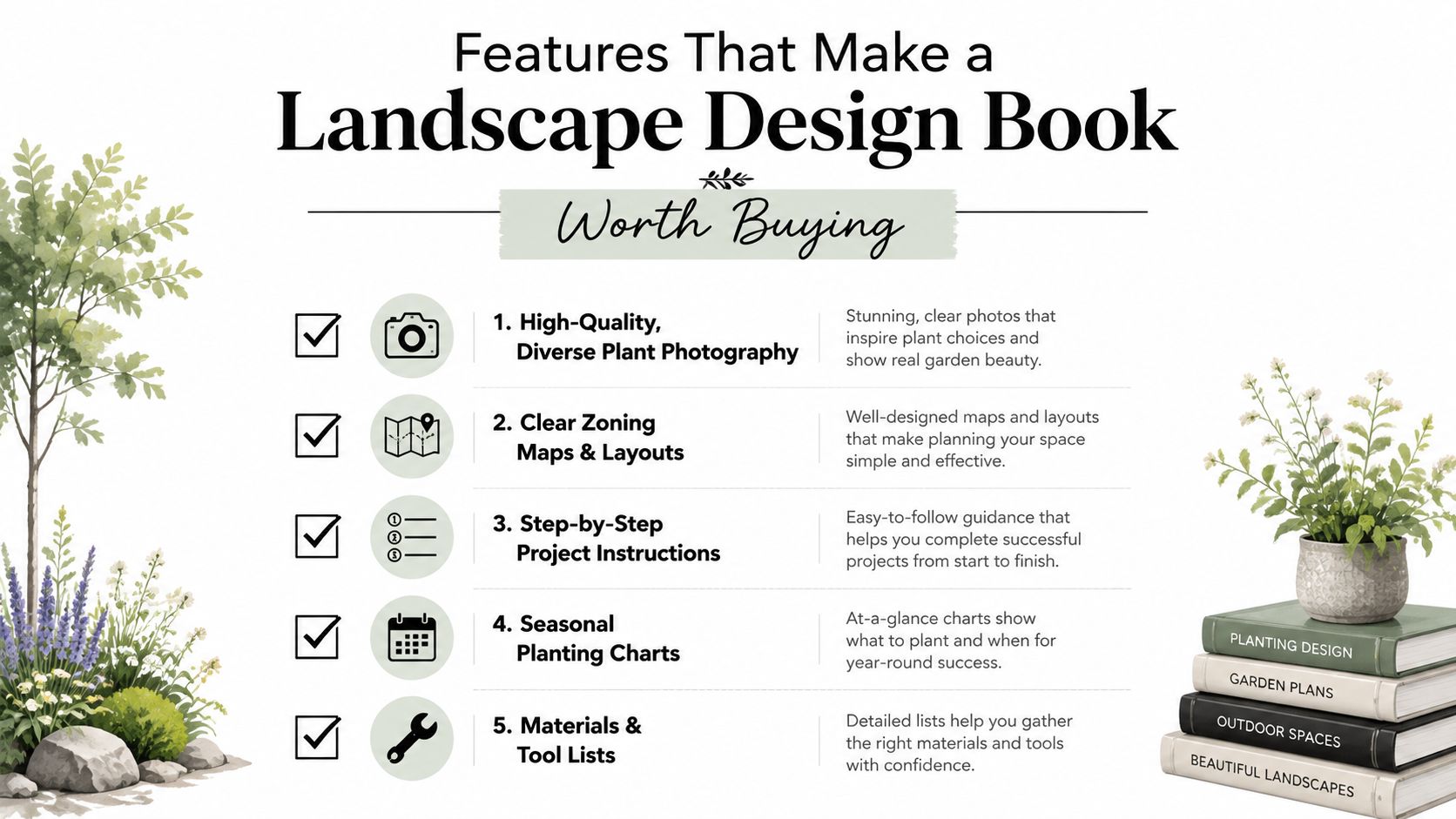
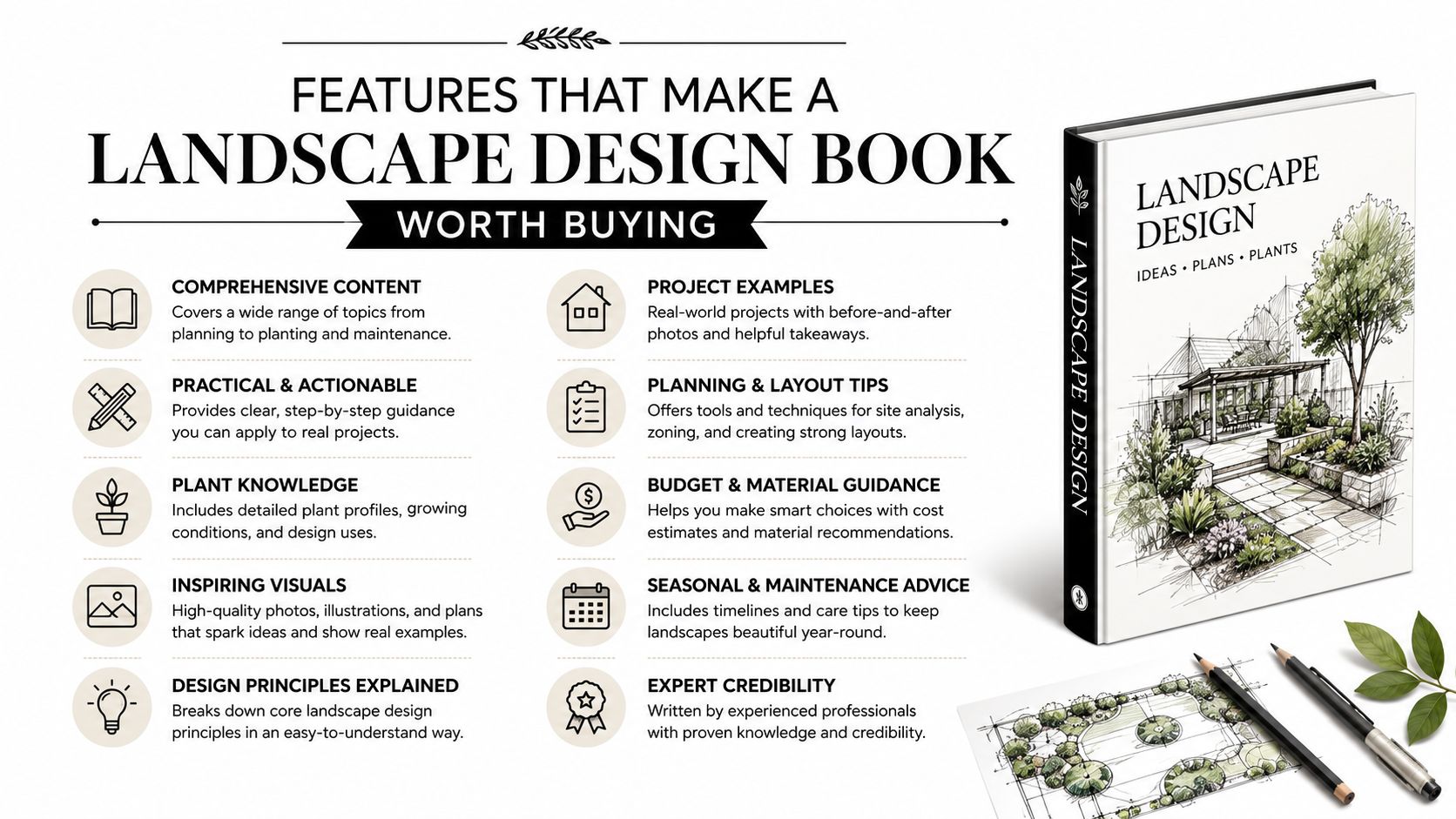
Features That Make a Landscape Design Book Worth Buying
A useful book earns its place by telling you what to do, not just what looks good. That's the whole test. If a title can't help you make a better decision about slope, spacing, materials, or maintenance, it's decoration wearing a hard hat.
What to look for inside the covers
Start with grading and drainage content. Books that explain contour lines, slope, runoff, and earthwork are worth far more to a homeowner than another page of pretty beds. A Guide to Site Planning and Construction covers contour lines, grading and earthwork calculations, site drainage, and erosion control, while the Architect's Pocket Book includes design guidance for materials, drainage, SuDS, planting densities, grass-seed rates, and maintenance programming (Google Books preview).
Next, look for plant hardiness and regional fit. A book that names plants without saying where they work is leaving half the job undone. Extension guidance on sustainable design says plants, site conditions, and placement should fit local needs, and that's the right standard for a homeowner too (University of Delaware Extension).
Then check for construction specs. The Harvard guide notes that Time-Saver Standards for Landscape Architecture serves as a source of site design and construction standards and data, which is exactly the kind of detail that keeps a residential project from turning vague or sloppy (Harvard GSD guide). If a book can't tell you how a patio edge, path base, or drainage detail should be thought through, it's not much use when the crew is on site.
Simple test: If the book has lots of glamour shots but no clear drawings, measurements, or material guidance, leave it on the shelf.
Finally, use your eyes. Clear diagrams, readable layout plans, and tables beat sprawling beauty spreads every time when the job is real. I want books that help a homeowner mark out a bed, think through water movement, and understand maintenance load before they start digging. A glossy book can still be fun, but fun is not the same thing as useful.
Best Picks Organized by Homeowner Goal
I'd spend the money if I were standing in your boots, trying to fix a real yard instead of decorating a bookshelf. I'm grouping the books by job, because that's how homeowners live with their projects. One person needs less mowing. Another needs water to move off the property. Another wants plants that belong here. Another wants a patio that won't feel like a DIY regret by next summer.
Compare the books by the problem they solve
| Homeowner Goal | Recommended Books | What Each Delivers |
|---|---|---|
| Low-maintenance yards | The New Low-Maintenance Garden, The Less Is More Garden, The New Southern Living Garden Book | Practical thinking for simplifying beds, shrinking upkeep, and keeping the design readable at home scale. |
| Drainage-aware design | A Guide to Site Planning and Landscape Construction, Landscape Architect's Pocket Book, Time-Saver Standards for Landscape Architecture | Slope, drainage, construction logic, and the kind of standards that keep water from becoming the main feature. |
| Native and climate-appropriate planting | Native Texas Gardens, Native Texas Plants, The Texas Native Plant Primer, How to Grow Native Plants of Texas and the Southwest | Plant choices that make sense for regional conditions and help homeowners stop guessing at what belongs. |
| Hardscape projects | Patio & Stone, Sunset Walks, Walls & Patio Floors, Hand-Built Outdoor Furniture | Buildable help for patios, paths, walls, and small features that need structure, not just style. |
For a homeowner who wants low upkeep, I'd start with titles that keep the plant list sane and the layout disciplined. The Less Is More Garden and The New Low-Maintenance Garden both push toward restraint, which is exactly what most overworked yards need. If you're trying to simplify a small lot or a cluttered front bed, those books are more useful than a giant dream-book.
For drainage, don't fake your way through it with a design title that only shows flower borders. Get the books that speak the language of grade and construction, because the fix has to move water, not just look tidy. If your backyard privacy problem is really a layout problem, this list of FenceScape privacy ideas can help you think beyond a row of shrubs and toward a more complete residential plan.
For native and climate-appropriate planting, the regional titles matter more than the universal ones. Native Texas Gardens, Native Texas Plants, and The Texas Native Plant Primer all keep the conversation rooted in place, which is the whole point. A homeowner who wants fewer plant losses and less hand-wringing should lean hard into books that talk region first.
For hardscape, I want books that show materials, structure, and build logic. Patio & Stone and Sunset Walks, Walls & Patio Floors stay closer to the job site than the coffee table, and that makes them better investments. If the project includes a deck-adjacent transition or a low-maintenance outdoor room, these composite deck landscaping inspiration ideas are a useful visual companion because they keep the focus on practical outdoor living, not just planting fluff.
If you buy more than one book, don't duplicate categories. Buy one that solves the layout or drainage issue, then one that handles plants for your region. That's the cleanest way to build a library that changes your yard.
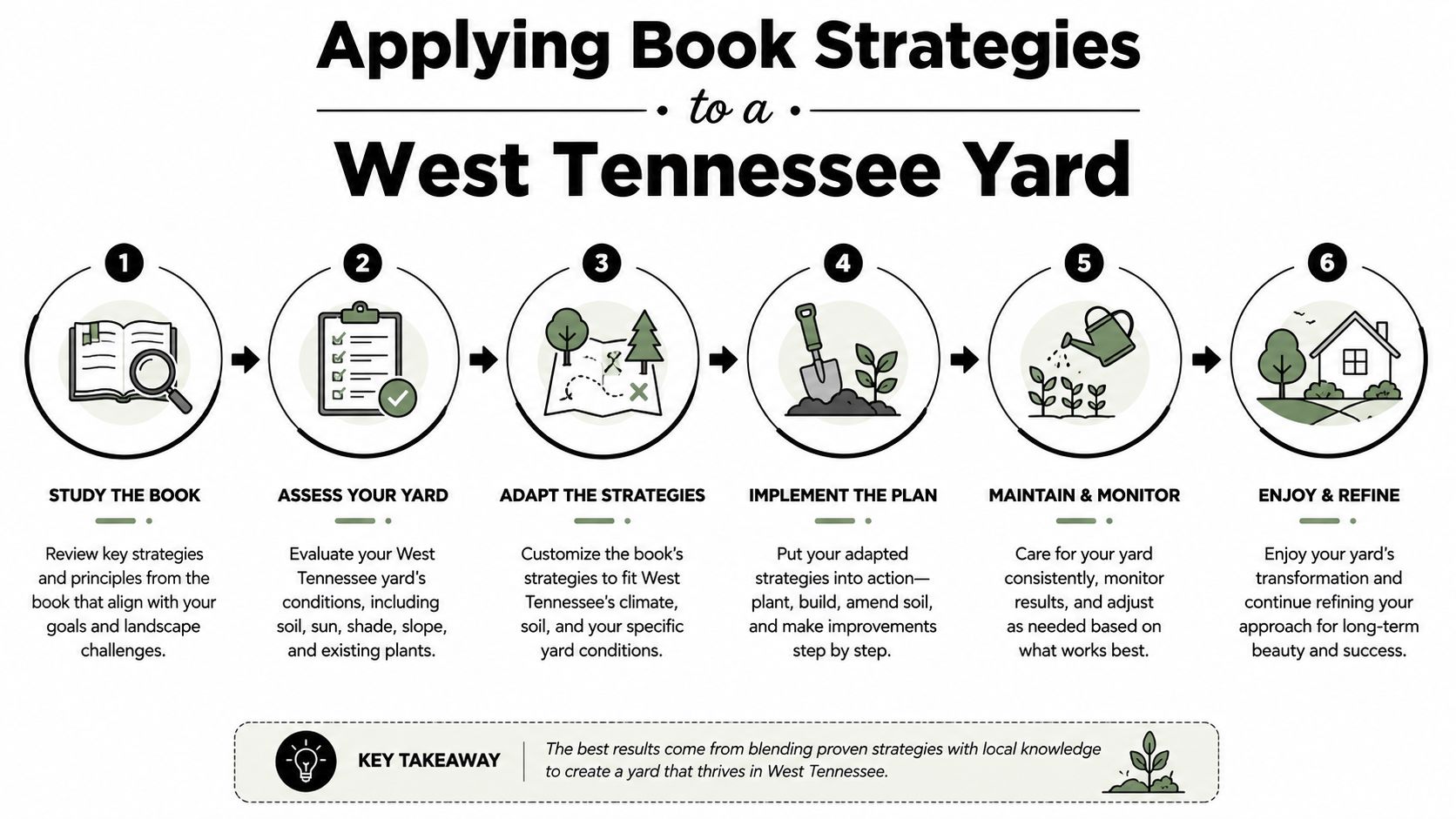
Applying Book Strategies to a West Tennessee Yard
A Jackson yard doesn't care how elegant the diagram looked in the book. Clay holds water, summer heat punishes weak plants, and storms show up with enough force to expose every bad grading decision. That means the page has to be translated, not copied.
Start with the ground, then the plants
A drainage diagram in a book should tell you where water is supposed to move. On a West Tennessee lot, I'd look first for the high point, the low point, and any place runoff naturally wants to collect. A contour line on paper is useful only if you understand that the slope itself is doing the work.
Read the land before you pick the plants.
Once the grading makes sense, I'd use regional planting guidance to choose material that can take wet feet at times and still survive summer stress. That's where native and adapted plant books earn their keep. A plant that looks great in a catalog but sulks in heavy soil is just a future replacement cost.
The same logic applies to layout. If the book shows a path or bed edge, use it as a pattern, then widen or simplify it for maintenance. Most residential lots need fewer moves, not more. The prettier the plan looks, the more ruthless you should be about asking whether it works with your mower, your hose, and your weekend.
A homeowner can get surprisingly far by borrowing three habits from good books. First, measure before you dig. Second, put water movement ahead of ornament. Third, choose plants and materials that don't fight the site. That's the difference between a plan that survives the first season and one that survives the decade.
If you want a second visual reference for the low-upkeep side of the yard, the book a free consultation resource from Kidzspace is useful as an example of how residential projects are often helped by a structured, expert conversation instead of more guesswork. The right book starts the thinking. The right plan finishes it.
When a Book Is Not Enough and a Pro Should Step In
Some problems are too expensive to solve with reading alone. Standing water that keeps returning, cracks tied to grading, unstable slopes, and drainage systems that need French drains or sump pumps are all signs that the next step is fieldwork, not more browsing. Books can help you understand the issue, but they can't measure the site, verify code requirements, or install a system that has to perform under pressure.
A licensed design and drainage contractor brings what the page can't. They can check elevations, judge soil behavior, work around utilities, and build with the equipment and warranty backing that a homeowner doesn't have in a garage. That's especially true on projects where water and structure are entangled, because a bad guess there can turn into erosion, settlement, or foundation trouble.
Know where the line is
If the project is a simple planting refresh, a book can carry a lot of the load. If the project affects drainage, grade, or retaining structure, the book should support the decision, not replace the professional.
That's the mindset I want homeowners to keep. Books make you a better client. They help you ask sharper questions, spot weak plans, and compare ideas with some confidence. But when the yard is already failing, the smartest move is to pair that knowledge with a contractor who can execute the fix properly. If you're comparing local companies and trying to decide who to trust with the work, this guide on how to choose the right landscaping company in Jackson, TN is the right next read.
For homeowners who want a sanity check before they spend on a major fix, the FenceScape privacy ideas article is another reminder that a good outdoor plan is often about solving a functional problem first. And when the issue is beyond the page, the right pro keeps the repair from turning into a repeat project.
If your yard needs more than a stack of books and a weekend of wishful thinking, Lawn & Leaf Solutions can help you turn the plan into something that works in West Tennessee soil and weather. They handle the drainage, installation, and maintenance details that books only describe, which is exactly what keeps a good idea from becoming a costly redo. Visit Lawn & Leaf Solutions if you want a yard plan that's grounded in real site conditions and built by people who do this work every day.