
You notice it the morning after a hard West Tennessee rain. The house smells a little earthy, a little stale, and a little wrong. Maybe the floors feel cooler than usual. Maybe the air inside feels sticky even though the AC is running. You crack a window, light a candle, and hope it passes.
Usually, it doesn't.
In Jackson and across West Tennessee, crawl space moisture problems often start subtly. A musty smell shows up before you ever see standing water. Then insulation starts sagging. Wood stays damp. Pests find a comfortable place to nest. By the time a homeowner finally looks under the house, the problem has often been active for a while.
Our region makes this worse. We get heavy rains, humid stretches, and soils that can hold water instead of letting it move away quickly. That means crawl space drainage has to be matched to the property, not copied from a generic article written for some other climate. A house on one lot may need simple grading and downspout work. Another may need a full interior drainage system because the water pressure around the foundation never really goes away.
That Musty Smell Is a Warning Sign
A lot of homeowners first call about odor, not flooding.
They'll say the house smells damp after rain, or the smell gets stronger in a hallway, closet, or near the return air vent. In many homes, that odor is coming from the crawl space. Moisture under the house doesn't stay under the house. It affects wood, insulation, indoor air, and eventually how the whole home feels.
In West Tennessee, that first warning sign matters because our weather gives moisture plenty of chances to build up. A single storm can expose weak grading, short downspouts, clogged drainage paths, or a crawl space that never fully dries between rains.
What that smell usually means
A musty odor is rarely just “old house smell.” It usually points to one of these conditions:
- Damp soil under the house that keeps releasing moisture into the air
- Wet framing or subflooring that stays cool and slow to dry
- Mildew or mold activity on wood, insulation, or debris
- Poor drainage outside that lets water collect near the foundation
If your home also has lower-level moisture issues, this guide on preventing basement flooding helps connect what's happening below grade to the larger drainage picture.
Musty air is often the first symptom homeowners notice. It's not the first part of the problem. It's just the first part you can smell.
Sometimes the smell source isn't the crawl space itself. Sewer gas, trapped water in exterior drains, or stagnant runoff can confuse the diagnosis. If you want a useful comparison for odor troubleshooting, this piece on practical advice for UK drainage problems shows how drainage odors can travel and linger in ways people don't expect.
Why early action matters
Homeowners often wait because they don't see puddles. That's a mistake.
A crawl space can stay too wet long before it ever looks flooded. Persistent dampness can lead to wood decay, insulation failure, and air-quality complaints upstairs. The earlier you trace the water path, the more options you usually have. Sometimes that means a shovel, a downspout extension, and a grading correction. Sometimes it means a sump and perimeter collection system.
Either way, the smell is doing you a favor. It's telling you to look under the house now, not six months from now.
Reading the Signs of Crawl Space Water Damage
You don't need special equipment to spot the early signs. You need a flashlight, a careful eye, and a willingness to slow down.
Start with your nose before you start with your eyes. A damp, sour, earthy smell often tells the truth faster than a quick visual scan.
What to look for on walls and floors
One of the clearest signs is efflorescence, the white powdery residue that shows up on masonry surfaces after water moves through them and leaves mineral deposits behind.
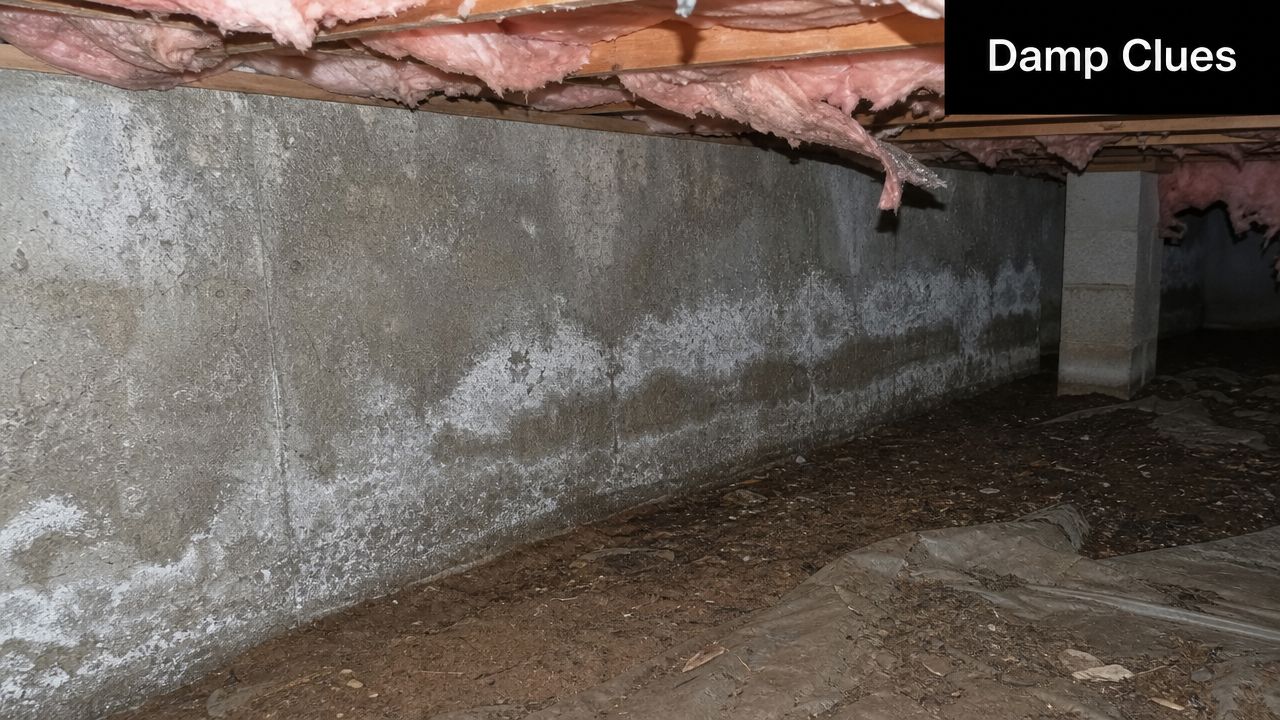
If you see that white staining on block or concrete, water has been moving through or against that surface. It doesn't always mean active flooding, but it does mean moisture is part of the foundation's story.
Look for these clues as you move around the crawl space:
- White staining on block or concrete that points to seepage through masonry
- Darkened soil or wet spots that stay damp well after rain
- Mud trails or washed channels that show water is entering with force
- Plastic sheeting with puddles above or below it that signals trapped moisture or poor drainage pathing
What to check overhead
Don't keep your flashlight pointed only at the ground. Raise it to the framing.
Check floor joists, beams, subflooring, and insulation. Trouble often hangs overhead before it collects underfoot.
- Soft, discolored, or fuzzy wood can indicate long-term moisture exposure
- Falling insulation usually means it has absorbed moisture, lost attachment, or both
- Rusting metal fasteners or hangers can signal a consistently damp environment
- Staining around plumbing penetrations may point to leaks that are being mistaken for groundwater
Practical rule: If insulation is hanging down, wood feels damp, and the air smells stale, don't assume you have one small issue. You probably have a moisture cycle.
Signs that point beyond water alone
Damp crawl spaces attract other problems.
Pests like moisture, shelter, and soft materials. If you see nesting, droppings, chewed insulation, or insect activity, water may be the underlying reason those pests settled there in the first place. A wet crawl space also tends to stay cooler and more humid, which makes mold and mildew easier to sustain.
For another practical overview of what chronic moisture does under a house, FHP Contracting's moisture solutions offer useful examples of how these symptoms tend to show up together.
A simple severity check
If you're trying to judge whether the issue is mild or serious, ask yourself:
- Does the smell return after every rain?
- Do materials stay wet for days instead of drying out?
- Are signs spread across the whole crawl space, not one isolated area?
If the answer is yes to all three, the problem is usually larger than surface moisture.
Assessing Your Property and Its Water Sources
Most crawl space water problems start outside.
Homeowners often focus on what they see under the house, but the actual cause is usually something much more ordinary. Roof runoff is dumping next to the foundation. The yard slopes the wrong way. A low spot keeps holding water. A neighbor's elevation sends runoff across your lot.
Walk the house after a rain
The best time to inspect your property is while water is moving.
Take a slow lap around the house and watch where runoff goes. Don't look only at the foundation. Look uphill, downhill, and anywhere the yard funnels water.
Check these items first:
- Gutters full of debris that overflow at the corners
- Downspouts ending too close to the house so roof water drops right back at the foundation
- Mulch beds or flower beds built up against siding that can trap moisture
- Low areas near crawl space vents or access doors where water sits after storms
If you've got pooling in the lawn as well as trouble under the house, this guide to standing water in yard solutions helps identify which outdoor drainage failures are feeding the problem.
Read the grade, not just the puddle
A lot of people look for dramatic washouts and miss the small slope errors that cause long-term trouble.
Walk several feet away from the foundation and look back. If the soil pitches toward the house, even slightly, water will keep working its way inward. In West Tennessee, that matters because repeated wetting is often the issue, not one major flood. Clay-heavy soils and compacted areas can hold water close to the house longer than homeowners expect.
The question isn't only “Did water get in?” The better question is “Why did water stay near the foundation long enough to get in?”
Why drainage is treated as a building issue
This isn't just contractor preference. Drainage is recognized as part of proper crawl space design.
North Carolina's residential code guidance states that if a wall-vented crawlspace is built where water might collect, an approved drainage system is required, and the crawlspace floor must be graded toward a drain according to the state code guidance on drainage in wall-vented crawlspaces. That matters because it reflects a broader construction principle. Water management under a house isn't an optional add-on when site conditions create standing-water risk.
Common source patterns in West Tennessee
Some properties have one obvious source. Many have two or three working together.
A typical pattern looks like this:
| Source | What it looks like | What it often causes |
|---|---|---|
| Roof runoff | Splashing or erosion at corners | Localized wet spots near foundation |
| Negative grading | Soil sloping back toward house | Widespread seepage after rain |
| Yard low spot | Water sitting near one side of home | Repeated dampness in same crawl area |
| Below-grade crawl floor | Water pressure from surrounding soil | Chronic entry from multiple points |
If you can identify the source pattern, you're already much closer to choosing the right fix.
Exterior Drainage Solutions for Prevention
Exterior drainage is your first line of defense. If you can keep water from collecting around the house, you reduce what the crawl space ever has to deal with.
That doesn't mean every exterior fix solves every crawl space issue. It means you should start by controlling the water you can intercept before you spend money managing water after it has already entered.
Regrading the soil
When the ground pitches toward the house, regrading is often the cleanest correction.
This works best when the slope problem is moderate, the yard has enough space to reshape, and runoff is mostly surface water rather than rising groundwater. A proper grade helps shed water away from the foundation before it has time to soak in.
Pros
- Addresses the problem at the surface
- Can improve both yard drainage and foundation conditions
- Often pairs well with simpler fixes like downspout extensions
Cons
- Doesn't solve deeper groundwater pressure by itself
- Can be limited by patios, sidewalks, driveways, and property lines
Catch basins and downspout extensions
If roof water is the main culprit, this is often where I'd start.
A house can dump a lot of water off the roof during a storm. If gutters overflow or downspouts release near the foundation, you're creating your own crawl space problem. Catch basins, buried drain lines, and longer downspout runs move that water away before it saturates the soil around the home.
A drainage system doesn't have to be complicated to be effective. It does have to collect water at the right spot and send it somewhere that stays dry.
This approach is a strong fit when you see erosion at corners, splashback on siding, or consistent wetness directly below gutter outlets.
Exterior French drains
An exterior French drain can be useful when water moves across the yard toward the house and you have a good discharge point.
It's not a cure-all. It works when the drain is placed where water travels, installed with the right fall, and connected to a discharge route that won't back up. If those conditions aren't there, a French drain can become an expensive trench that never really fixes the issue.
For homeowners comparing layouts and installation basics, this overview of how to install a French drain system shows the core components and where they make sense.
Choosing the right outside fix
Here's the practical comparison:
| Solution | Best use case | Main advantage | Main limitation |
|---|---|---|---|
| Regrading | Surface water moving toward foundation | Fixes slope at the source | Limited by site layout |
| Downspout drainage | Roof runoff dumping near home | Direct, targeted correction | Won't solve groundwater |
| Catch basins | Concentrated low spots or hardscape runoff | Captures surface flow quickly | Needs proper outlet |
| Exterior French drain | Water crossing the yard toward the house | Intercepts runoff before it reaches foundation | Depends on placement and discharge |
The mistake I see most often is choosing a system before identifying the water path. Homeowners hear “French drain” or “sump pump” and assume the product is the diagnosis. It isn't. The right answer depends on whether the water is falling from the roof, flowing across the yard, pushing through the soil, or some mix of all three.
Interior Crawl Space Drainage Systems Explained
When water still gets into the crawl space after exterior improvements, or when the site naturally drives water toward the house, an interior system becomes the reliable way to control it.
The simplest way to think about it is this. An interior drainage system works like a gutter system for the inside edge of your foundation. Instead of trying to pretend water will never enter, the system accepts that some water will reach the crawl space perimeter and gives it a controlled path out.
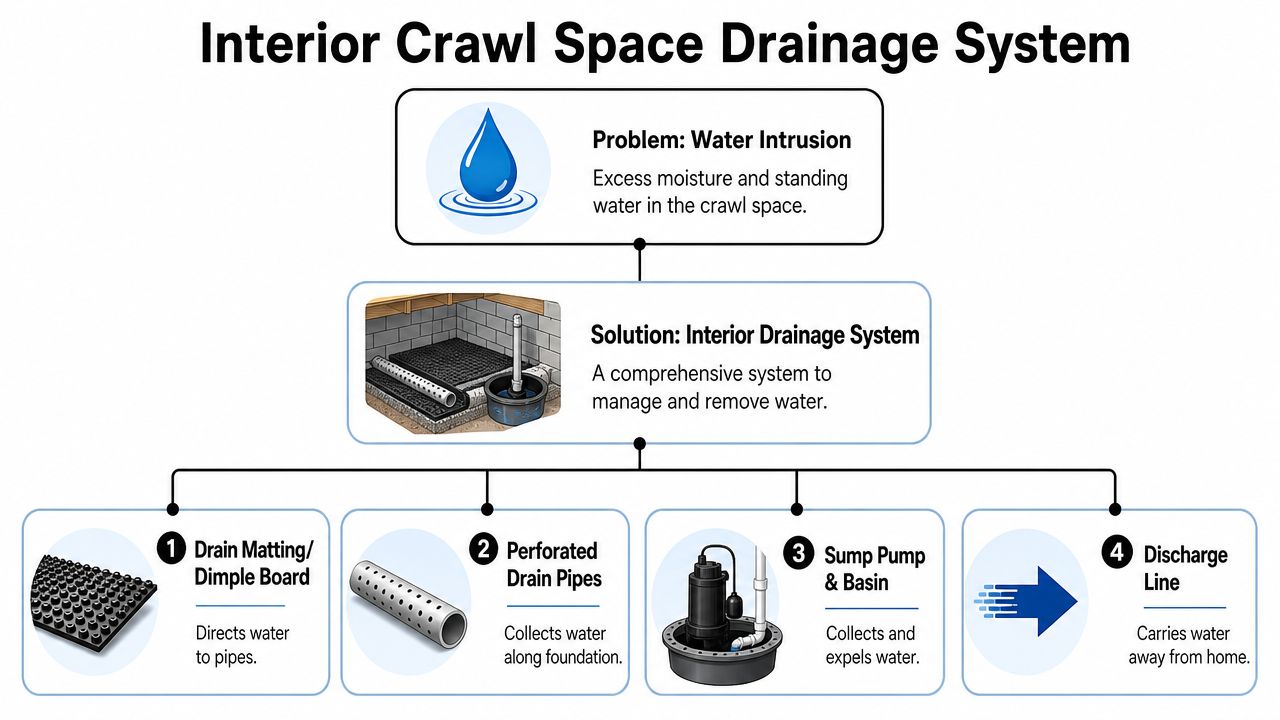
What a proper system includes
A professionally installed crawl-space drainage system is more than an open trench. It uses a perimeter drain to collect seepage and route it to a sump pump, and Energy Star guidance for closed crawl spaces also recommends grading the floor to a low point with drains installed to remove bulk water before encapsulation materials go down, as described in this overview of crawl-space drainage system design.
The parts matter because each one does a separate job.
- Perimeter trench or channel collects seepage where water shows up most often, usually along the wall or footing area.
- Perforated drain pipe gives that water a path to travel instead of letting it spread across the crawl space.
- Gravel and filter fabric protect the system from silting in and losing capacity.
- Sump basin and pump remove collected water when gravity alone won't do it.
- Ground cover or vapor barrier helps reduce moisture rising from the soil after bulk water is managed.
Why cheap systems fail
A shallow trench without proper stone, pipe support, and filtration may work for a while. Then silt moves in, water bypasses the collection path, and the crawl space gets wet again.
The detailing is what separates a lasting installation from a temporary one. Recommended assemblies use gravel around and over perforated pipe plus soil-filter fabric to reduce clogging, and the crawl-space floor should slope toward the drain or sump. Guidance also notes that crawl space drains should terminate outdoors or into an interior drain or sump, and gutter or foundation drains should not tie into that line, as summarized in this crawl space building code checklist.
Field note: If the pipe can clog, the pump can't save the system. Collection has to work before discharge matters.
Drainage solution comparison
| Solution | Best For | Pros | Cons |
|---|---|---|---|
| Interior perimeter drain | Seepage along walls and footing edges | Captures recurring intrusion at the perimeter | Requires trenching and proper discharge |
| Sump pump only | Limited water collecting at one predictable low point | Direct removal of collected water | Doesn't collect widespread seepage by itself |
| Vapor barrier only | Ground moisture control after water entry is addressed | Helps reduce humidity from exposed soil | Won't manage active water intrusion |
| Full interior system with sump and barrier | Chronic seepage or broad moisture problem | Handles collection, removal, and moisture control together | Larger project scope |
If you're weighing interior collection against outside interception, this comparison of sump pump vs French drain is useful because it frames the decision around how water behaves, not just what product sounds familiar.
The role of vapor barriers
A vapor barrier is important, but homeowners often expect it to do work it can't do.
Plastic on the ground helps slow moisture vapor from the soil. It does not stop liquid water from entering the crawl space perimeter. If bulk water is still coming in, encapsulating too early can trap moisture problems instead of solving them first.
That same principle applies in other below-slab and below-floor assemblies. If you want a good side reference on moisture control layers, this garage floor vapor barrier guide gives a clear look at why material placement and sequence matter.
A good system handles water first, then humidity.
Understanding the Costs and Project Scope
Most homeowners want the price first. That's understandable. Crawl space drainage isn't a small cosmetic repair. It's a real water-management project under the house.
The final number depends on the layout, access, moisture severity, discharge route, and whether you're solving only water collection or also adding moisture control measures like a new ground cover or encapsulation.
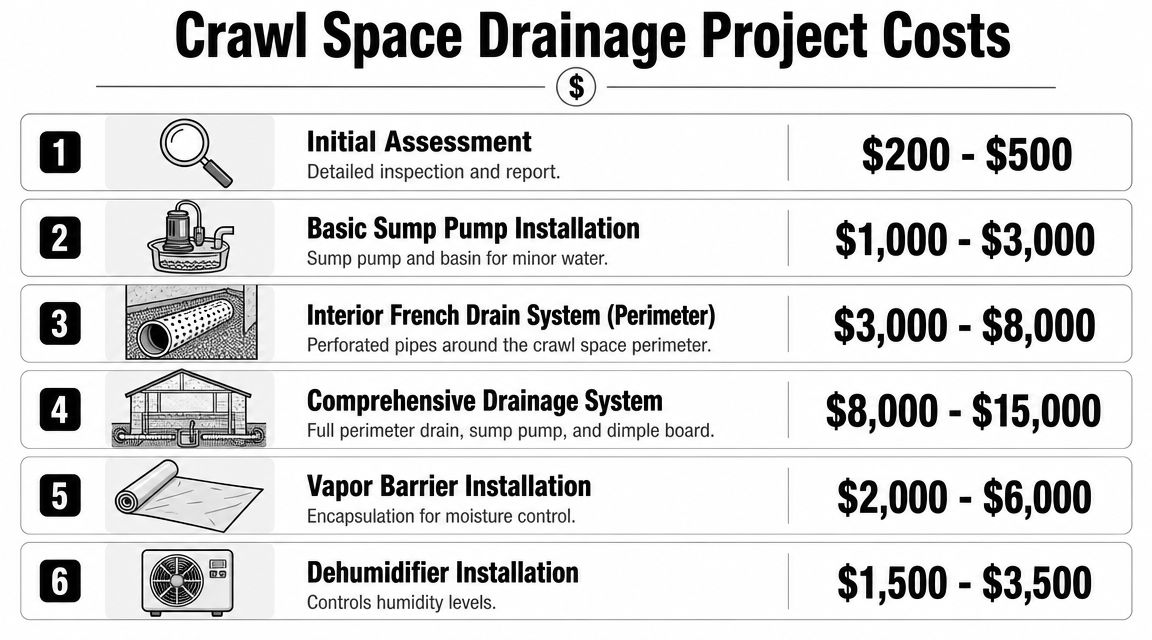
What current pricing shows
For a typical 1,200-square-foot home needing 140 to 180 linear feet of drainage, a full perimeter interior system with a sump pump averages $5,000 to $9,000, while a system that also includes full encapsulation can rise to $8,000 to $12,000, according to this 2026 pricing overview for crawl space drainage system cost.
That same source says contractors often price installation at $30 to $70 per linear foot. On the material and labor side, that puts many projects in the range of roughly $4,200 to $12,600 before add-ons, using the same source and home-size example.
What changes the quote
Two crawl spaces that look similar from the front yard can price very differently.
Here are the biggest cost drivers:
- Linear footage needed because perimeter systems scale with the amount of crawl space edge that needs collection
- Water severity since broad seepage usually requires more than a localized fix
- Discharge complexity if pumped water has to be routed farther or around obstacles
- Moisture-control add-ons such as replacing an old vapor barrier or pairing drainage with encapsulation
- Access difficulty when the crawl space is tight, obstructed, or hard to work in
Why cheap estimates can be misleading
Low bids often leave out the parts that make the system last.
That may mean limited collection footage, undersized discharge planning, poor trench detailing, or no real attention to how the floor slopes. If a quote sounds dramatically simpler than what the site conditions suggest, ask what water source it's designed to handle.
For homeowners trying to compare trenching and yard-side costs with foundation-adjacent work, this guide to the cost of French drain installation can help you separate outside drainage pricing from full crawl space system pricing.
Think in terms of scope, not just price
A sump pump alone is not the same project as a full perimeter collection system. A plastic ground cover is not the same project as drainage plus encapsulation.
The better question is not “What does crawl space drainage cost?” It's “What level of intervention does this house need?” Once that's clear, the price makes more sense.
DIY Tips vs When to Call a Professional
A lot of crawl space moisture problems start with something simple outside the house. In West Tennessee, I see that often after a hard rain on clay-heavy soil. Water does not soak in quickly, so a short downspout, a settled flower bed, or a clogged gutter can send it straight toward the foundation.
That is the kind of issue a homeowner can often handle without getting into a major repair.

Good DIY jobs
These are reasonable do-it-yourself tasks if the water problem is minor, visible, and limited to surface runoff:
- Clean and test gutters during the next rain so you can spot overflow and leaks
- Add or improve downspout extensions where roof water is dumping near the foundation
- Touch up shallow grading where a small area beside the house has settled and now holds water
- Clear leaves, mulch, and debris from drainage paths so runoff can keep moving away from the home
Those jobs help because they reduce how much water reaches the crawl space in the first place. Sometimes that is enough. Sometimes it is only the first step.
When DIY stops making sense
Bring in a professional if the source is unclear, if water is showing up across several parts of the crawl space, or if the repair involves trenching, pumps, electrical work, or figuring out where collected water can discharge safely.
One site condition matters a lot. If the crawl space floor sits lower than the outside ground, the house is already set up to collect water during wet periods. In that case, a sump pump by itself usually is not the whole answer. As explained in this guide to a crawl space floor below outside ground level, homes with that layout often need perimeter collection along with pumping because water can enter from more than one side.
A bag of gravel and a short pipe will not solve a year-round drainage pattern.
A practical decision rule
DIY work makes sense if all three of these are true:
- You can clearly see the source from outside
- You can fix it without trenching inside the crawl space or installing a pump
- You can check the result during the next rain and tell whether the fix worked
If one answer is no, the safer move is to get the site evaluated.
For homeowners in Jackson and across West Tennessee, Lawn & Leaf Solutions handles drainage installation work such as French drains, sump pumps, and yard water-management systems. That level of work makes sense when basic runoff fixes do not match the actual cause.