
You can stand in a West Tennessee yard after a hard rain and see the whole story at once. The low spots are holding water, the clay is slick, the mulch has washed into the driveway, and the front bed looks crowded even though the shrubs were “small” when they went in. That's usually the moment homeowners realize outdoor design isn't about picking pretty plants first, it's about fixing the yard in the right order.
Outdoor space design basics start with the site you already have, then the structures you add, then the plants that have to live with both. The old rule still holds in modern practice, the process starts with the user's needs and the site's conditions, then organizes line, form, color, texture, and visual weight into functional outdoor rooms Hunter Irrigation's history of landscape design. In plain terms, a good plan answers where water goes, where people walk, what gets shaded, and what can survive in the soil you've got.
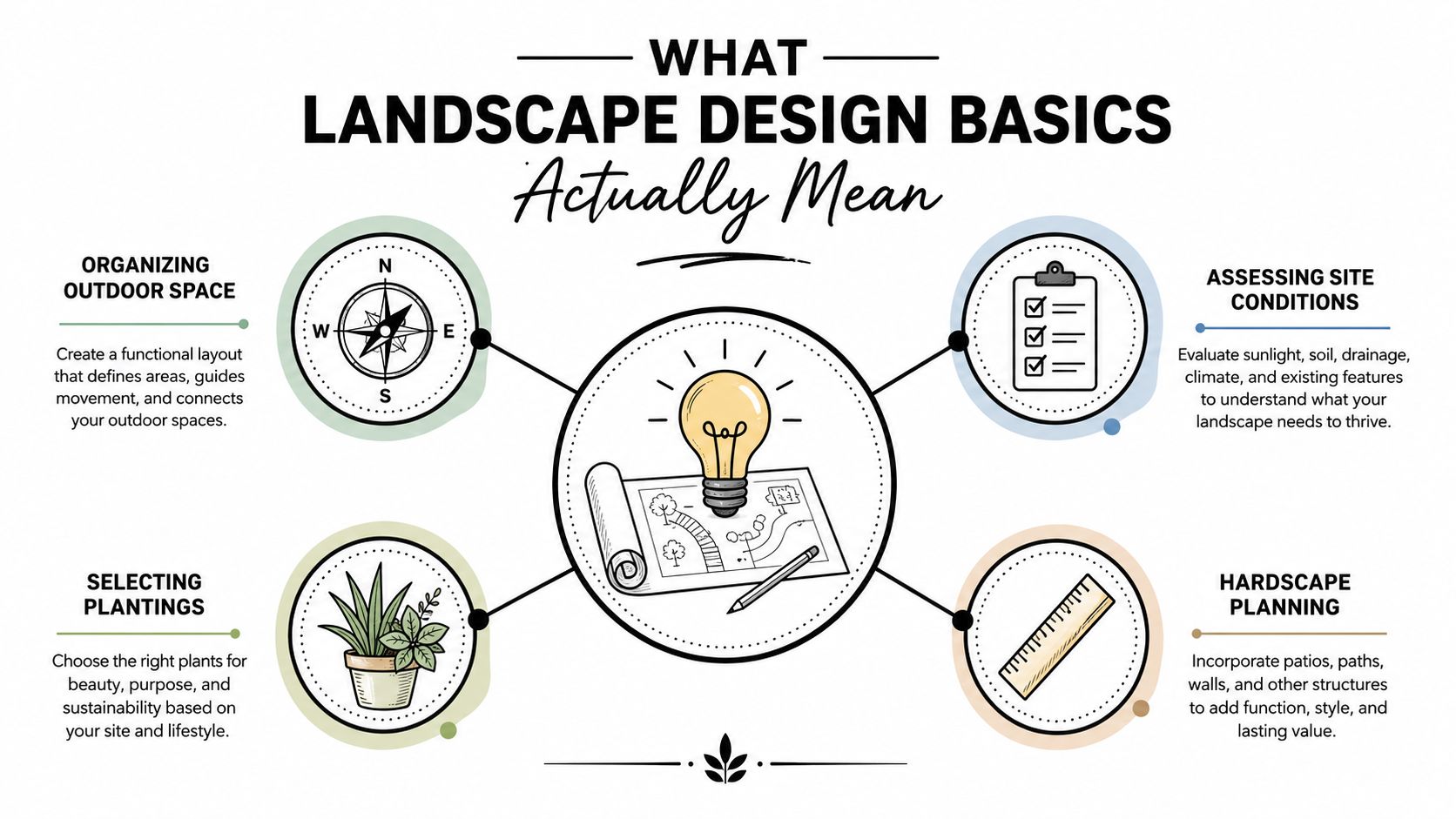
What Landscape Design Basics Actually Mean
A front yard can look fine from the street and still fail the moment rain hits, shade shifts, and the clay starts holding water. That is the point where yard design basics stop being abstract and start becoming a working plan for real soil, real drainage, and real foot traffic.
Three layers that matter
The simplest way to read outdoor space design fundamentals is in three layers. The first layer is the site, which means slope, drainage, sun, soil, utilities, and anything that already lives there. The second layer is structure, which includes paths, beds, edging, walls, and other hard elements that give the yard shape. The third layer is planting, which fills the structure and softens it with living material that can handle the site.
That order matters in West Tennessee because heavy clay, sudden downpours, and long humid stretches punish plans that start with plant color and end with drainage. I've seen yards where every plant was chosen with care, yet the layout still failed because the bed shape trapped water or the walk ran straight through the wettest part of the property. A good-looking plan that cannot shed water will keep creating the same problems.
A better way to judge any plan is simple. First, read what the yard is already doing. Second, decide where people need to move and where water needs to go. Third, choose plants that can live inside that structure without constant rescue work. If you want a practical checklist for those decisions, use these 10 yard rules to keep in mind.
Practical rule: If the site keeps fighting your idea, the site usually wins.
A basic plan should feel like problem-solving, not decoration shopping. That may sound plain, but the useful part of design is often hidden once the work is finished. A bed that drains right, a path that does not turn slick, and a shrub that reaches full size without crowding the porch all count as good design. In this region, that usually means respecting clay soil, giving runoff a clear path, and choosing materials that can hold up through summer humidity.
Reading Your Site Before You Draw Anything
The smartest yard plans start on foot, not on a computer. A pencil sketch and a slow walk tell you more than a dozen saved photos ever will, especially in a region where one hard rain can expose every grading mistake at once.
Four checks to make before you buy anything
Start with sun exposure. Walk the property morning, midday, and late afternoon, and mark where the full sun, part shade, and deep shade land. A spot that looks sunny in March may be swallowed by tree shade in June, and that matters for plant choice, mowing, and how fast the soil dries after storms.
Next, check the soil and drainage. West Tennessee clay often holds water instead of shedding it, so you want to see where puddles sit, where the surface crusts, and where water disappears slowly. NOAA's recent weather pattern data isn't needed to prove what local homeowners already know from experience, storms are strong enough to expose weak drainage fast, and the site will tell you the truth after rain.
Then study slope and water flow. Watch where runoff moves from the roof, driveway, and lawn. A yard doesn't need dramatic hills to have a drainage problem, because flat ground can still collect water in the wrong place and send it toward beds or foundations.
Finally, note the existing features. Keep the useful stuff on the site, such as mature trees, downspouts, utilities, existing beds, walks, and retaining edges. The North Carolina State Extension recommends drawing a scaled base plan, using about 1 inch = 10 feet for an average homeowner's outdoor space, and mapping items like utilities, roof overhangs, existing beds, and drainage conditions before any layout decisions are made NC State Extension landscape design guidance.
Write the sketch by hand first. You'll notice problems faster than you will on a screen.
That one-page site inventory becomes the filter for every other decision. If a corner stays wet, it doesn't get a thirsty plant just because the tag looked pretty. If a bed is in brutal afternoon sun, it doesn't get a shade lover because a nursery display was staged in filtered light.
A quick sketch, a few notes, and a rain check after a storm are enough to start well.
The Core Design Principles Made Simple
Good design feels balanced because the eye knows where to rest. In a yard, that works much like arranging furniture in a room. You don't push every chair against one wall, and you don't put the sofa wherever it happens to fit, you place the anchor pieces first, then let the rest support them.
How the eye reads a yard
Unity means the yard feels like one place instead of a pile of unrelated parts. In practice, that usually means repeating a few materials or plant types so the front walk, beds, and porch don't all speak different languages. Balance means the visual weight feels intentional, which can be formal and symmetrical or looser and asymmetrical depending on the house and lot.
Scale is the one beginners miss most often. A small foundation bed filled with oversized shrubs swallows the house, while tiny plants dropped into a big front yard disappear. Design composition has long used rules like proportion, order, repetition, and unity to create functional outdoor rooms that are attractive and usable Hunter Irrigation's history of landscape design.
Rhythm comes from repetition with small changes. Think of three similar shrubs repeated along a walk, or a tree, then a shrub mass, then a perennial sweep that guides the eye. Focal point is the thing that stops the eye, maybe a specimen tree, a small water feature, or a tighter planting group at the end of a view line.
A front yard example that works
If the front bed feels flat, one change can fix a lot. Move one shrub group closer to the walk to tighten the composition. Replace a pair of identical plants with an uneven grouping if the house feels too stiff. Add a single tree or sculptural shrub where the eye needs a landing spot.
The Garden City movement in England helped formalize the idea that planned green space belongs inside communities, not just as decoration landscapingduty.com on landscaping history. That idea still matters here because a West Tennessee yard has to do more than look good from the street. It has to handle kids, muddy weather, delivery traffic, and the kind of storms that expose weak layouts.
A practical test helps. Step back from the street, squint, and look for clutter. If every plant fights every other plant, the layout needs fewer types, fewer shapes, and stronger anchors.
Choosing Plants That Thrive in West Tennessee
Plant tags tell you more than the flower color ever will. Look first at mature size, sun needs, and the plant's tolerance for the soil and moisture you already identified. That's the difference between a bed that settles in and one that starts crowding sidewalks, hiding windows, and needing repeated pruning.
Build from the top down
University of Florida IFAS and Virginia Tech both emphasize planning with mature size and layering in mind, starting with trees and moving down through shrubs, perennials, and groundcover University of Florida IFAS plant layering guidance. Virginia Tech also notes that plan circles should represent approximate mature spread, often about two-thirds of listed height for spread unless otherwise specified Virginia Tech landscape planning guidance. That's not a guess, it's a practical benchmark that keeps new beds from looking packed too early.
In West Tennessee, I like plants that forgive clay and humidity without constant babysitting. Native dogwoods bring seasonal interest and fit smaller spaces well when the drainage is decent. Crepe myrtles work when they're given enough room and full sun. Dwarf yaupon hollies hold shape nicely near walks and foundations. Coneflowers are an easy perennial choice where the soil drains and the sun is honest.
The plants that disappoint most often are the ones that hate wet feet or that outgrow the space before the homeowner expects it. In heavy clay, avoid stuffing moisture-sensitive shrubs into a low corner just because the bed looked empty on installation day. A nursery pot can hide a lot of future trouble.
| Layer | Plant | Sun | Mature Size | Why It Works |
|---|---|---|---|---|
| Tree | Native dogwood | Part shade to sun | Small to medium, site dependent | Fits front-yard scale and gives seasonal structure |
| Tree or large shrub | Crepe myrtle | Full sun | Varies by cultivar | Handles heat well when given space |
| Shrub | Dwarf yaupon holly | Sun to part shade | Compact | Good near entries and along walks |
| Perennial | Coneflower | Full sun | Clumping perennial | Reliable color in a layered bed |
| Groundcover | Low, spreading cover suited to the site | Sun to part shade | Low and broad | Helps knit beds together and reduce bare soil |
Use the internal guide on landscaping in Tennessee if you want a regional lens on site fit and plant behavior.
The trick is matching the plant to the weak point in the yard. If the bed bakes in afternoon sun, pick for sun. If a corner stays damp after rain, pick for drainage tolerance or redesign the grade before planting. That loop, site first, plant second, saves money and keeps the yard from looking tired by year three.
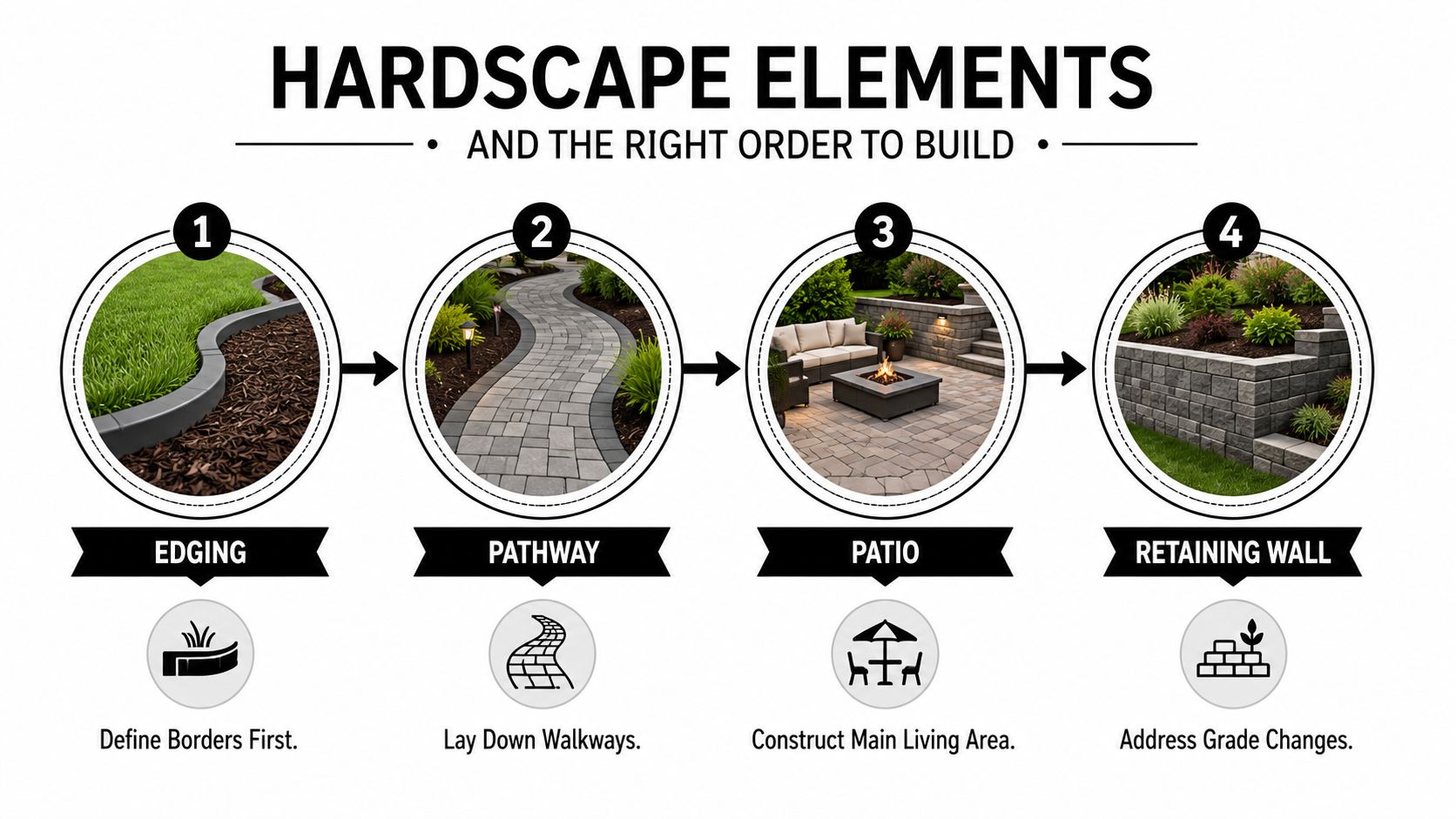
Hardscape Elements and the Right Order to Build
Hardscape is the skeleton of the yard. Edging, paths, patios, and walls define how people move and where the eye stops, while also keeping lawn grass from creeping into places it doesn't belong.
Build the shell before the soft parts
The right order protects the work. Start with rough grading, then solve drainage, then install hardscape, then add irrigation, then plant, and finish with mulch. If you skip the first two steps and lay turf or finish beds too early, the first storm can wash the project into a redo.
That sequence is especially important in yards that hold water or slopes that send runoff toward the house. A patio that's perfectly poured still fails the job if the surrounding grade collects runoff at its edge. The same is true for borders, because a clean bed edge won't help if water keeps cutting through it.
For homeowners planning decorative concrete, a useful reference point is the range of concrete work by Atlanta Concrete Solutions at Atlanta Concrete Solutions decorative residential concrete. It helps to see how slabs, finishes, and layout decisions affect the rest of the outdoor space before anything gets built.
The material choice matters, but the sequence matters more. A solid walkway, a sensible patio edge, and a retaining wall that responds to grade changes all help the planting feel deliberate instead of dropped in at random.
If timber edging or raised borders are part of the plan, the fit matters there too. The internal guide on landscape timber installation is useful when you're deciding how to frame beds without making the yard look overbuilt.
Put the hardscape where the water and feet naturally want to go, not where an empty patch happens to be.
That mindset keeps the whole property cleaner. It also stops the common shortcut of building around bad drainage, which looks finished for a season and then starts failing at the edges.
Fixing Drainage Before It Fixes You
Water is either part of the design or it becomes the problem that rewrites the design later. In West Tennessee, that's not theory. Clay soil, sudden storms, and long humid stretches make drainage one of the first things a yard has to get right.
Three tools that solve most yard water issues
Grading is the first and simplest move. Soil should slope away from the house so water doesn't sit at the foundation or back up into beds. This is the right fix for a yard that feels soft after storms but doesn't have a hidden pipe issue.
A French drain works when subsurface water keeps showing up in a low, wet area. It collects water below the surface and moves it away before the soil stays saturated too long. That's useful for soggy back corners, wet fence lines, and areas that never really dry out.
A channel drain belongs where water races across hardscape. Driveways, patio edges, and transitions from slab to lawn are common places for surface flow to cause trouble. If water sheets across the concrete and heads toward the garage or bed, a channel drain gives it a controlled path.
Know when DIY ends
Some drainage work is a weekend project. A small regrade, a simple downspout extension, or better surface shaping around a bed may be manageable if the problem is limited. Once you're dealing with foundation seepage, repeated washouts, or water that travels across multiple parts of the property, the scope gets bigger fast.
If you want a step-by-step example of subsurface drain logic, Peoria French drain installation tips show how one kind of system is organized. It's not local to West Tennessee, but the basic idea of collecting and redirecting water is easy to recognize.
The internal guide on how to improve lawn drainage is also worth a look if you're deciding whether the issue is grading, a drain, or both.
A yard needs the same logic as a gutter system on a house. Catch the water where it wants to go, move it where it won't cause damage, and don't ask plants to solve a plumbing problem.
Seasonal Maintenance That Protects Your Design
A good plan doesn't end at install. It needs a simple maintenance rhythm so the layout keeps its shape, the plants stay healthy, and the drainage improvements don't get buried under neglect.
Four windows that keep the yard working
Spring is cleanup and reset time. Clear winter debris, inspect edges, freshen mulch where it's thin, and use pre-emergent where it fits the bed plan. If the design depends on clean lines, spring is when you protect them before weeds and leaf litter blur everything together.
Summer is about discipline. Mow at the right height for the turf, water enough to reach the roots, and don't overwater just because the heat feels harsh. The EPA notes that outdoor water use can account for nearly 30% of residential water use in the United States, and much of it is used inefficiently U.S. EPA on water-efficient outdoor practices. That's why mulching and smarter irrigation are design choices, not just chores.
Fall is cleanup again, but with leaves and plant health in mind. Remove heavy leaf buildup, keep drainage paths open, and overseed only where the lawn can support it. This is also the time to judge whether the plant spacing you chose still reads well after a growing season.
Winter is for tool care and planning. Sharpen, clean, and store what you use, then mark what needs adjustment next year. If a shrub was too tight or a bed held water too long, winter notes keep that mistake from repeating.
For homeowners comparing tools and planning purchases, smart buying tips for trimmers can help with practical equipment decisions that match the scale of the yard.
The internal guide on seasonal lawn maintenance for Jackson residents fits well with this kind of year-round rhythm.
Maintenance should reinforce the design, not fight it.
That's the goal. When the schedule fits the layout, the yard stays cleaner, the plants last longer, and you spend less time correcting avoidable messes.
Common Mistakes and Your Next Step
The costliest outdoor design mistakes usually start small. They look harmless on day one, then the first hard rain exposes weak grading, poor placement, or a bed that never should have been there in the first place.
What goes wrong and how to fix it
Planting too close to the house happens when people buy by container size instead of mature size. In West Tennessee clay, that mistake gets worse because crowded roots and tight beds hold moisture near the foundation and make trimming a constant job. The fix is to work from a scaled base plan and leave room for the plant's full spread from the start.
Ignoring the downspout is another common miss. Roof water lands in one spot, mulch gets displaced, and bed edges start breaking down after repeated storms. The fix is to decide where runoff goes before you lock in the bed layout, especially on sites that already stay wet.
Choosing by flower color instead of site fit creates short-lived beds. A plant can look perfect in the nursery, then struggle once it meets heavy soil, summer humidity, or a light level it cannot handle. The fix is simple. Let sun, soil, and moisture guide the plant list first, then choose colors within those limits.
Skipping the base plan leads to guesswork. Without scale, paths end up too tight, beds lose their shape, and hardscape feels out of place. The fix is a clear drawing with measurements before anything gets ordered or dug.
Treating drainage as separate from design is the biggest structural mistake. Around here, water control belongs in the plan from the beginning, because a pretty yard that holds water will stop looking pretty fast. Shape the grade, drains, and planting together so the whole site works as one system.
Lawn & Leaf Solutions offers full-service outdoor design and installation, drainage systems, sod, and maintenance work for West Tennessee properties, so a site that needs both layout and water control can be handled by one crew. With 18 years of hands-on experience and a licensed approach, the team is built for the kind of yard problems that go beyond appearance and start affecting the ground under your feet.
Once you know the common mistakes, the next step is straightforward. If your yard keeps flooding, crowding, or washing out, do not wait for the next storm to show you what is wrong. Lawn & Leaf Solutions can walk the property, look at drainage and layout together, and give you a free estimate for a plan that fits West Tennessee soil.