
If your lawn in Jackson looks tired even though you mow it, water it, and try to stay on top of weeds, fertilizer is usually part of the answer. A lot of homeowners are stuck in the same spot. The grass is pale in spots, thin along the driveway, and never seems to hit that thick, dark green look you want.
The problem isn't just feeding the lawn. It's feeding the right grass, at the right time, and in a way that works with West Tennessee weather instead of fighting it. Clay soil holds nutrients differently than sandy ground. Humid summers change how grass handles stress. Bermuda and fescue don't even want the same schedule.
After working in Jackson and across West Tennessee for years, I've seen two common mistakes over and over. People either fertilize too little and wonder why the lawn stays weak, or they throw down product too often and create burn, disease pressure, and soft top growth that can't handle summer. Neither one gives you the best lawn on the block.
A good lawn program also ties into the bigger picture of how your property looks from the street. If you're working on the whole exterior, this complete curb appeal guide is worth reading alongside your lawn plan. And if you want the basics of turf health dialed in first, this guide on how to maintain a healthy lawn is a solid companion.
The Secret to a Greener Lawn in West Tennessee
The secret isn't a magic fertilizer bag from the garden center. It's timing.
Most lawns can look better with a simple, disciplined feeding plan. But in West Tennessee, "simple" still has to account for heavy soil, spring swings, and long humid stretches that punish grass that's been pushed too hard. That's why generic national advice often falls apart here.
Why timing beats product hype
Homeowners usually focus on brand first. I get it. Every bag promises greener color, deeper roots, and a tougher lawn. But if you apply the wrong product at the wrong time, even a good fertilizer works against you.
Three things matter more than the logo on the bag:
- Grass type: Bermuda, zoysia, and fescue don't grow on the same schedule.
- Soil condition: Clay can hold nutrients, but it also compacts and can lock up root growth.
- Seasonal stress: A lawn that's heading into a Jackson summer needs a different feeding approach than one heading into fall.
Practical rule: Feed the lawn for what it's about to face next, not just for how it looks today.
What homeowners usually get wrong
The most common question isn't really what fertilizer to buy. It's how often to fertilize lawn without making a mess of it.
Some people feed every time the grass loses color. Others wait until the lawn looks bad, then try to fix months of neglect in one pass. Both approaches lead to uneven growth and frustration. A healthy lawn follows a plan. It doesn't get random applications based on panic.
The good news is that once you match your schedule to your grass and your soil, lawn care gets a lot less confusing.
Decoding Your Lawns Diet Grass Types and Soil Health
Fertilizer is a diet plan for turf. Your lawn needs the right nutrients, in the right amount, when it's able to use them.
If you skip that part and just chase green color, you're treating symptoms instead of building a stronger lawn.

What the bag numbers really mean
Every fertilizer bag has an N-P-K analysis. That's shorthand for nitrogen, phosphorus, and potassium.
Think of them this way:
| Nutrient | What it does for the lawn | When it matters most |
|---|---|---|
| Nitrogen | Drives green color and blade growth | Active growing periods |
| Phosphorus | Supports early root development | New lawns and low-testing soils |
| Potassium | Helps turf handle stress | Heat, traffic, and seasonal transition |
Nitrogen gets the most attention because it's what homeowners see first. Grass greens up and grows faster. But more green doesn't always mean healthier turf. Too much top growth can leave roots lagging behind, especially in hot weather.
Potassium is underrated in this region. In a humid West Tennessee summer, anything that helps the lawn handle stress better matters.
Bermuda and fescue are not the same lawn
A lot of bad fertilization programs start with one wrong assumption. People think all grass should be fed on one calendar.
That doesn't work here because the two most common lawn types in our area behave differently:
- Tall fescue and other cool-season grasses do their best work in the cooler parts of the year.
- Bermuda and zoysia want to be fed when heat and sunlight are driving active growth.
For cool-season grasses common in regions like West Tennessee, expert guidance recommends 4 to 6 applications annually at 0.5 to 1 pound of actual nitrogen per 1,000 square feet per application, with heavier emphasis from late August through early November. Purdue Extension also reports 20 to 30 percent turf density increases with timed fall applications in those systems, which is why fall feeding matters so much for fescue-heavy lawns in our area (Purdue Extension guidance on cool-season turf fertilization).
That one point clears up a lot of confusion. If you fertilize fescue like Bermuda, you can push it at the wrong time. If you fertilize Bermuda like fescue, you waste product and get weak results.
Soil testing is the first real step
Before you lock in a schedule, test the soil.
A soil test tells you what your lawn needs instead of what a bag says every lawn needs. That's a big difference. Some Jackson yards are heavy enough in clay that nutrients linger longer than homeowners expect. Other yards have construction fill, poor topsoil, or pH issues that make fertilizer less effective.
A soil test helps you answer questions that matter:
- Is pH in a workable range? Grass can't use nutrients well if the pH is off.
- Are you short on phosphorus or potassium? If not, you may not need a high-middle-number product.
- Are you wasting money on the wrong blend? Many lawns need a simpler plan than homeowners think.
For a deeper look at what healthy ground should look like beneath the turf, this guide on the science of healthy soil for a thriving lawn is worth your time.
Healthy lawns don't start with fertilizer. They start with knowing what the soil will and won't support.
Choosing Your Tools Slow-Release vs Quick-Release Fertilizers
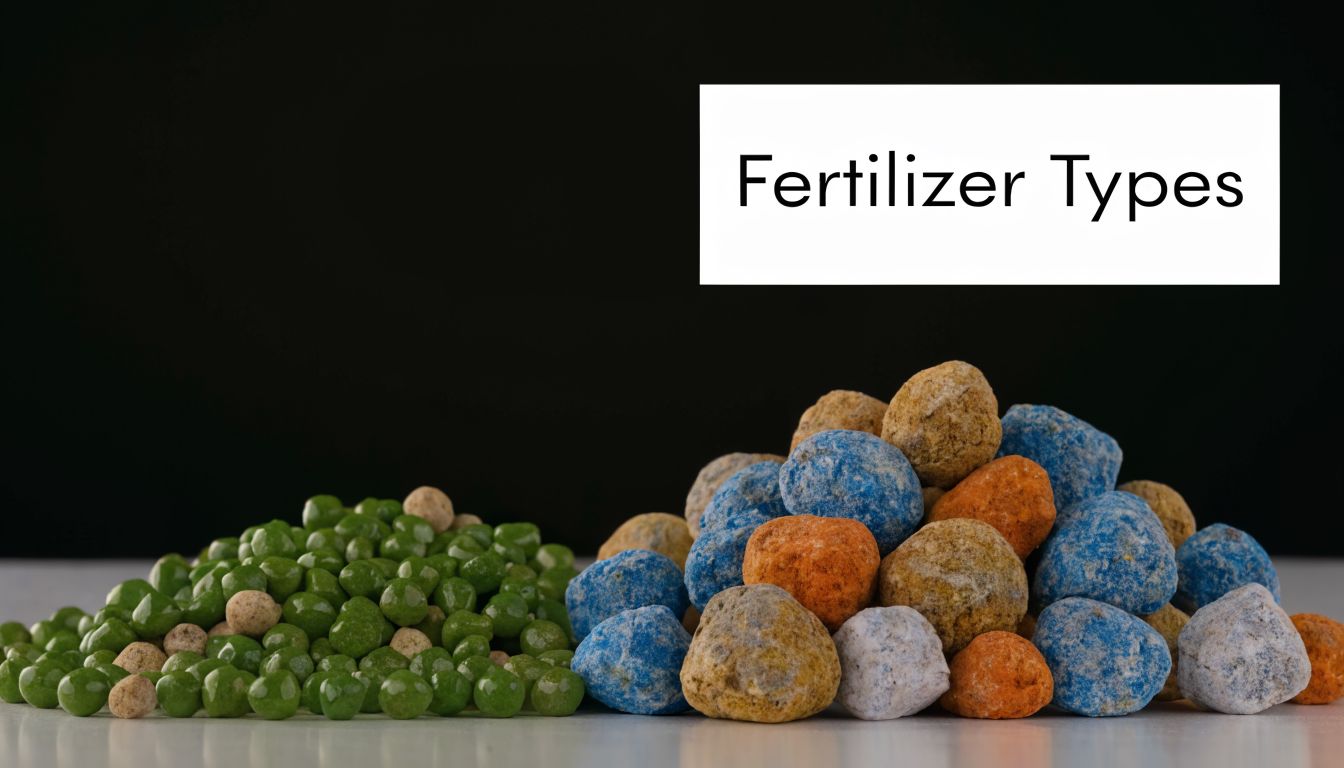
Once you know your grass type and soil condition, the next choice is the product itself. Many do-it-yourself lawn plans go off track at this stage.
Two bags can look similar on the shelf and behave very differently in the yard.
Quick-release gives speed and risk
Quick-release fertilizer is exactly what it sounds like. It becomes available fast. That can be useful when a lawn needs a visible response and conditions are right.
The upside is obvious. You can get a faster green-up.
The downside is just as obvious in Tennessee heat. Fast-release nitrogen can surge top growth, raise burn risk, and disappear before the lawn gets lasting benefit. It also gives you less margin for error if your spreader setting is off or your pattern overlaps.
Slow-release gives steadier growth
Slow-release fertilizer feeds over time. That's what I prefer for most homeowners trying to build a durable lawn, not just a temporarily darker one.
It usually gives you:
- More even color: You don't get the hard jump followed by a fade.
- Better root support: The lawn isn't pushed into soft, flashy growth.
- Less stress in hot weather: That's a big deal in our summers.
- Lower runoff risk: Nutrients are released at a pace the lawn can better use.
For warm-season grasses like Bermuda and zoysia in transition areas such as West Tennessee, guidance supports feeding every 6 to 8 weeks during peak growth, and using 20-0-10 formulations with slow-release nitrogen for summer applications because rapid-release products can exceed uptake in 85°F+ heat and contribute to runoff. The same guidance notes improved drought tolerance through deeper rooting under consistent nutrient availability (warm-season fertilization guidance from Weed Man).
Which one should you use
Here's the practical answer.
| Situation | Better choice | Why |
|---|---|---|
| Spring green-up on an established lawn | Slow-release, sometimes with a small quick component | Balances response with control |
| Summer feeding on Bermuda or zoysia | Slow-release | Safer under heat stress |
| A lawn already under drought stress | Usually wait or go very light | Fertilizer won't fix dry roots |
| A homeowner chasing instant dark color | Quick-release tempts people | But it's often the wrong move |
If you're comparing products for southern turf, this guide on the best fertilizer for southern lawns can help you sort through labels without wasting money.
If you want a lawn that holds up, not just one that pops for a week, lean slow-release most of the time.
A Sample Fertilization Schedule for Jackson TN Lawns
Homeowners want a straight answer. Not theory. Not bag marketing. An actual plan.
In West Tennessee, most lawns require fertilization 3 to 6 times per year, and for cool-season grasses the key applications are early spring, late spring, and fall, with September to October often considered the most critical window for root development before dormancy (regional fertilization timing guidance from Grasshopper Gardens).
That doesn't mean every yard needs the same number of applications. It means most good programs land in that range, then adjust for grass type, soil condition, mowing habits, and whether the homeowner wants a solid lawn or a showpiece.
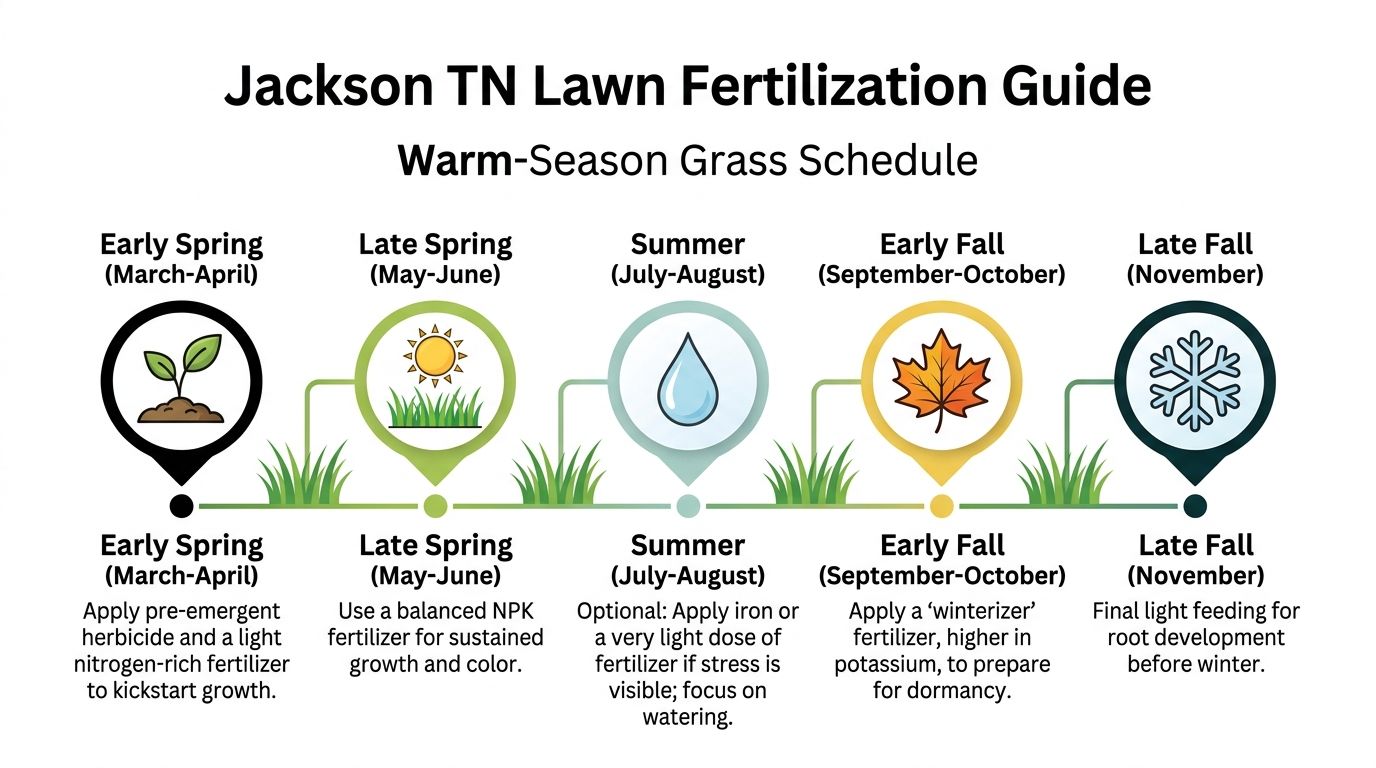
Sample schedule for tall fescue lawns
Tall fescue is common in Jackson, especially in neighborhoods with mixed sun and shade. It can look great here, but only if you stop treating it like a summer grass.
A practical annual rhythm looks like this:
Early spring
Feed lightly once the lawn is actively growing. Don't jump too early just because you had a warm week. The goal is to support recovery and color, not force tender growth.
Late spring
This feeding helps the lawn prepare for incoming summer stress. A slower-release product makes more sense here than a hard hit of fast nitrogen.
Late summer to early fall
Fescue programs separate average lawns from strong ones. As temperatures begin to ease, the grass shifts back into a growth pattern that responds well to feeding.
Mid-fall
This is often the most valuable application for root work and density. If your lawn thinned during summer, this is also the best season to pair feeding with seeding work.
Optional late fall
Some established fescue lawns benefit from another carefully timed feeding, especially if you're aiming for a dense, dark stand heading into winter.
A simple fescue plan for most homeowners is 3 to 4 well-timed applications. A more intensive lawn can move toward the upper end if the site and maintenance support it.
Sample schedule for Bermuda and zoysia lawns
Warm-season grasses want a different calendar. If you've got Bermuda, the lawn should be fed when it's awake and actively growing, not while it's just thinking about waking up.
Here's the practical pattern:
- Spring after green-up: Don't fertilize dormant Bermuda just because the calendar says spring. Wait until the turf is actively moving.
- Late spring: This is a strong feeding window for color and spread.
- Mid-summer: If the lawn is healthy and irrigated well, another application can keep it vigorous.
- Late summer or early fall: A lighter, well-timed feeding can help carry the lawn toward dormancy without overpushing it.
For many Bermuda lawns in Jackson, that works out to a steady schedule during the warm months rather than scattered random treatments.
How to choose between a lean plan and a full plan
Not every homeowner wants the same lawn.
Some want a yard that looks healthy, stays mostly weed-free, and holds up to kids and pets. Others want a sharper cut, deeper color, and tighter density all season. That difference changes how often to fertilize lawn in a real-world setting.
Use this framework:
| Lawn goal | Better fit |
|---|---|
| Basic health and decent color | A leaner schedule |
| Dense turf with stronger seasonal performance | A fuller, timed program |
| Shaded fescue with slower growth | Fewer, smarter applications |
| Sunny Bermuda with active summer growth | Regular summer feeding |
Pair fertilizer with the right lawn work
Fertilizer isn't a standalone fix. On compacted clay, nutrients can sit near the surface while roots struggle below. On thin fescue lawns, fall feeding works much better when combined with aeration and overseeding.
If you're planning that kind of renovation, this guide on when to aerate and overseed lawn fits right into the fall schedule.
The best schedule is the one you can follow consistently and match to your grass. A perfect plan on paper doesn't help if it ignores what your yard is actually growing.
A few timing rules that save headaches
Keep these in mind before every application:
- Don't fertilize because the neighbor did: Microclimates, shade, and grass type change the timing.
- Don't feed heat-stressed turf heavily: Color loss in summer doesn't always mean hunger.
- Don't treat new seed like mature sod: Young grass needs a more careful approach.
- Don't guess on spreader settings: Uneven application ruins good product.
A printed calendar on the garage wall beats memory every time.
Troubleshooting Common Fertilization Mistakes
A lawn will usually tell you when the feeding program is wrong. You just have to read the clues correctly.
Most homeowners misread those clues. They see yellow and assume they need more fertilizer. They see fast growth and think the lawn is thriving. Sometimes the opposite is true.
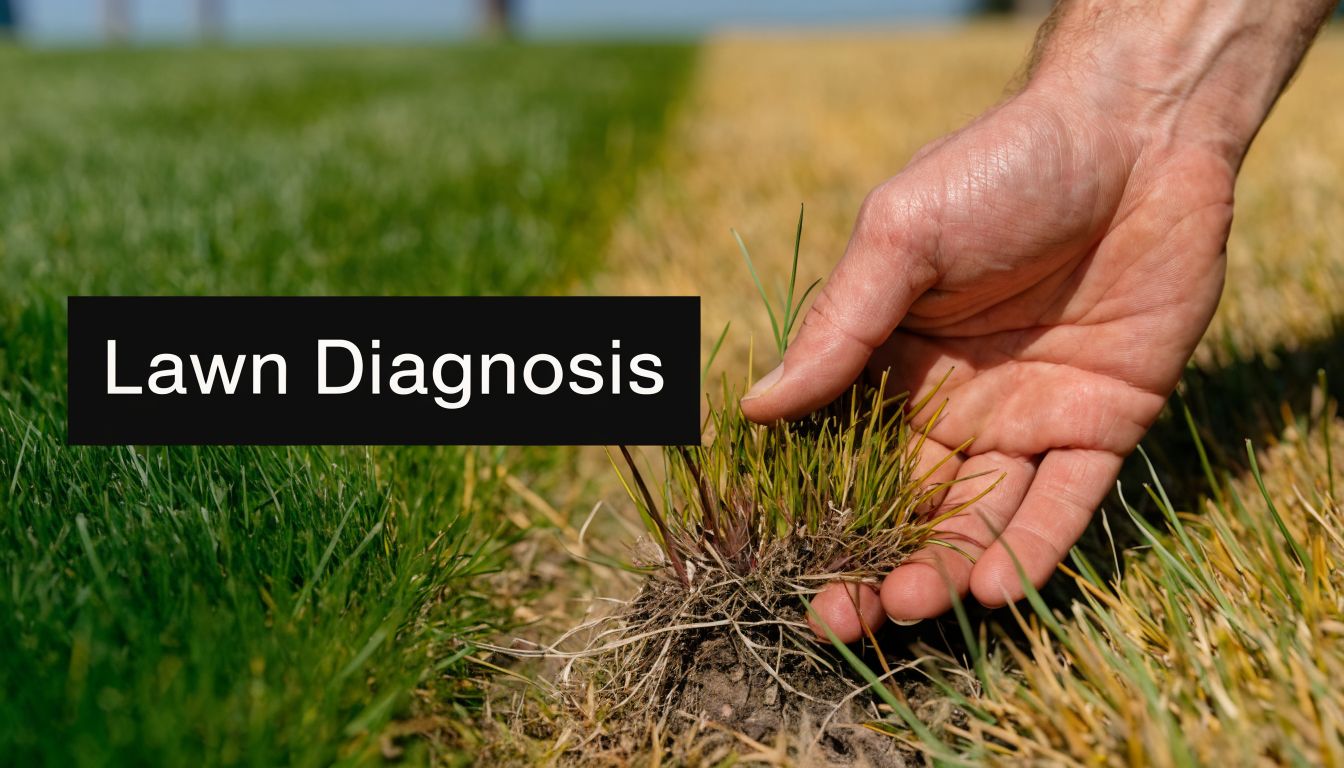
Signs you've pushed the lawn too hard
Overfertilized turf usually doesn't hide it for long.
Consumer guidance warns that fertilizing more than twice yearly can risk overfertilization, which can scorch grass brown and patchy, while also noting that you should never exceed 1 pound of water-soluble nitrogen per 1,000 square feet per application to reduce leaching risk (Consumer Reports guidance on lawn fertilization limits).
In the yard, that often shows up as:
- Burned streaks or spots: Usually from overlap, a spill, or too much fast-release nitrogen.
- Sudden, excessive blade growth: The lawn shoots up, but the root system doesn't keep pace.
- Patchy dark and light stripes: Spreader calibration or walking pattern is off.
- More mowing, weaker summer performance: The grass looks impressive for a short window, then falls apart under stress.
If that happens, don't add more product trying to even the color out. Water thoroughly, stop feeding, and let the lawn settle.
Signs your lawn isn't getting enough
Underfed lawns are usually less dramatic, but the symptoms are still clear once you know them.
Watch for these:
| Symptom | What it often means |
|---|---|
| Pale green color | Nitrogen is running short |
| Thin turf | The lawn isn't growing thick enough to compete |
| Slow recovery after traffic | The plant lacks vigor |
| Weeds gaining space | The turf stand is too weak to crowd them out |
Under-fertilizing also reduces the lawn's resistance to pest and disease pressure. Nitrogen plays a key role in helping turf handle heat and cold, so a starved lawn usually struggles at the worst possible time.
Common false diagnoses
Not every bad-looking patch is a fertilizer problem.
I've seen homeowners throw more nitrogen at lawns that were really dealing with one of these:
- Compaction: Roots can't move through tight clay.
- Drainage issues: Water sits, roots decline, and the lawn yellows.
- Drought stress: Fertilizer won't fix dry soil.
- Disease pressure: More feeding can make some problems worse.
- Shade: The grass type and light level don't match.
Brown doesn't always mean hungry. Sometimes it means stressed, soaked, compacted, or cut too low.
The fastest way to avoid repeat mistakes
Use the same checklist every time before you fertilize:
- Check the grass type first
- Look at current weather, not just the date
- Use a calibrated spreader
- Sweep spills off hard surfaces
- Water according to the product label and current conditions
Good fertilization is boring in the best way. Even coverage, measured timing, and no drama.
Adjusting for West Tennessee Heat Drought and Drainage
Bag instructions don't know your yard. They don't know the backyard stays soggy after a storm, the front slope bakes in the afternoon, or the side yard is hard as brick by July.
That's why West Tennessee lawns need local adjustment.
Clay soil changes the game
Our clay soil can be helpful and frustrating at the same time. It holds nutrients better than sandy soil, but it also compacts easily. Once that happens, fertilizer can sit near the surface while roots stay shallow and stressed.
That's one reason a lawn can be fed and still not improve much. The nutrition is there, but the root system can't fully use it. In those yards, aeration often helps the fertilizer program work better because it opens the soil and improves movement of air, water, and nutrients.
Heat changes what "needs feeding" really means
In a Jackson summer, a lawn can fade because it's hot, dry, compacted, or overcut. Homeowners often assume the fix is more nitrogen.
Usually it isn't.
Heavy feeding during intense heat can make stress worse, especially on cool-season turf. The lawn may respond with a short burst of top growth, then struggle harder because roots are already under pressure. In warm-season lawns, timing still matters, but the product choice and rate matter just as much.
Drainage problems waste fertilizer
If water stands after rain, you don't just have a wet-lawn problem. You have a root problem.
Roots sitting in saturated soil lose vigor. Once root health slips, fertilizer efficiency slips too. You can spend money on product and get very little return because the turf can't use what you applied. In low spots and poorly graded areas, fixing drainage often matters more than adding another round of nutrients.
Local regulation and low-input options
Some Tennessee guidance also points toward more conservative fertilizer plans. Guidance tied to 2025 watershed rules in some West Tennessee basins may restrict nitrogen applications between Oct. 15 and Mar. 15, and the same source notes that some experts now support 1 to 2 applications per year in lower-input programs, with options like Milorganite or mulching clippings to recycle up to 25 percent of nitrogen needs (Milorganite schedule and low-input guidance).
That matters for homeowners with runoff-prone yards, drainage trouble, or lawns that don't need a high-input program.
A practical low-input approach can include:
- Mulching clippings back in: That returns some nutrients to the soil.
- Using organic-style feeding: Slower, steadier nutrition can fit some lawns well.
- Backing off in vulnerable areas: Slopes, swales, and saturated spots need extra caution.
- Matching the plan to expectations: Not every lawn needs a full, aggressive schedule.
A yard with drainage trouble shouldn't be fertilized like a flat, well-drained lot. The water movement decides part of the program.
DIY Fertilization vs Hiring a Lawn Care Professional
DIY lawn fertilization can work. Plenty of homeowners can handle it if they're willing to learn their grass type, measure square footage, calibrate a spreader, and stay disciplined with timing.
The question is whether they want to.
When DIY makes sense
If you enjoy yard work, keep records, and don't mind trial and error, doing it yourself can be a good fit.
DIY tends to work best when:
- Your lawn is straightforward: One grass type, decent drainage, no major shade puzzle.
- You don't mind storing equipment and product: Spreader, leftover bags, cleanup tools.
- You can stick to a schedule: The lawn doesn't care if work got busy that month.
- You're comfortable reading labels carefully: Rate errors are where problems start.
For some homeowners, that's satisfying. They like seeing the results and managing the property themselves.
Where DIY usually breaks down
Most mistakes don't come from laziness. They come from small errors that stack up.
A homeowner buys the wrong blend, applies too early, overlaps a pass, misses a weather shift, or feeds a stressed lawn because the color looked off. None of those errors seem huge in the moment. Together, they can leave streaks, burn, wasted product, or a lawn that never really improves.
The yards that give people the most trouble usually have one or more of these:
| Yard condition | Why it gets harder |
|---|---|
| Mixed grass types | One schedule doesn't fit all |
| Heavy compaction | Fertility and root health disconnect |
| Drainage issues | Nutrients wash or sit in the wrong places |
| Shade transitions | Growth rates vary across the same yard |
What a professional changes
A good lawn professional doesn't just spread fertilizer. They remove guesswork.
That usually means better timing, better product matching, more accurate spreader calibration, and a trained eye that can tell the difference between nutrient stress, mowing stress, drainage trouble, and disease pressure. It also means you don't have to build your weekends around treatment windows.
If you're weighing that decision, this article on the benefits of hiring a professional lawn service in Jackson TN lays out the trade-offs clearly.
The practical way to decide
Ask yourself these questions:
- Do I know what grass I have?
- Am I willing to measure, schedule, and calibrate correctly?
- Can I tell the difference between underfeeding and a drainage problem?
- Do I want lawn care on my Saturday list all season?
If yes, DIY can work.
If not, hiring help is usually cheaper than repeating mistakes in product, time, and lawn damage. The best lawns aren't always owned by people who work hardest on them. They're often owned by people who work from the right plan.
If you'd rather skip the guesswork and get a fertilization plan that fits your grass, soil, and drainage conditions, Lawn & Leaf Solutions can help. The team serves Jackson and West Tennessee with licensed lawn care, drainage solutions, and practical maintenance plans built for local conditions. Schedule a free estimate and get a clear recommendation for what your lawn needs.