
A lot of Jackson homeowners read about sump pump vs french drain after the same kind of weekend. A hard storm rolls through. Water sits in the backyard for days. The crawl space smells damp. The basement corner gets dark and musty. Along the foundation, the soil stays soft long after the rest of the yard should've dried out.
That’s usually when the true question starts. You don’t just want water gone today. You want the right system, installed in the right place, so you’re not dealing with the same mess every spring.
In West Tennessee, that decision isn’t simple because the ground conditions matter. Heavy clay soil holds water. Some lots have enough slope for gravity drainage, and some don’t. Storms can go from steady rain to a sudden dump of water fast enough to expose every weak point around a foundation. A sump pump and a French drain can both solve water problems, but they solve different kinds of water problems.
Your Soggy Yard Problem Has a Solution
A common Jackson scenario looks like this. Water gathers near the back patio, then starts creeping toward the house. One side yard turns into a muddy strip after every storm. Inside, the crawl space or basement starts showing signs that water isn’t just a surface problem anymore.
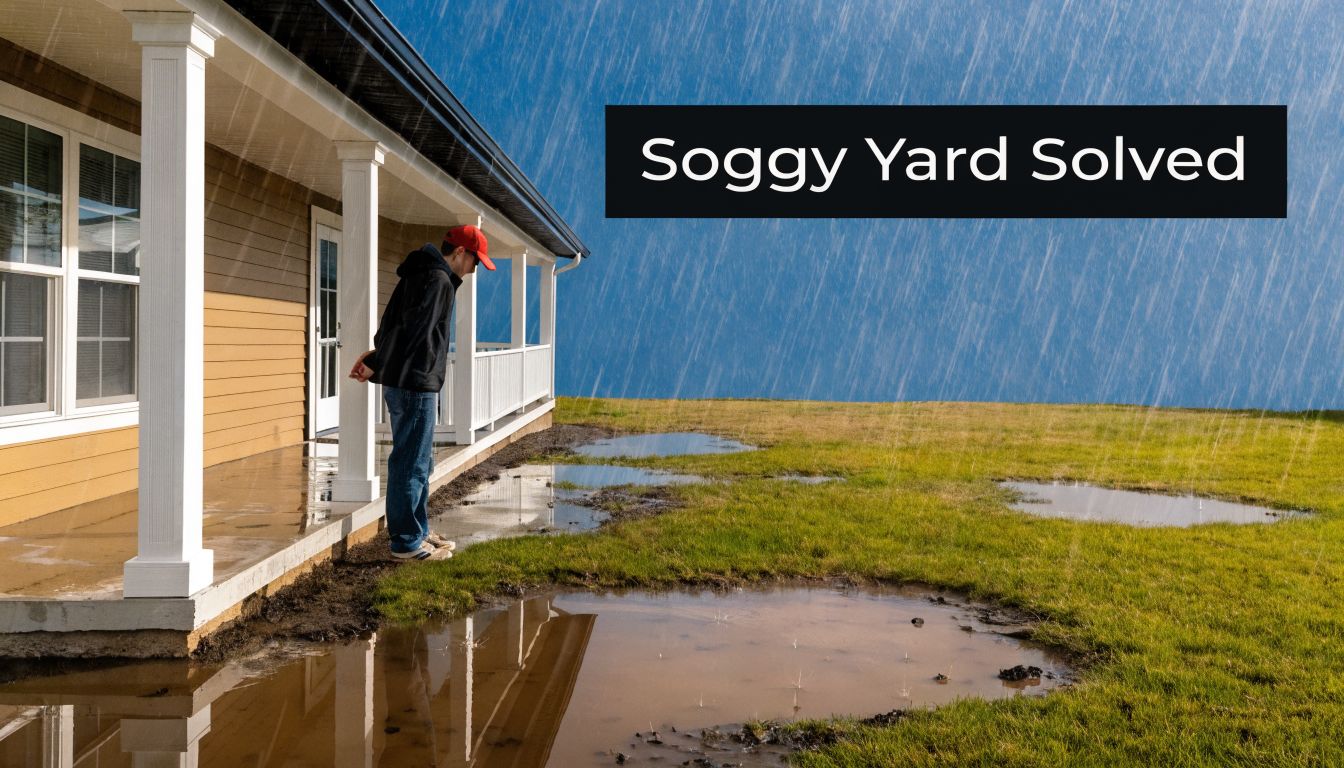
Most homeowners start by treating the symptom they can see. They add dirt to a low spot, cut a shallow trench, or extend a downspout. Sometimes that helps. Often it doesn’t, because the underlying issue is how water moves through the entire property, not just where the puddle shows up.
What the problem usually means
If the yard stays wet but the house interior stays dry, the fix often leans toward redirecting water before it collects. If water is entering below grade, or rising into a basement or pit area, the fix may need active removal. That’s the core difference between these two systems.
A French drain intercepts and redirects water. A sump pump collects water in a pit and pushes it out. One works by gravity. The other works by mechanical force.
Homeowners trying to solve soggy lawn problems usually get the best results when they stop asking for a single product and start asking where the water is coming from, where it’s getting trapped, and where it can safely go.
Start with the symptom you have
If you’re dealing with standing water against the house, muddy lawn areas that never seem to dry, or recurring wet spots after storms, a more detailed look at standing water in yard solutions helps narrow down whether the problem is surface grading, subsurface drainage, or both.
Water around a house is rarely just a “yard problem.” In West Tennessee, it often becomes a foundation problem if it isn’t redirected early.
Understanding How Each Drainage System Fights Water
The simplest way to understand sump pump vs french drain is this. A sump pump removes water after it reaches a collection point. A French drain tries to intercept water and steer it away before it becomes a bigger problem.
Here’s a quick side by side look.
| Feature | Sump pump | French drain |
|---|---|---|
| How it works | Actively pumps collected water out | Passively redirects water through gravel and perforated pipe |
| Best use | Heavy inflow, basement flooding, high water table conditions | Yard drainage, foundation perimeter seepage, steady groundwater |
| Power needed | Yes | No |
| Works during outage | Not without backup | Yes, if slope allows gravity flow |
| Typical placement | Basement, crawl space, sump pit | Yard, footing perimeter, trench line |
| Main limitation | Mechanical failure or power loss | Needs proper slope and layout |
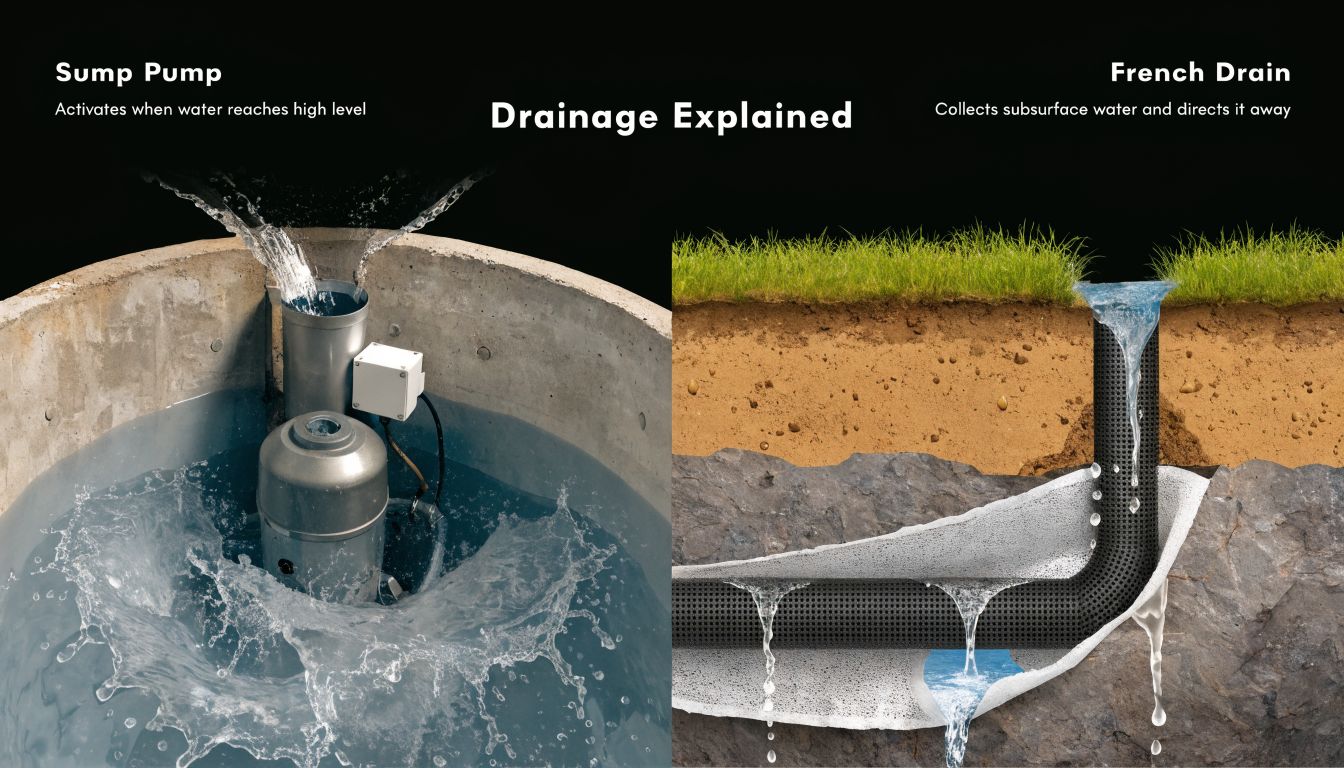
How a sump pump works
Think of a sump pump as the property’s emergency ejector. Water enters a sump basin, usually at the lowest point of a basement or crawl space area. When the water rises high enough, the pump activates and sends that water away through a discharge line.
That makes it useful when water arrives fast, or when gravity alone won’t move it where it needs to go. In homes with below-grade spaces, that matters a lot.
According to Angi’s comparison of French drains and sump pumps, sump pumps were introduced in the early 20th century and became standard by the 1970s for basements in rainy climates. The same source notes that industry estimates show 70-80% of U.S. basements experience water issues annually, and sump pumps are preferred in 60% of severe cases because they activate automatically.
How a French drain works
A French drain acts more like a buried channel system. It uses a trench, gravel, and a perforated pipe to collect water moving through soil and redirect it away from the foundation or wet area. The system doesn’t force water anywhere. It relies on gravity and a proper outlet.
That makes it a better tool for ongoing seepage, shallow groundwater movement, and yard areas where water repeatedly gathers and lingers. If the site has enough grade, it can move a lot of nuisance water with minimal sound and with little upkeep.
For homeowners wanting a clear visual example of layout and placement, Voyager Plumbing French drains shows the kind of subsurface system that works when the goal is interception and redirection rather than pumping.
The real mechanical difference
The question isn’t which system is “better” in the abstract. The question is what kind of water you’re fighting.
- Choose active removal when water is entering a low point and must be forced out.
- Choose passive redirection when water can be intercepted earlier and carried away by grade.
- Use both when the property gets both steady seepage and sudden inflow.
If you’re focused on protecting the structure itself, this overview of foundation drainage solutions is helpful because it puts yard drainage and below-grade waterproofing in the same conversation.
A sump pump is the right answer when water has nowhere else to go. A French drain is the right answer when you can stop that water before it piles up.
Comparing Cost Installation and Long-Term Maintenance
A lot of Jackson-area homeowners ask the cost question first. I understand why. Drainage work is not cheap, and both options involve more than a quick fix from the hardware store.
The better question is what the system will cost you to install, maintain, and live with over time.
Upfront cost only shows part of the picture
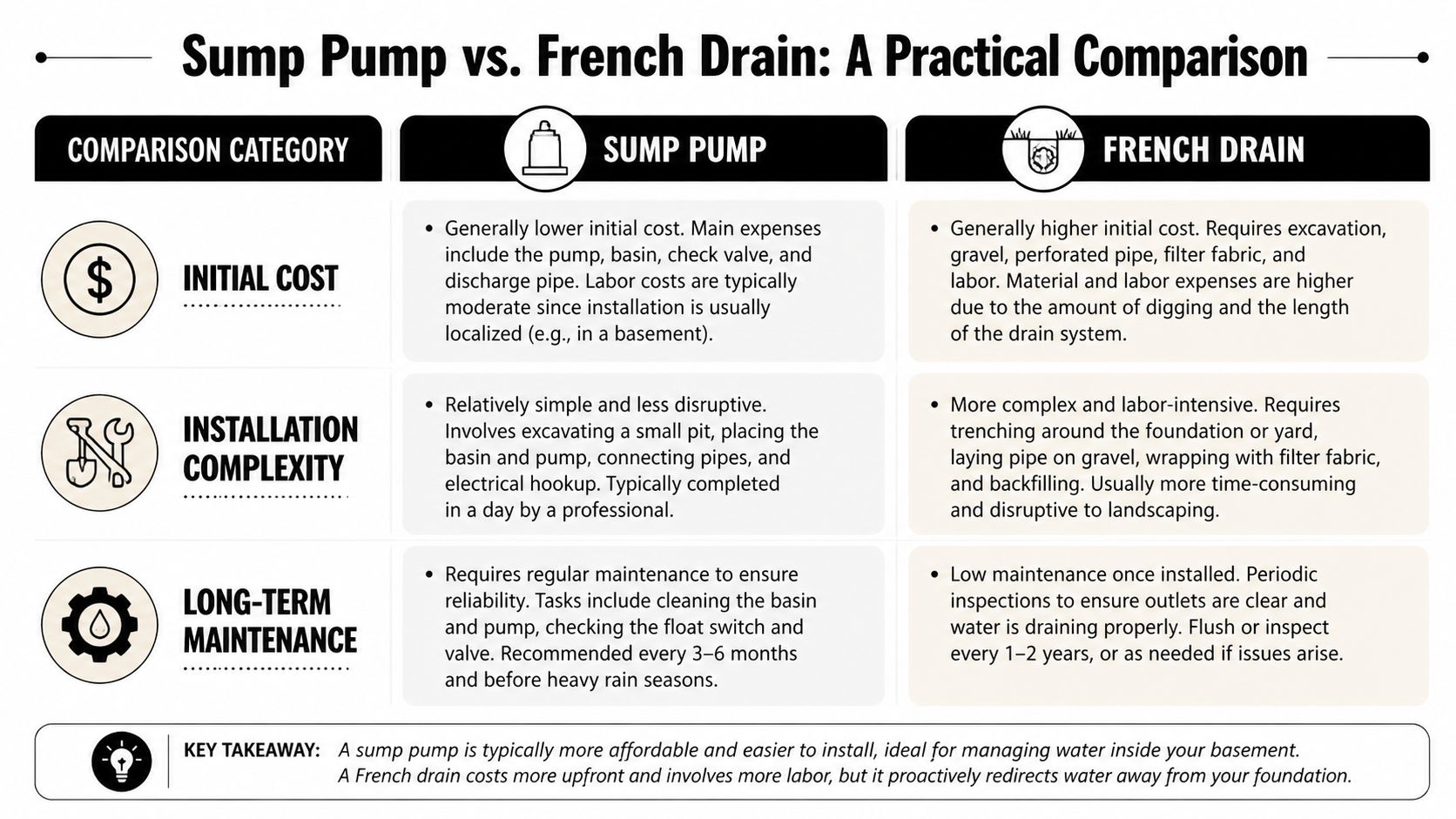
National averages cited by One Call Plumbing’s drainage comparison put sump pump installation at about $1,200 to $3,000 and a French drain at about $9,300 on average.
That gap is large, but it does not mean the sump pump is automatically the better buy.
A sump pump usually wins the first-round budget conversation because the work is concentrated and the starting price is lower. A French drain often costs more because it requires excavation, pipe, stone, fabric, outlet planning, and cleanup. On West Tennessee properties with heavy clay, trenching can also be slower and harder on equipment than homeowners expect, especially after rain.
Installation affects the property in different ways
A sump pump install is usually a tighter, more mechanical job. The crew may cut concrete, set a basin, run discharge piping, and handle electrical work. The disruption is real, but it is often limited to one section of the basement, crawl space, or foundation perimeter.
A French drain spreads the work across more ground. Exterior systems may run along the foundation, through a side yard, or across the low part of the lot. Interior systems can require saw-cutting concrete. On a Jackson property with sticky clay soil, the yard can stay torn up longer because backfill, grading, and surface repair matter if you want the system to keep draining the way it should.
What the installation usually feels like on site
- Sump pump install: concentrated work area, mechanical components, discharge routing, power dependency
- French drain install: trenching, grading, outlet planning, more surface restoration
- Combined system: more labor and more disruption up front, but often fewer compromises when the property has both yard saturation and water pressure near the house
Practical rule: If water is showing up in several places, yard, footing area, and interior low points, one small fix usually turns into a repeat repair.
Long-term ownership is where the decision changes
Homeowners who plan to stay in the house for years should compare replacement cycles, service calls, and failure risk during storms.
The same source notes that sump pumps typically last 7 to 10 years, while a well-maintained French drain can last 30 years or more. It also notes that sump pumps need annual inspections and that repairs often run about $300 to $800.
That lines up with what we see in the field. A sump pump is an active piece of equipment. Motors wear out. Switches fail. Check valves stick. Discharge lines clog or freeze. If the power goes out during a hard storm and there is no battery backup, the system can stop right when you need it most.
A French drain has fewer service points because there are no motors or switches. Its maintenance is usually inspection, flushing when needed, and fixing isolated blockages from sediment or roots. The trade-off is access. If part of the line is buried under concrete, beds, or a driveway, repairs can be more involved.
Side by side ownership comparison
| Ownership factor | Sump pump | French drain |
|---|---|---|
| Average install cost | $1,200 to $3,000 | $9,300 average |
| Average lifespan | 7-10 years | 30+ years with good maintenance |
| Routine upkeep | Annual inspection and testing | Occasional inspection and cleaning |
| Typical repair cost | $300-$800 | Infrequent, depends on access and blockage |
Which option usually costs less over time
If the house needs immediate water removal from a basement or crawl space, the sump pump often makes financial sense because it solves the urgent problem fast.
If the property has a long-term drainage pattern that can be intercepted and carried away by grade, a French drain often gives better value across a longer ownership window. The same analysis from One Call Plumbing states that French drains are more cost-effective over a 20-year period despite the higher upfront price.
That is the trade-off. Lower upfront cost versus fewer replacement cycles. Mechanical protection versus passive drainage. Short-term relief versus a larger excavation project that may reduce recurring water problems for decades.
If you want a clearer sense of what drives price on trench depth, pipe length, outlet work, and yard repair, this guide on the cost of French drain installation breaks those variables down.
Cheap drainage that does not match the water source usually becomes expensive drainage later.
The West Tennessee Factor Soil Slopes and Storms
General drainage advice often breaks down in West Tennessee because the local ground conditions change how water behaves. Jackson-area properties don’t drain like sandy lots. Clay-heavy soil holds water tighter, sheds runoff differently, and builds pressure against foundations faster when the ground is already saturated.
Clay soil changes the job
In clay-heavy regions like West Tennessee, French drains can handle 0.5-2 gallons per minute per 100 linear feet through gravity flow, while a 1/2 HP sump pump can benchmark at 2,000-4,000 gallons per hour, or 33-67 gallons per minute, according to Zavza Seal’s drainage comparison for clay-heavy regions. That gap tells you something important. A French drain is useful for intercepting slow, persistent water movement. A sump pump is built for active removal when water is entering a structure faster than passive drainage can manage.
In practical terms, that means a soggy side yard and a flooding basement are not the same problem, even if the same storm caused both.
Slope decides whether gravity can help you
A French drain only works as well as its outlet and slope. If the lot allows water to move downhill to daylight or to a proper discharge point, a French drain can be a smart long-term tool. If the property is flatter, boxed in, or lower than the surrounding grade, gravity has fewer options.
That’s why some Jackson properties need grading correction before any buried drain will perform the way the homeowner expects. A drain pipe cannot fix bad water flow on its own if the lot doesn’t give the water somewhere to go. Homeowners dealing with broad surface runoff often need to think about grading a yard for drainage before they think about pipe.
Storm pattern matters too
West Tennessee storms aren’t always gentle all-day rains. A property can go from manageable saturation to fast accumulation in a short time. That’s where the difference between “intercepting” water and “moving” water becomes obvious.
A French drain helps by collecting seepage and reducing the amount of water pressing against the home. A sump pump helps when that water reaches a point where it must be lifted and expelled. On lots with heavy clay and limited natural fall, relying on only one method can leave a gap.
What tends to work best in local conditions
- For steady yard saturation: Exterior interception and redirection usually make the biggest difference.
- For below-grade water entry: Active pumping becomes much more important.
- For properties with mixed symptoms: Pairing exterior drainage with an interior collection and pump system often matches the way water behaves on site.
Jackson properties often benefit from 1/2 HP submersible pumps paired with exterior drains, as noted in the same source above. That recommendation makes sense locally because it addresses both steady pressure around the house and faster inflow during hard weather.
A homeowner in a hilly area with clean fall away from the home may do very well with gravity-based drainage alone. A homeowner on a flatter lot with a wet crawl space or basement may not. Soil, slope, and storm behavior all matter together.
Scenarios When to Choose a Sump Pump French Drain or Both
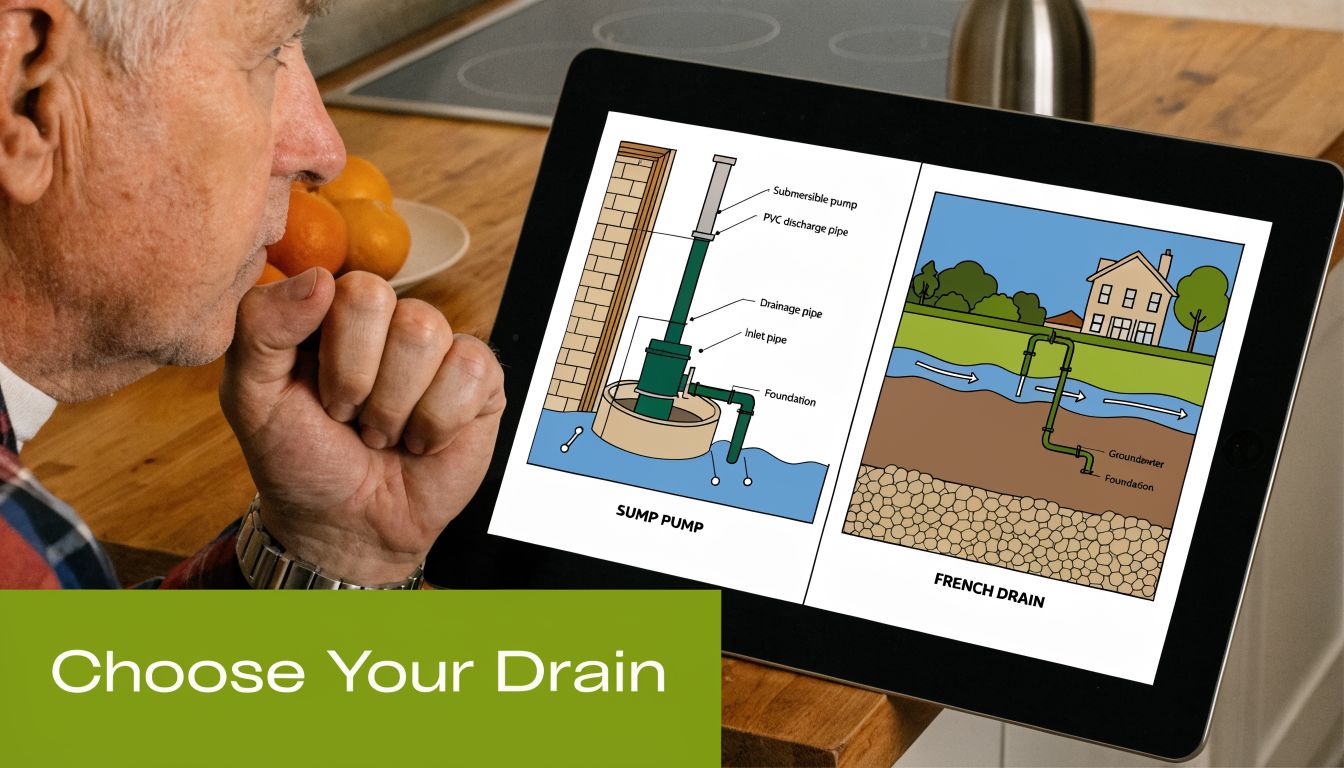
The easiest way to choose between sump pump vs french drain is to match the system to the symptom. Most bad drainage decisions happen when homeowners buy a product before diagnosing the path water takes to the house.
Choose a sump pump when water is entering low and fast
If water collects in a basement, rises at the lowest point of the house, or shows up during hard rain as active intrusion rather than damp soil, a sump pump is usually the more direct answer.
This is especially true on lots where gravity discharge is limited. When the structure sits lower than surrounding grade, or when water pressure under the slab or around the foundation pushes water inward, you need a way to force it out.
A sump pump also makes sense when the problem isn’t broad yard saturation but concentrated water entry into the home itself. In that situation, passive drainage alone may not keep up.
Choose a French drain when the property needs interception
If the yard stays muddy, water tracks along the foundation, or seepage builds slowly after rain, a French drain is often the better fit. It works best when the goal is to collect and redirect water before it enters living space.
This is the right call when the warning signs are mostly outside:
- Persistent wet strips along one side of the house
- Pooling near beds or patios after moderate rain
- Soil staying soft long after the storm passes
- Water following the foundation line instead of draining away
A French drain doesn’t “rescue” a flooded room. It reduces the odds that water gets there in the first place.
Choose both when the house has layered water problems
Many West Tennessee homes don’t have a single-source issue. They have a site problem and a structure problem at the same time. Surface runoff moves toward the house. Subsurface moisture builds along the foundation. Then a storm knocks power out, right when water levels are highest.
According to Rainbow Restoration’s comparison of French drains and sump pumps, sump pumps fail 100% of the time during power outages without a backup, and the Southeast averages 5-10 major outages per year. The same source notes that a hybrid system, where an interior French drain channels water to a sump pit, can reduce the pump’s dependency and runtime by up to 70%.
That hybrid setup is often the smartest answer when a property has multiple failure points.
Why the combined approach works
- The French drain reduces the water load reaching the interior system.
- The sump pump handles what gravity can’t remove quickly enough.
- The house gains protection in more than one condition, including long wet periods and intense storms.
On a difficult lot, the best drainage system is often not a choice between two tools. It’s the right sequence of both.
If you know your home needs active removal, regular testing and upkeep matter just as much as installation. This practical guide to sump pump installation and maintenance essential tips for homeowners is a good next step.
Making Your Final Decision with Lawn & Leaf Solutions
A good drainage decision usually comes down to one plain question. Is your main problem water that needs to be redirected, or water that needs to be pumped out?
If the issue is a soggy yard, steady seepage, water tracking along the foundation, or subsurface moisture moving through clay soil, a French drain often makes more sense. If the issue is active basement or crawl space flooding, a low collection point, or a property where water has to be lifted to leave the site, a sump pump is often the necessary tool.
Use the property, not the product, to guide the choice
A lot of homeowners get stuck because they want a universal answer. There isn’t one. The same system that works well on a sloped lot outside Medina may underperform on a flatter Jackson lot with heavier clay and poor outlet options.
The safest approach is to evaluate three things together:
- Where the water starts
- How it moves across or through the property
- Whether gravity can carry it away without mechanical help
Why an on-site diagnosis matters
Drainage failures usually happen because the wrong problem was identified. A homeowner sees standing water and assumes yard grading is the issue, when the underlying pressure is below grade. Or they install a pump for basement water without reducing the amount of groundwater reaching the house in the first place.
That’s why site assessment matters so much in West Tennessee. Soil type, slope, discharge location, foundation layout, and storm behavior all affect whether a sump pump, a French drain, or a combined system will solve the problem.
A professional inspection can trace the water path, identify whether the trouble is surface runoff or groundwater pressure, and map out where discharge can happen safely and legally. That’s the difference between a system that works for one storm and one that keeps working season after season.
Frequently Asked Questions About Drainage Solutions
Can I install a sump pump or French drain myself
Some homeowners can handle minor drainage corrections, but full sump pump and French drain installations are less forgiving than they look. The biggest DIY mistakes are poor slope, bad outlet planning, undersized collection areas, and discharge lines that send water right back toward the house.
A sump pump also adds electrical and mechanical considerations. A French drain demands correct trench depth, gravel wrap, pipe placement, and drainage path. If any of that is wrong, the system may move very little water or clog early.
For simple surface fixes, DIY can help. For recurring foundation or basement water, professional installation is usually the safer investment.
What happens if the power goes out during a storm
If a sump pump doesn’t have backup power, it won’t run during an outage. That’s one of the biggest weaknesses of a pump-only strategy.
A French drain keeps working during a power outage because it relies on gravity, not electricity. That’s one reason combined systems are attractive on West Tennessee properties that see storms and outage risk in the same season.
Smart questions to ask about outage planning
- Do you have backup power? If not, the pump stops when power stops.
- Can part of the water load be handled passively? If yes, a drain system can reduce the burden on the pump.
- Does the discharge path stay open in bad weather? A blocked outlet can make even a working system struggle.
Where does the water go after the system collects it
That depends on the property layout and local drainage options. A sump pump sends water through a discharge line away from the foundation. A French drain usually carries water downhill to a suitable outlet.
The key is safe discharge. Water should leave the problem area and stay away from the house. A bad discharge plan can create a loop where the system empties water into a place that sends it back toward the foundation.
If you don’t know where the water will exit, you don’t have a full drainage plan yet.
What are signs that a sump pump is failing
Most pumps give warning signs before complete failure. Watch for unusual cycling, strange noise, inconsistent activation, or water remaining in the pit longer than it should.
A failing pump may also show up as repeated dampness in an area that was previously protected. If the unit is getting older, annual testing becomes even more important.
Warning signs worth acting on
- Frequent cycling that seems off for the weather
- No activation when water rises in the basin
- Rattling or grinding sounds from the motor area
- Water lingering in the sump pit after it should’ve discharged
What are signs that a French drain isn’t working properly
French drain problems usually show up outside first. You may notice the same wet strip reappearing, mulch washing out, water holding along the foundation, or a yard area staying saturated despite having a buried drain.
Clogs, crushed sections, root intrusion, or bad slope can all affect performance. Because the system is underground, homeowners often miss the early warning signs until standing water returns.
Which system is better for older homes in Jackson
Older homes often need a more careful diagnosis because the site may have changed over time. Landscaping settles. Downspouts get altered. Additions change roof runoff. Soil around older foundations can also behave differently than expected.
Some older homes do well with exterior interception. Others need interior collection and pumping because water already has a path inside. Many need a combination. The age of the home matters less than the way water currently moves around it.
If your yard stays soaked, your foundation is taking on water, or you’re tired of guessing which fix will hold up in West Tennessee weather, Lawn & Leaf Solutions can help you sort it out. Their team serves Jackson and surrounding areas with drainage assessments, French drains, sump pump systems, grading corrections, and practical solutions built around the way water moves on your specific property. Schedule a free estimate and get a plan that fits your soil, slope, and storm risk.