
At its core, a foundation drainage solution is any system designed to keep water away from your home's foundation. Think of things like French drains or sump pumps—their whole job is to intercept and redirect excess water before it can cause trouble.
By giving water a clear path to follow, these systems prevent it from building up in the soil and pressing against your foundation. This pressure is the real culprit behind most cracks, basement leaks, and even serious structural damage over time.
Why Your Foundation Is at Risk Without Proper Drainage
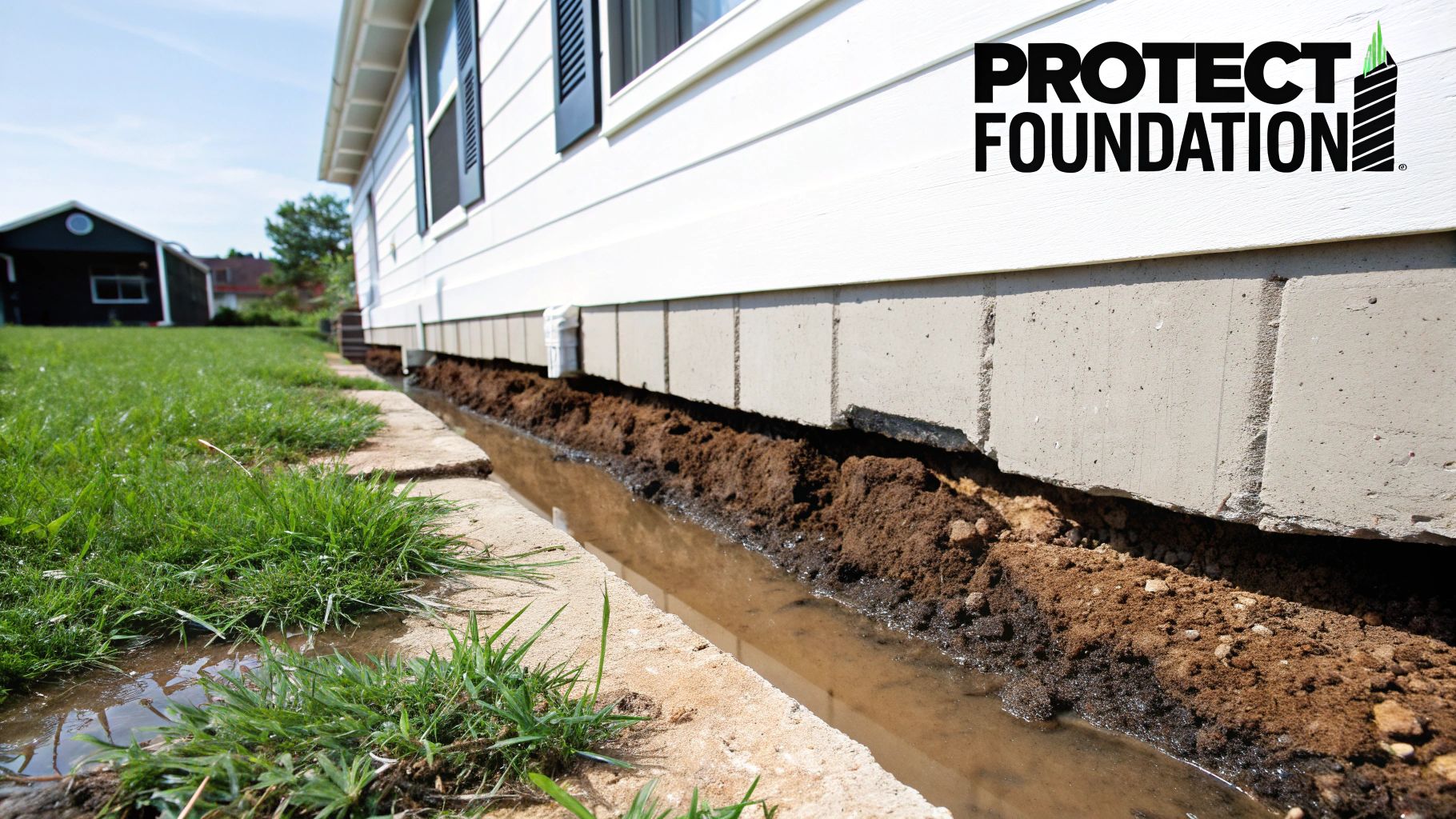
Imagine your foundation as a boat hull sitting in the ground. Here in West Tennessee, our heavy clay soil acts like a thick, stubborn bathtub. When we get one of our signature downpours, that clay soil doesn't just absorb the water; it swells up and holds onto it for dear life.
As the soil expands, it exerts an incredible amount of force against your foundation walls. This is what we call hydrostatic pressure, and it’s public enemy number one for any foundation. It’s a silent, powerful force that is constantly pushing, looking for the smallest crack or weak spot to force its way through.
The Hidden Danger of Hydrostatic Pressure
When that trapped water has nowhere to go, it starts to cause problems that can seriously undermine your home’s stability. The damage from unchecked water pressure doesn’t happen overnight, but once it starts, it can be destructive and costly.
Some of the biggest risks include:
- Foundation Cracks: That constant pressure will eventually create tiny fractures in the concrete, which grow larger over time and weaken the entire structure.
- Water Intrusion: Moisture will inevitably find its way through those cracks, leading to musty crawl spaces, a damp basement, and the perfect environment for mold.
- Soil Erosion: Over time, moving water can literally wash away the soil supporting your foundation, causing parts of your home to settle or shift.
These aren't just minor inconveniences; they're a major threat to your investment. Across the U.S., homeowners spend over $5 billion every year on foundation repairs caused by poor drainage. And here in the Jackson, TN area, where heavy rains are just a part of life, that risk is even greater. The good news? A well-designed subsurface drainage system can prevent up to 90% of this water-related structural damage.
A foundation drainage system isn't just another home improvement project. It's an insurance policy for your property's health, stability, and value—actively defending your home against the relentless threat of water.
The most effective way to manage these risks is to invest in a professional drainage solution from an expert like Lawn & Leaf Solutions. To dive deeper into the specific types of systems available, check out our guide to understanding foundation drainage systems.
Recognizing the Telltale Signs of Foundation Water Problems
Water damage rarely shows up overnight with a basement flood. It's usually much more subtle, starting with quiet little clues that something isn't right. Learning to spot these early warnings is the single best thing you can do to stop a small issue from turning into a massive, expensive repair.
These signs can pop up both inside and outside your home. Think of yourself as a detective, and your property as the scene. By paying close attention, you can catch drainage problems long before they threaten the structural integrity of your home.
Let's start our investigation where the problems often first appear: inside your basement or crawl space.
Interior Red Flags
The lowest level of your home is ground zero for water intrusion. If you have excess water pushing against your foundation, your basement or crawl space is almost always the first place to show the evidence.
Be on the lookout for these classic signs:
- That Musty, Damp Smell: A persistent earthy or musty odor is a dead giveaway. You're smelling the result of moisture buildup, which creates the perfect environment for mold and mildew to grow.
- Visible Mold or Mildew: See any dark, splotchy stains or fuzzy growth on walls, exposed wood, or even boxes you have stored? That’s not just grime; it's a clear sign you have a chronic moisture problem.
- White, Chalky Stains on Walls: Ever notice a crusty, white substance on your concrete or brick? That’s called efflorescence. It's the mineral and salt deposits left behind after water seeps through the masonry and evaporates, telling you for a fact that water is getting in.
- Damp Walls or Peeling Paint: Dark patches, water stains that look like a map, or paint that's blistering and peeling away from the wall are all signs that water is actively migrating through your foundation.
- New Cracks in Walls or Floors: Small hairline cracks can be part of a house settling, but pay close attention to new ones. Cracks that appear in drywall or, more seriously, in the concrete foundation itself often mean that water pressure is causing the foundation to shift.
Putting these signs on the back burner is a big gamble. Poor foundation drainage is a huge driver of property damage, contributing to a staggering 25% of all home insurance claims nationwide. The good news? Studies have shown that a properly installed foundation drainage system can cut the risk of flooding by up to 80%.
Exterior Warning Signs
Now, let's take a walk outside. The ground immediately surrounding your foundation can tell you just as much as the basement walls.
Water is lazy—it always takes the easiest path. If your yard grading is off or your drainage is overwhelmed, that path will lead straight to your foundation.
Keep your eyes peeled for these external signals:
- A Persistently Soggy Lawn: If you have parts of your yard that stay mushy and saturated for days after it rains, your property isn't draining correctly. Puddles that collect right up against the house are an especially urgent red flag.
- Gaps Between Soil and Foundation: Take a look at where the dirt meets your foundation wall. If you see the soil pulling away, creating a gap, it’s a sign of our heavy West Tennessee clay soil getting waterlogged and then shrinking as it dries out. This cycle puts immense stress on your foundation.
- Overflowing Gutters and Misdirected Downspouts: This is one of the most common—and fixable—culprits. When gutters are clogged or downspouts dump water right at the base of your house, they’re funneling thousands of gallons of runoff directly to the area you need to keep driest.
By learning to spot these clues, you're taking the most critical first step in protecting your home. If any of this sounds familiar, it might be time to investigate the signs that you need a French drain installation in your yard.
Choosing The Right Foundation Drainage Solution
Not all water problems are created equal, which means a one-size-fits-all approach to foundation drainage is bound to fail. Think of it like a doctor diagnosing an illness; you can't prescribe the right medicine until you understand the root cause. Choosing the correct system for your home means getting a handle on how different solutions work and what specific problems they’re built to solve.
Some solutions act like an underground highway, collecting and moving water away before it ever gets a chance to press against your foundation. Others work as the last line of defense, kicking out any water that manages to sneak into your home. Once you understand the core job of each, you can make a smart decision that truly protects your property.
French Drains: The Underground Interceptor
There's a good reason a French drain is one of the most effective and popular solutions out there. It’s essentially a hidden, underground trench designed to intercept groundwater before it becomes a problem. Picture a perforated pipe, wrapped in a protective fabric and nestled in a bed of gravel—it creates an easy, downhill path for water to follow away from your home.
Instead of letting water saturate the soil and build up that intense hydrostatic pressure, the French drain gives it a much simpler route to take. This system is a workhorse for managing widespread moisture in the soil, especially in yards with the heavy clay content we often see here in West Tennessee.
- How It Works: The trench is strategically sloped to use gravity, gathering water along its entire length and channeling it to a safe discharge point, like a storm drain or a dry well far from your house.
- Best For: Homes dealing with chronically soggy lawns, properties on a slope where water naturally runs toward the foundation, and managing the subsurface water that seeps into basements or crawl spaces.
For a deeper look into how these systems can completely transform a waterlogged yard, you can learn more about the benefits of professional French drain installations and how they are built to last.
Sump Pumps: The Basement Guardian
If a French drain is the interceptor, a sump pump is the guardian at the gate. This device is your home's automated defense system against flooding in your lowest-lying areas, like basements and crawl spaces. It sits in a specially constructed basin, or sump pit, installed right at the lowest point of the floor.
When water from the surrounding soil starts to fill that basin, it triggers a float switch that kicks the pump into action. The pump then forcefully ejects the water through a discharge pipe, sending it far away from your foundation. It’s a simple but incredibly powerful mechanism that can prevent thousands of dollars in water damage.
A sump pump is the ultimate emergency response system for your home. It sits quietly, waiting for a threat, and springs into action the moment water levels rise, ensuring your basement or crawl space stays dry during even the heaviest downpours.
This guide can help you start thinking about whether your water issues are coming from inside or outside your home.
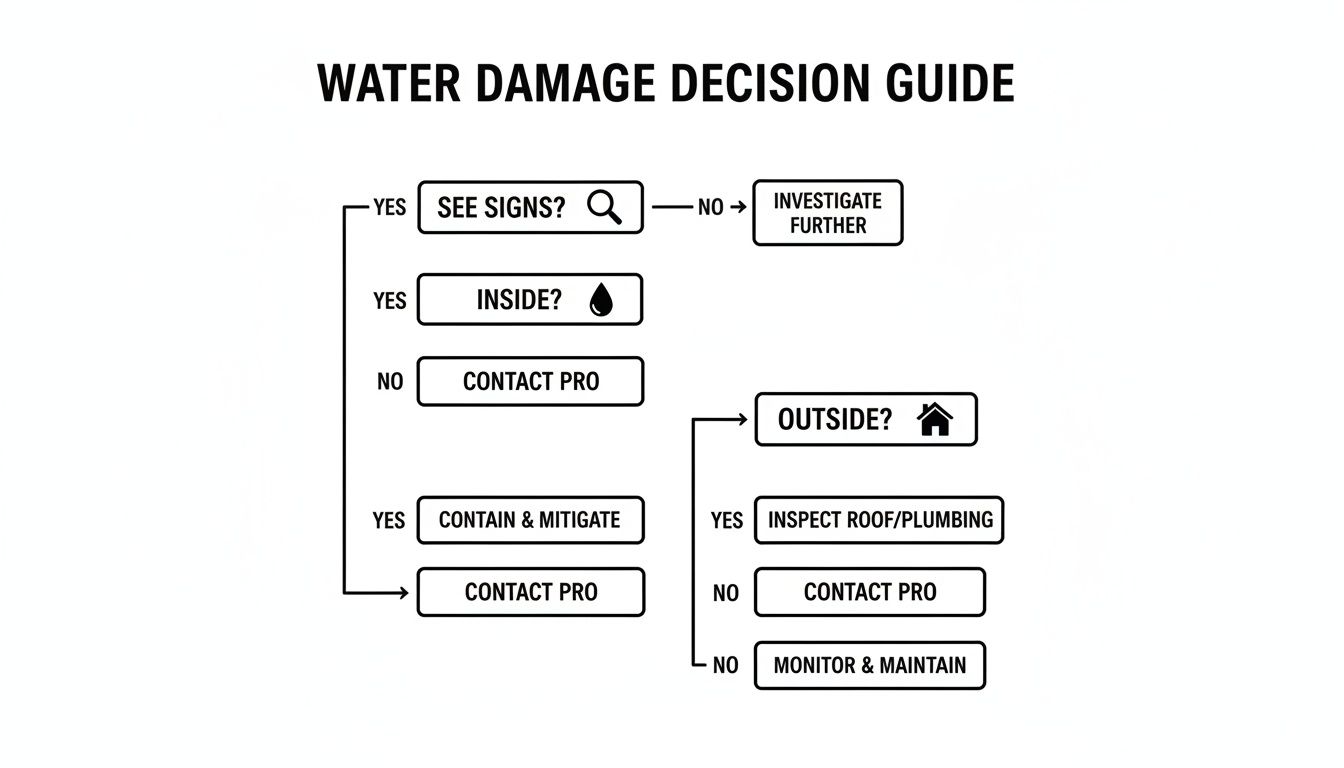
The main takeaway here is that figuring out where the signs appear—whether it's musty smells inside or soggy ground outside—is the first crucial step toward choosing the right fix.
Downspout Extensions: The Simple First Step
Sometimes, the simplest fixes make the biggest difference. Downspout extensions are a perfect example. A standard downspout often dumps thousands of gallons of roof runoff right at the base of your foundation—exactly where you don't want it.
An extension is just a straightforward attachment that carries that water much farther away from your home, ideally at least 10 feet. This simple move prevents that concentrated flow from saturating the soil right next to your foundation walls, which dramatically reduces hydrostatic pressure. It's a low-cost, high-impact fix that every homeowner should consider.
Comparing Foundation Drainage Systems
To help you sort through the options, this table breaks down the most common systems side-by-side. Each one plays a distinct role, and often the best strategy involves a combination of solutions tailored to your property’s unique challenges.
| Drainage Solution | How It Works | Best For | Pros |
|---|---|---|---|
| French Drain | A sloped, gravel-filled trench with a perforated pipe intercepts and redirects subsurface water. | Managing widespread groundwater, preventing soggy lawns, and protecting foundations from chronic moisture. | Highly effective, long-lasting, and operates silently and invisibly once installed. |
| Sump Pump | An electric pump in a basement or crawl space basin automatically ejects water that enters the pit. | Preventing basement and crawl space flooding, especially in homes with high water tables. | Provides powerful, automated protection against acute water intrusion events. |
| Downspout Extensions | Channels roof runoff through a pipe or trough to a safe distance away from the foundation. | Any home with gutters, as a foundational step to manage a major source of water. | Inexpensive, easy to install, and immediately reduces water saturation near the house. |
Making the right choice always starts with a proper diagnosis of your property’s specific water issues. A professional assessment from a team like ours at Lawn & Leaf Solutions can pinpoint the true source of the problem—whether it's surface runoff, subsurface groundwater, or both—and help you design a system that offers complete and lasting protection.
How West Tennessee's Soil and Climate Shape Your Needs
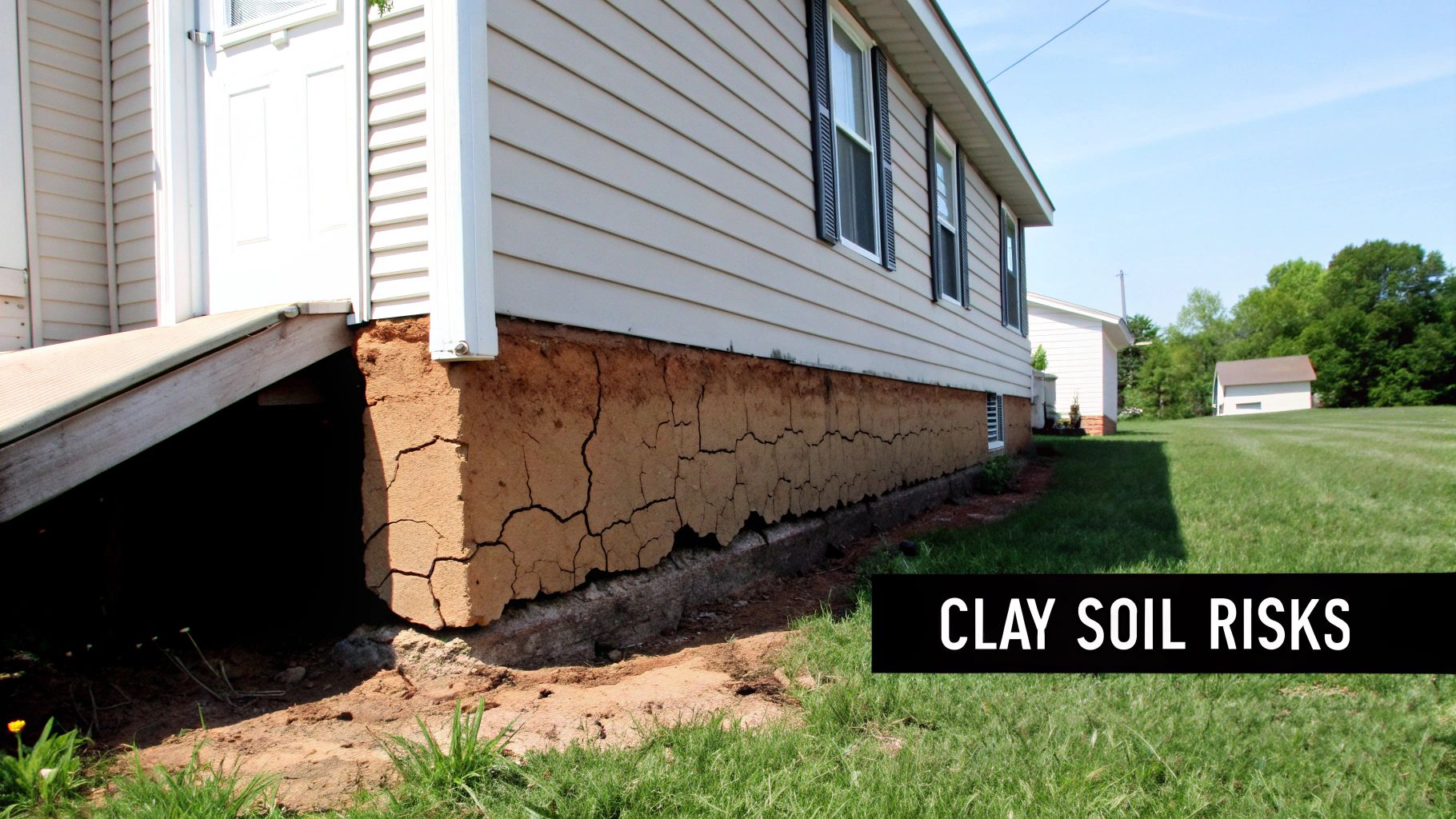
A foundation drainage system that works perfectly in another state might fail spectacularly here in Jackson. The reason isn't poor design—it’s a fundamental mismatch with our unique local environment. West Tennessee’s specific blend of soil and weather demands a specialized approach, turning any generic, one-size-fits-all system into a recipe for disaster.
The story of your foundation’s health really begins and ends with the ground it sits on. Around here, that means dealing with our region’s infamous heavy clay soil. Clay is a different beast entirely compared to sandy or loamy soils. Its particles are tiny and packed together, creating a dense, stubborn structure that just doesn't let water pass through easily.
Instead of draining away, rainwater gets trapped. That slow permeability is the real root cause of so many foundation headaches.
The Clay Soil Cycle Of Stress
Think of the clay soil around your home as a powerful, unpredictable sponge. When it gets saturated during one of our intense spring downpours, it doesn't just get wet—it physically expands. The soil swells outward and upward, pushing with immense force directly against your foundation walls. This is that hydrostatic pressure we’ve been talking about, but amplified by the very nature of our ground.
Then, during our hot, dry summers, the complete opposite happens. The clay gives up its moisture, shrinking and cracking as it bakes in the sun. As it shrinks, the soil actually pulls away from your foundation, creating gaps and voids.
This relentless cycle of expanding in the wet season and contracting in the dry season puts your foundation under constant, cyclical stress.
This constant movement can lead to a host of serious problems:
- Settlement and Shifting: As the soil supporting your home moves, the foundation can settle unevenly, causing those ugly structural cracks.
- Weakened Concrete: The continuous pressure and moisture can degrade the concrete over time, making it much more vulnerable to water intrusion.
- Void Formation: When the soil shrinks away, it leaves gaps that collect even more water during the next storm, making the whole cycle worse.
In West Tennessee, your foundation isn’t just sitting on the ground; it’s in a constant battle with it. A proper foundation drainage solution isn't about fighting the water—it's about managing the behavior of our specific clay soil.
Our Weather Makes It Worse
West Tennessee's climate acts as a powerful catalyst, making the problems caused by our clay soil even more intense. We don’t just get gentle showers; we get sudden, high-volume deluges, especially in the spring and fall. These storms can dump several inches of rain in a very short time, completely overwhelming the slow-draining clay.
This sudden rush of water has nowhere to go but to pool against your foundation, cranking up the hydrostatic pressure right when your home is most vulnerable. The humid summers that follow don't help, either. They prevent the ground from drying out quickly, keeping the soil saturated and the pressure high for extended periods.
For homeowners in the Jackson area, this means effective solutions like French drains and catch basins are absolutely crucial for preventing foundation damage—a problem that affects around 60% of U.S. homes in wet climates.
This local context is precisely why a generic drainage plan is doomed from the start. Only an expert with deep, hands-on knowledge of West Tennessee’s soil, grading challenges, and water tables can design a fix that will actually last. This kind of expertise is non-negotiable for a successful foundation drainage solution. If you're considering a DIY approach, make sure you understand the complexities involved by reading our guide on how to construct a French drain for Tennessee yards.
Let's talk numbers. Budgeting for any big home project can feel a bit daunting, but getting a handle on the costs is the first step to making a smart, confident decision for your home. When it comes to foundation drainage solutions, think of the price tag less as an expense and more as a direct investment in your property's health and future value.
The key is to see this as a preventative measure. Honestly, the cost of putting in a proper drainage system now is just a fraction of what you'd shell out for major structural repairs later. Fixing foundation cracks, dealing with a sinking slab, or repairing serious water damage can easily run into the tens of thousands. A proactive drainage plan suddenly looks like a very wise financial move.
What Goes Into the Final Cost?
Every property is unique, which means every drainage system has to be tailored to the home it's protecting. Several key things will shape the final estimate for your place here in the Jackson area.
Here are the main factors we look at:
- Project Size: The total linear feet of a French drain is one of the biggest cost drivers. A simple drain along one problem wall will naturally cost less than a full system wrapping around your entire foundation.
- The Parts and Pieces: Quality materials make a difference. For example, a high-capacity sump pump with a battery backup will cost more upfront than a basic model, but that extra protection is priceless during a West Tennessee thunderstorm.
- Your Property's Quirks: Things like steep slopes, buried utility lines, or tight spaces where we can't easily bring in equipment can add to the labor needed to get the job done right and safely.
- Putting Your Yard Back Together: Our crew always works to keep disruption to a minimum. Still, some landscape repair, like laying new sod, might be part of the final budget to get your yard looking good as new.
Think of a drainage system not as a cost, but as equity protection. Every dollar spent preventing water damage is a dollar invested in preserving your home's market value and avoiding catastrophic repair bills.
The Real Value of Calling in the Pros
It's easy to see the appeal of a DIY project to save a few bucks. But foundation drainage is one of those jobs where professional expertise really does pay for itself. A system that's installed incorrectly can fail right when you need it most, leading to the exact disaster you were trying to prevent in the first place.
When you get a professional assessment from a team like Lawn & Leaf Solutions, you're ensuring that we're solving the right problem with the right solution. That expertise keeps you from overspending on a system you don’t need or, even worse, underspending on one that won't actually do the job. We give you clear, detailed quotes that explain every part of the project, so you know exactly where your investment is going and can plan your budget without any guesswork.
Common Questions About Foundation Drainage
It's one thing to understand the different types of drainage systems, but it’s another to picture what the actual project will look like at your home. It’s completely natural to have questions about the practical side of things.
Let's walk through some of the most common questions we hear from homeowners right here in West Tennessee. Getting these details ironed out upfront helps you know exactly what to expect.
How Long Does a Typical Installation Take?
This is usually the first thing people ask. For a standard residential home in our area, a professional French drain installation usually takes somewhere between 1 to 3 days.
Of course, that can change depending on the specifics. A longer, deeper drain will naturally take more time. Tricky access to the work area or dealing with our heavy clay soil can also add to the schedule. Any good contractor will give you a clear, detailed timeline with their estimate, so you're never left guessing.
Will the Project Ruin My Landscaping?
I get it—the thought of a mini-excavator tearing up the yard you've worked so hard on is a scary one. While any digging means some level of disruption, a true professional makes protecting your landscape a top priority.
Our crews are meticulous about this. We carefully slice and roll up the existing sod, setting it aside so we can put it right back in place when we're done. We work around your flower beds, shrubs, and patios as if they were our own.
A professional drainage job isn't just about solving a water issue. The real goal is to fix the problem and leave your yard looking like we were never even there. The best solutions are the ones you can't see.
What Kind of Maintenance Do Drainage Systems Require?
Here’s the good news: most of the systems we install, like French drains, are built to be incredibly low-maintenance. They do their job silently underground for years and years with very little help from you.
Your main job is just to keep an eye on the discharge point—the spot where all that water exits the pipe. You'll want to make sure it stays clear of leaves, grass clippings, or anything else that could clog it up.
- For sump pump systems: We recommend a quick annual check-up. Just test the pump to make sure it kicks on, clean any gunk out of the basin, and confirm the battery backup is good to go.
- For surface drains: If you have catch basins in your yard or a channel drain across the driveway, you'll want to clear out leaves and debris every so often, especially after a big storm.
When we finish a job, we'll always walk you through the simple upkeep for your specific system. If you want a deeper dive, you can explore our ultimate guide to foundation drainage systems for homeowners for more details.
Is It Better to Combine Different Drainage Solutions?
Yes, absolutely. In fact, the most robust and effective drainage plans almost always involve a combination of different systems working together. It's rare for a single type of drain to be the silver bullet for every water problem on a property.
For instance, a really solid strategy might look something like this:
- Downspout Extensions to get all that roof water moved far away from the house.
- A French Drain along the foundation to intercept the groundwater that’s always trying to seep in.
- A Channel Drain across the driveway to stop surface water from pooling and running into the garage.
A proper expert assessment is all about figuring out the right mix of foundation drainage solutions to give your home layers of protection from every angle.
Ready to stop worrying about water damage and protect your home's value? The team at Lawn & Leaf Solutions has the local expertise to design and install the perfect drainage system for your West Tennessee property. Schedule your free, no-obligation estimate today by visiting us at https://lawnandleafsolutions.com.