
So you've got a soupy, squishy lawn. Before you start digging trenches or calling in the heavy equipment, let's take a step back. The single most important part of solving any drainage issue is figuring out exactly what’s causing it in the first place.
I can’t tell you how many yards I’ve seen where the fix was surprisingly simple. Sometimes, all that’s needed is a good core aeration or redirecting a downspout. Other times, the problem runs deeper, and you’ll need a more robust solution like a French drain, channel drain, or dry well. The trick is to match the solution to the problem, and that starts with a little detective work.
Pinpointing Your Lawn's Drainage Problems
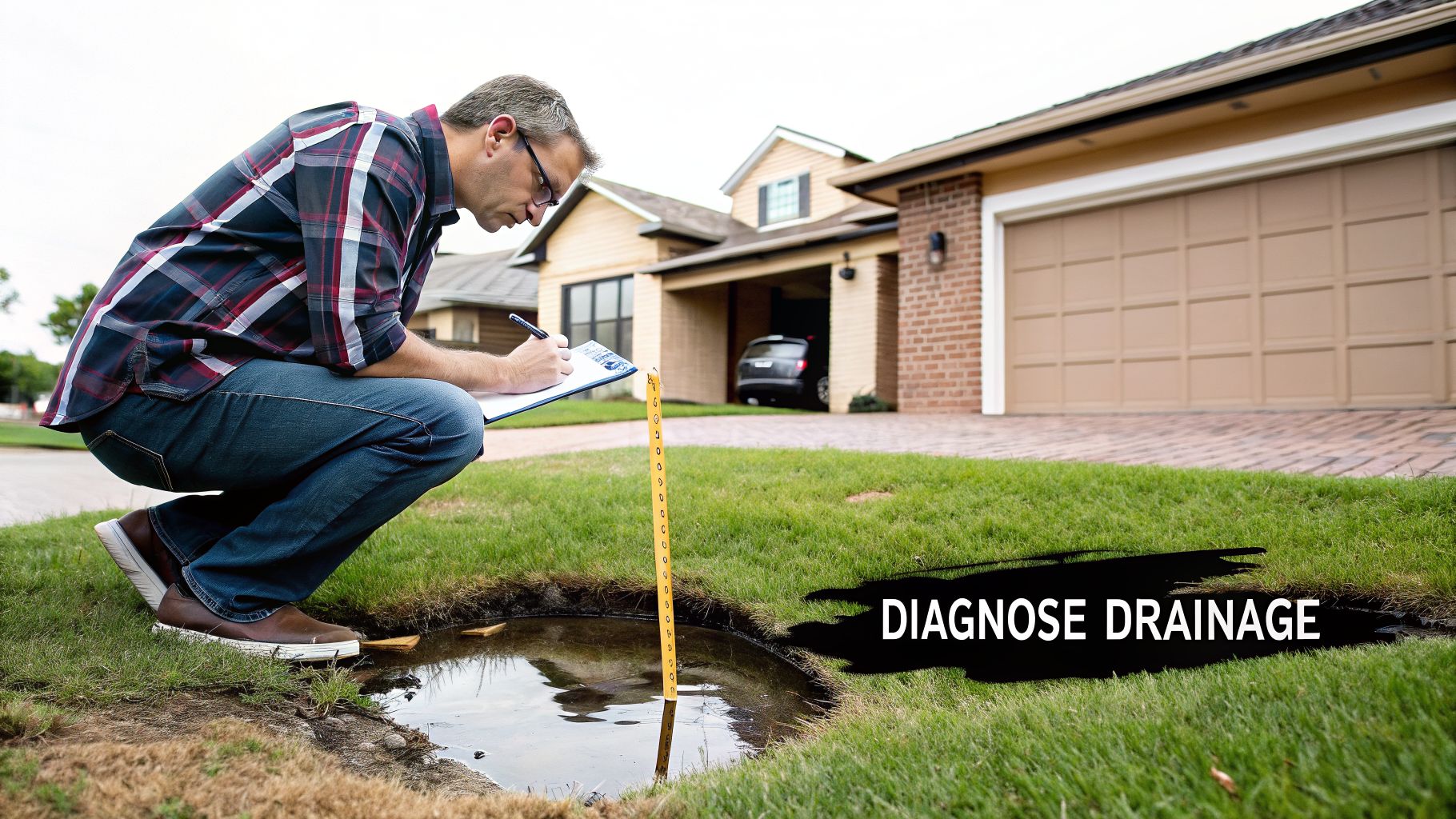
Jumping straight to an expensive fix without understanding the why is the biggest mistake you can make. You might assume you need a thousand-dollar French drain when the real culprit is just heavily compacted soil from years of foot traffic. In that case, a simple aeration session could do the trick for a fraction of the cost.
Let's get to the bottom of what your lawn is trying to tell you.
Reading the Telltale Signs
The best time to diagnose your yard is right after a classic West Tennessee downpour. Go outside and take a look, then check again about 24 hours later. Your lawn will give you all the clues you need.
Here’s what to watch for:
- Lingering Puddles: If you still see standing water a full day after the rain has stopped, that’s a dead giveaway. These puddles are grass-killers and mosquito magnets.
- Spongy, Muddy Ground: Does one area of your lawn feel like a swamp long after everything else has dried out? That's a clear sign of oversaturated soil that can't breathe.
- Yellowing Grass or Bare Spots: Waterlogged soil suffocates grass roots, cutting off their oxygen supply. This stress leads to weak, yellow turf and eventually bare patches where nothing seems to grow.
- Weed and Fungus Outbreaks: Certain weeds and nasty lawn diseases, like nutsedge and root rot, absolutely thrive in damp, soggy conditions. If you see a sudden explosion of them, poor drainage is often the underlying cause.
As you walk your property, try to map out where these symptoms are happening. Is the water pooling at the bottom of a slope? Is it concentrated near a downspout? Or is the whole yard just a uniformly soggy mess?
Pro Tip: Grab your phone and take pictures right after it rains. These photos create a perfect visual map of how water is flowing (or not flowing) across your property. It makes it so much easier to pinpoint the exact low spots that need attention.
Digging Deeper with a Percolation Test
Once you’ve found the problem areas, a percolation test (or "perc test") is a fantastic way to see how well your soil actually absorbs water. It sounds technical, but it’s a simple DIY test that gives you hard data.
Just dig a hole about a foot deep and a foot wide in the soggy spot. Fill it to the top with water and let it drain out completely—this pre-saturates the surrounding soil. Then, fill it up again, stick a ruler in, and measure how much the water level drops each hour.
Healthy lawn soil should drain somewhere between 1 and 2 inches per hour. If you're seeing less than 1 inch per hour, you’re almost certainly dealing with heavy clay soil or serious compaction. This is incredibly common around Jackson, TN, and is a major reason for solving common lawn drainage issues in Jackson, TN. Knowing your drainage rate helps you decide if you need to amend the soil itself or install a system to physically move the water.
Identifying Soil Compaction and Thatch
Finally, don’t forget to check for two very common culprits that can effectively create a waterproof blanket over your lawn: soil compaction and thatch.
Soil compaction is just what it sounds like—the soil particles have been squeezed together so tightly that there's no room for air or water to move through. You'll find it in high-traffic areas, under the kids' swing set, or along the path your mower takes every single week. If the ground feels rock-hard to the touch, compaction is part of your problem.
Thatch is the layer of dead stems, roots, and other organic gunk that builds up between the soil and the green grass blades. A little bit is fine, but when that layer gets thicker than a half-inch, it acts like a raincoat, stopping water from ever reaching the soil and roots below.
Quick Fixes for a Waterlogged Lawn
When your yard turns into a swamp after every storm, you need relief now. While a major drainage overhaul might be the long-term answer, there are a few immediate things you can do to protect your grass and buy yourself some time. These are the quick wins I recommend to homeowners before they jump into a big construction project.
The first thing to tackle is soil compaction. Here in West Tennessee, we have a lot of heavy clay soil that water just can't penetrate. When the ground is packed down, rainfall has nowhere to go but sideways, creating puddles everywhere.
The most effective way to fight this is core aeration. This process involves pulling small plugs of soil from the lawn, instantly creating thousands of little channels for water and air to get down to the roots. You can rent a machine for an afternoon or have a pro do it. Just make sure the tines are penetrating 2-4 inches deep every few inches across the soggy areas. It’s a simple step, but you’ll see a dramatic improvement in how quickly your lawn dries out.
Manage Water at the Source
Believe it or not, the biggest offender is often your own house. A single downpour can dump hundreds of gallons of water off your roof. If your downspouts are emptying right next to your foundation, you're just creating a concentrated bog.
Luckily, the fix is incredibly simple and cheap: downspout extenders. These inexpensive attachments just clip onto your existing downspouts and direct all that roof runoff several feet away from your foundation. It’s a five-minute job that can solve a massive part of the problem almost instantly.
Sometimes, just keeping things clean and clear is half the battle. You can learn more about how simple maintenance tasks, like fall cleanups that prepare your landscape for the rainy season, can make a huge difference for drainage.
Rethink Your Watering Habits
This might sound obvious, but many well-meaning homeowners actually make their drainage problems worse by overwatering. An automatic sprinkler system running on a fixed schedule doesn't know it just rained for two days straight.
A soggy lawn is a global agricultural issue, and the same principles apply right in your backyard. Research shows that while 25-30% of agricultural land is drained, millions of hectares still need it. For homeowners in Jackson, this translates to root rot and costly turf damage after heavy rains. Combining simple grading with aeration—poking holes 2-4 inches deep—can boost infiltration rates by 20-30%. You can explore more about global drainage solutions and their local impact in this comprehensive agricultural study.
Turn off the sprinklers and check the soil manually. If the top two inches feel dry, then it's time to water. And when you do, water deeply and less often. This encourages the grassroots to grow deeper, making your turf much more resilient to both soggy conditions and dry spells.
These temporary fixes are powerful first steps. But if you find yourself constantly having to fix standing water in your yard, it’s probably time to start thinking about more permanent solutions.
Permanent Drainage Solutions to Protect Your Property
If you've tried the simple fixes—aerating the soil, extending your downspouts, adjusting your sprinklers—and you're still looking at a swampy mess, it's time for a bigger plan. When water just won't go away, you have to get serious about giving it somewhere to go.
These permanent systems are the heavy hitters of lawn drainage. They’re engineered to control large amounts of water, protect your home’s foundation, and finally give you back your yard. This isn't just about digging a ditch; it's about creating a long-term strategy to manage water both on the surface and deep in the soil.
This decision guide gives you a great starting point for figuring out what to tackle first when you spot a soggy lawn.
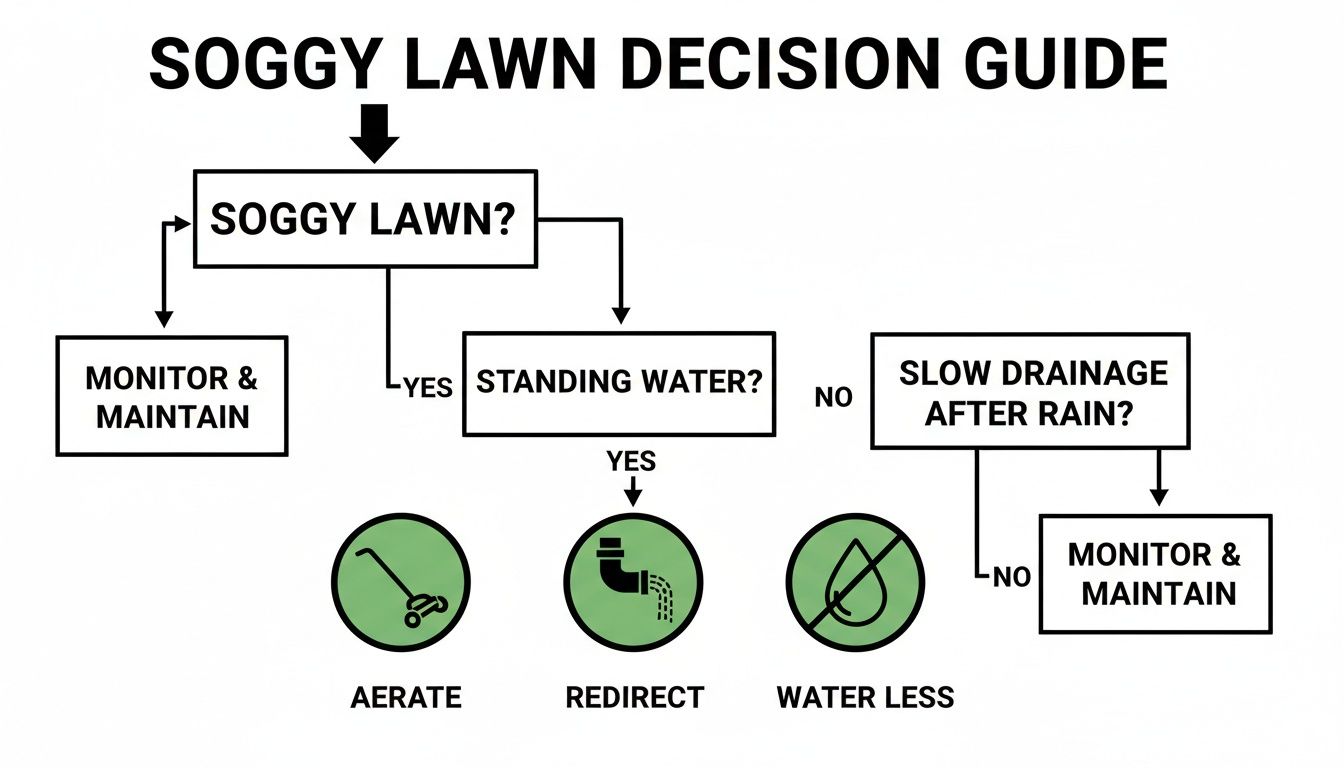
As you can see, sometimes all it takes is a simple adjustment. But when those steps don't cut it, you'll need one of the more robust solutions below.
The Power of a French Drain
The French drain is the undisputed champion for dealing with underground water. It’s an invisible workhorse that solves problems you can't see on the surface, like saturated soil that stays wet long after a rain. If you have widespread sogginess or a low spot that turns into a permanent puddle, a French drain is almost always the answer.
It works by creating an easy path for groundwater to follow.
- We dig a sloped trench and lay a perforated pipe inside.
- The trench is filled with gravel, which allows water to easily seep in.
- Once in the trench, water flows into the pipe and is carried by gravity to a safe exit point—far away from your house.
A well-built French drain is more than just a tool for drying out your lawn. It actively relieves the immense water pressure (hydrostatic pressure) that builds up against your foundation, which is a leading cause of cracks and basement leaks. Think of it as an investment in the structural integrity of your home.
We often recommend French drains for backyards that are constantly wet, especially at the base of a slope. They're also crucial for protecting retaining walls. For anyone facing these serious water issues, our team has deep experience with foundation drainage solutions that safeguard your most important asset.
Channel Drains for Hardscape Runoff
While a French drain tackles water under the ground, a channel drain is designed to catch water flowing across the surface. You've probably seen these grated drains running across driveways, patios, or around pool decks.
Their job is to intercept sheets of water moving over hardscapes before that water can flood your yard, erode your landscaping, or seep under your garage door. A channel drain sits flush with the pavement, catches the runoff, and funnels it into a pipe that directs it away safely. They are a must-have for any home with large paved areas.
Subsurface Drainage: The Ultimate Fix
Modern subsurface drainage systems are a game-changer, and the numbers back it up. The market for these systems is growing fast because they are so effective at eliminating waterlogged soil. In fact, North America accounts for 45% of the global market.
Professionals typically install pipes 18-24 inches deep to pull excess water away from the root zone. This simple act can improve soil aeration by 40% and has been shown to boost turf growth by 25-50% in a single season. For homeowners here in West Tennessee, that means a healthier lawn, fewer mosquitos, and an end to soil erosion. You can find more details on these trends in the drainage system market report on marketresearchfuture.com.
Dry Wells: A High-Capacity Water Solution
So, what happens if you have nowhere to send all that water? On a flat property or in a neighborhood with strict runoff rules, a dry well is an ingenious solution.
A dry well is basically a large, buried holding tank that collects water from your other drainage systems. It then gives that water time to slowly and safely absorb deep into the subsoil. It can hold hundreds of gallons, preventing your yard from flooding during a heavy downpour.
Choosing the Right Drainage Solution for Your Yard
With several powerful options available, it can be tricky to know which one fits your specific problem. This table breaks down the most common permanent solutions to help you decide.
| Solution | Best For | How It Works | Best Location |
|---|---|---|---|
| French Drain | Widespread sogginess, wet basements, protecting foundations. | A gravel-filled trench with a perforated pipe collects groundwater and directs it away. | Along foundations, at the base of slopes, across large, low-lying turf areas. |
| Channel Drain | Runoff from driveways, patios, and other hard surfaces. | A grated surface channel intercepts sheet flow and funnels it into a pipe. | Across driveways, in front of garage doors, along patio edges. |
| Dry Well | Properties with no downhill slope or outlet for drainage. | An underground basin collects large volumes of water and allows it to slowly percolate into the soil. | A discreet, low-traffic area of the yard, often at the end of a French drain line. |
| Sump Pump | Basements, crawl spaces, or very low spots where gravity isn't enough. | An electric pump automatically removes water from a collection pit when it fills. | In the lowest point of a basement/crawl space or tied into an exterior drainage system. |
Each of these systems targets a different type of water problem. Identifying whether your issue is surface runoff or saturated groundwater is the first step toward choosing the right one.
The Role of Sump Pumps
Sometimes, gravity just can’t get the job done. If you need to move water uphill to get it away from your house, you need a sump pump. This is common in low-lying areas or for homes with basements and crawl spaces below the surrounding grade.
A sump pump system is straightforward:
- A basin, or "sump pit," is installed at the lowest point to collect incoming water.
- A pump sits inside the pit and automatically kicks on when the water hits a certain level.
- The pump then forces the water through a discharge pipe, moving it up and away from your foundation.
While we often think of them for basements, sump pumps are also a powerful tool for exterior drainage, providing the ultimate defense against flooding in challenging landscapes.
Using Landscaping and Soil Health to Fight Drainage Issues
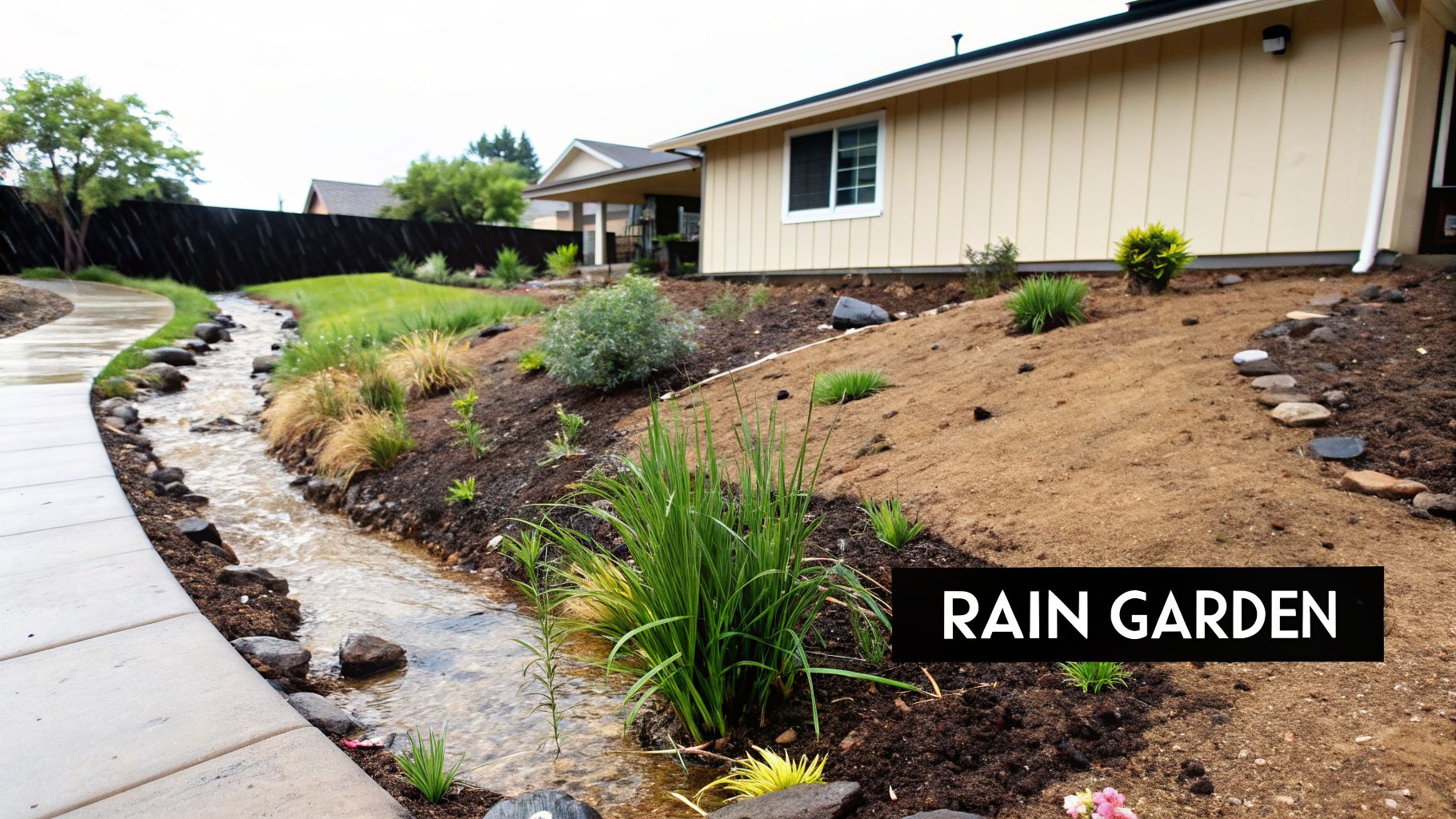
Sometimes the best fix for a soggy yard doesn't involve digging trenches or installing pumps. In my experience, some of the most effective and beautiful solutions come from working with nature, not trying to force it. By improving your soil and making smarter landscaping choices, you can solve drainage problems and add incredible beauty to your property at the same time.
You’re not just fixing a wet spot; you’re turning a problem area into a beautiful, functional feature. It’s a greener approach that gets to the root cause, transforming a soggy mess into a landscape that works for you.
Build a Better Foundation with Healthy Soil
Here in Jackson and across West Tennessee, our heavy clay soil is a constant source of drainage headaches. Clay particles are incredibly fine and they pack together tightly, leaving almost no room for water to soak in. The result? A lawn that stays squishy for days after a storm.
The most sustainable way to fix this is by improving the soil structure itself. You can dramatically change how your soil absorbs water simply by adding plenty of organic matter.
We often recommend topdressing with several inches of high-quality compost. Working this into the top layer of your soil introduces larger particles that create crucial air pockets. This process physically breaks up that dense clay, allowing water and oxygen to get down to the roots where they belong, instead of sitting on the surface.
This isn't a quick fix, but a long-term strategy for a healthier lawn. You can dive deeper into this topic in our guide on the science of healthy soil for a thriving lawn. Better soil structure doesn't just help with drainage—it makes your grass tougher against drought and disease, too.
Turn a Soggy Spot into a Rain Garden
Instead of constantly battling a low, wet spot in your yard, why not lean into it? A rain garden is a fantastic solution. It’s essentially a shallow, landscaped depression that’s designed to collect rainwater runoff and let it soak slowly into the ground. It's an elegant, eco-friendly way to manage all that excess water.
By filling it with water-loving perennials and shrubs, you create a gorgeous garden feature that is actively solving your drainage issue. These plants have deep root systems that are perfect for breaking up compacted soil and drinking up huge amounts of water.
A few moisture-loving plants that do wonderfully in our West Tennessee climate include:
- Cardinal Flower: Its stunning red spikes are a magnet for hummingbirds and it doesn't mind having wet feet.
- Swamp Milkweed: A beautiful and vital host plant for monarch butterflies that thrives in damp areas.
- River Birch: A fast-growing tree with unique peeling bark that is right at home in wet soil.
- Siberian Iris: These elegant flowers are surprisingly tough and can handle both wet and dry periods.
A well-planned rain garden can completely transform a useless, muddy patch of lawn into a vibrant, living part of your landscape.
The Critical Role of Grading and Mulch
Even with great soil, you can't ignore the lay of the land. Proper grading is absolutely essential. Your entire lawn should have a gentle but consistent slope away from your house—we always aim for a minimum 2% grade. That simple contour uses gravity to pull water away from your home's foundation, a step that can prevent up to 80% of foundation cracks caused by water pressure.
Strategic mulching is another key player. Applying a 3-inch layer of organic mulch in your garden beds does two things: it helps the soil retain up to 25% more moisture during dry spells, and it slows down runoff during heavy downpours. This is a huge help in preventing soil erosion, which is often a direct result of poor drainage.
The need for effective erosion control is a growing concern globally, with the drainage system market projected to hit USD 99.6 billion by 2035. This boom is driven by the increasing need to protect properties from water damage—a challenge we see firsthand right here in West Tennessee. Smart grading and landscaping are your first and best line of defense.
Deciding Between DIY and Hiring a Professional
You've diagnosed the soggy spots and have a few potential solutions in mind. Now comes the big question: Do you grab a shovel and tackle this yourself, or is it time to call in a professional? The right answer really boils down to the complexity of the job, your budget, and how you value your own time versus a guaranteed result.
This is a classic sweat equity vs. expert guarantee decision. For some folks, there's nothing more satisfying than solving a problem with their own two hands. For others, the peace of mind that comes with a professional warranty is worth every penny.
When to Go the DIY Route
Let's be clear: plenty of drainage fixes are perfect for a weekend warrior. If you're dealing with minor to moderate water issues, a DIY approach can save you a lot of money and be genuinely rewarding. These are the kinds of projects where some good old-fashioned manual labor goes a long way, without needing a garage full of specialized equipment.
Consider handling these jobs yourself:
- Core Aeration: You can rent a core aerator for an afternoon to tackle compacted soil. It's a workout, for sure, but it’s a straightforward process that provides immediate benefits for your lawn's health.
- Downspout Extenders: This is easily the simplest fix. Buying and attaching a few extenders takes just minutes, but it can make a world of difference by moving roof runoff away from your foundation.
- Creating a Small Rain Garden: If you've got a bit of a green thumb, digging out a shallow basin in a soggy area and planting it with water-loving native plants can turn an eyesore into a beautiful, functional garden feature.
The biggest win with DIY is obviously the cost savings—you're just paying for materials and maybe a rental. Just be honest with yourself about the time it will take and what can go wrong. I've seen homeowners try to create a simple swale, only to get the grading slightly off and accidentally channel more water toward their house.
When to Call in the Professionals
While DIY is great for smaller tasks, some jobs just aren't worth the risk. They demand a level of precision, heavy machinery, and experience that only a professional drainage contractor brings to the table. Trying to DIY a complex installation can easily lead to a failed system, expensive mistakes, or even damage to your property. It’s a lot like the logic behind DIY vs Professional Foundation Installation—when the stakes are this high, expertise matters.
You should hire a pro for projects like these:
- Installing a French Drain: This is so much more than digging a trench and laying a pipe. A professional understands exactly how to calculate the slope—a 1% grade is the bare minimum for gravity to do its job. They also use commercial-grade geotextile fabric and the right kind of pipe to prevent the system from silting up and failing in a few years.
- Large-Scale Regrading: Changing the slope of your entire yard is a job for a skilled operator with the right equipment. One mistake with the grade can create a new, much worse problem right next to your foundation.
- Sump Pump Installation: Properly installing a sump pump, tying it into a discharge line, and handling the electrical work safely is definitely a job for someone who has done it hundreds of times before.
The biggest advantage of hiring a company like Lawn & Leaf Solutions is the warranty. When we install a drainage system, we stand behind our work. You get the peace of mind that the job was done right the first time, using materials designed to withstand our heavy West Tennessee clay soil.
Understanding the Costs
Your budget is going to play a huge role in this decision. A few DIY fixes might only set you back a couple hundred dollars, but a professional installation is a real investment in protecting your home's value.
Here's a ballpark idea of what to expect:
- DIY Aeration/Downspouts: $50 – $200
- Professional French Drain Installation: This can run anywhere from $25 to $50 per linear foot, based on the depth, soil type, and how easy it is to access the area. A typical system for a backyard often lands in the $3,000 to $7,000 range.
- Professional Regrading: Costs vary widely, but projects often start around $1,500 and can increase significantly for larger or more complex properties.
When you start gathering quotes, make sure the contractor gives you a detailed breakdown of all costs—materials, labor, and any required permits. A transparent quote is the first sign you're dealing with a trustworthy company. If a more serious fix is on your radar, learning how to choose the right French drainage company for your property is a crucial next step. Making a smart financial choice now will protect your property for years to come.
Common Questions About Lawn Drainage Solutions
Once you've got a plan in mind for tackling your yard's water issues, it's completely normal to have a few more questions. Over the years, we've heard just about all of them from homeowners here in Jackson and West Tennessee.
Getting a handle on the timeline, what to expect during the project, and how to care for your new system will help you move forward with confidence. Let's walk through some of the most frequent ones we hear.
How Long Until I See Results from a New Drainage System?
That’s a great question, and the answer really hinges on which solution we're implementing.
For simpler fixes like core aeration or just redirecting your downspouts, you'll see a noticeable improvement right after the very next significant rainfall. It’s a quick and satisfying win.
For the bigger projects—a French drain, dry well, or sump pump system—the results are immediate. The moment the system is installed and the ground is put back together, it's ready to perform. The next time a storm rolls through, those areas that used to be miniature lakes will stay firm and usable. Honestly, it's one of the best parts of the job, knowing your yard is finally protected.
Will a New Drainage System Ruin My Existing Lawn?
This is a totally fair concern. Any professional installation like a French drain requires trenching, and there's no way around some temporary disruption to the turf. But a skilled, conscientious team knows how to minimize that impact.
Our process is designed to be as clean as possible:
- We start by carefully lifting and setting aside the existing sod wherever we can.
- The trench is dug precisely—no wider or deeper than necessary.
- After installing the system, we backfill the trench correctly to prevent it from sinking later.
- Finally, we neatly replace the original sod over the entire work area.
With a little watering, the grass along the trench lines usually bounces back and looks seamless within a few weeks. Our goal is always to leave your property better than we found it, with a solution that works and a yard that looks great.
Can I Just Add Topsoil or Sand to Low Spots?
We see this attempted all the time, and I have to be blunt: it almost always makes the problem worse. Simply dumping more dirt or sand onto a soggy, low spot is like putting a bandage on a deep wound. The real issue is almost always the heavily compacted clay soil underneath that just can't drain.
Adding more soil on top creates a "bowl" effect. Water seeps through the new topsoil and gets trapped against the impermeable clay below. You end up with a permanently soggy, unstable mess where grass will struggle to survive.
The only effective fix is to address the root cause. That means either amending the native soil with organic matter to improve its structure or, more often, installing a drainage system that physically carries the water away.
What Kind of Maintenance Does a Drainage System Need?
One of the best things about a properly installed subsurface system is how little upkeep it needs. When a French drain is built right—using a high-quality filter fabric and the correct type of gravel—it's virtually maintenance-free. The fabric and stone work together to keep silt and roots from ever clogging the pipe.
Your main job is just to keep the entry and exit points clear of debris.
- For channel drains on a patio, that just means clearing leaves from the grates every so often.
- For a French drain, you'll want to make sure the discharge outlet isn't getting blocked by grass clippings or leaves.
We always give our clients simple, specific instructions for their particular system to make sure it performs flawlessly for decades.
Ready to finally solve your yard's water problems? The expert team at Lawn & Leaf Solutions has over 18 years of experience designing and installing precision drainage systems that protect properties in Jackson and West Tennessee. Schedule your free, no-obligation estimate today and get the peace of mind that comes with a dry, healthy, and beautiful lawn.